Has education and verbal communication in the 21st Century deteriorated compared to the early 20th Century? Talk to a young person at length today and you will be inundated with the word “like” and the phrase “I mean” or “you know what I’m saying?” Can this be the result of the reliance on modern technology to communicate, a drop in the level of education or both?
Here is a great example of a conversation I overheard recently between two young women:
A: “So, I was, like, at the store, and I, like, saw this, like, really cute dress.”
B: “Oh, like, what color was it?”
A: “It was, like, pink, and I was, like, totally going to buy it, but then I, like, remembered I have no money.”
B: “That’s, like, so sad!”
A: “I know, right? It was, like, the best dress ever!”
I have to confess, I find the repeated use of the word “like” very distracting when listening to someone tell me something.
Another expression in common use today is “No worries!” During one conversation recently a young adult helping me with a technical problem with email told me at least 6 times, “No worries!” . . . . . yet I was worrying. I was not able to send email, only receive them. At the end of the conversation I said, “Thanks for helping me!” to which the answer was, “No worries!” Then I said, “Sorry for taking up some much of your time,” and again the response was, “No worries!” I was so pleased to have my email working again that I ended the conversation by simply saying, “No worries.”
Poor and repeated word usage is not limited to the youth of America. Professional athletes and celebrities suffer from the same addiction. One notable difference is an athlete likes to add “Man” to the end of a sentence, “You know what I mean, man?” Another popular phase is, “Yeah, man, I mean it was [BLAH, BLAH, BLAH], man,” in response to a question. That is particularly uncomfortable when they are being interviewed by a woman. I cannot imagine that Jim Thorpe spoke like that in 1913 nor did the “The Four Horsemen” of Notre Dame’s 1924 famed football team that beat Army.
Most schools in the early 1900s were single room buildings, especially in rural America.
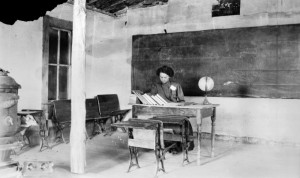
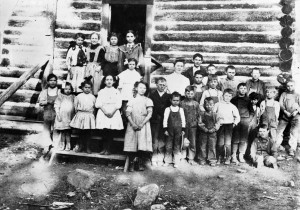
It is not likely that the children in Miss Zosel’s class used phrases in use today. In the halls of high education, Latin and Greek were taught in the early 1900s, while today we teach remedial English in college. One thing for certain, students in the 1900s must have repeatedly used the words, “Yes, ma’am or sir,” or “No, ma’am or sir, ” and “Thank you, ma’am or sir,” in response to their teacher.
Education was not available to every child in the 1900s, but those provided schooling were given challenging course work. A great way to appreciate the level of eduction in the 1900s is to look at examinations given an elementary school student to qualify for high school and what a high school student was expected to know to graduate.
The 1912 Bullitt County, Kentucky, examination given to 8th Grade students is a good benchmark for the level of education provided more than 100 years ago. It would be interesting to have an 8th Grade student of today look at this test just to see how they react.

Going back a bit further, here is one section of an examination from 1895 given to graduates from high school in Saline County, Kansas. The students were given one hour to complete the entire exam that consisted of 6 sections. The subject sections were not dissimilar to the Bullitt County Schools 8th Grade examination of 1912.
Examination Graduation Questions of Saline County, Kansas. April 13, 1895
GRAMMAR (Time, one hour)
1. Give nine rules for the use of Capital Letters.
2. Name the parts of speech and define those that have no modifications.
3. Define Verse, Stanza, and Paragraph.
4. What are the principal parts of a verb? Give principal parts of do, lie, lay, and run.
5. Define Case. Illustrate each Case.
6. What is Punctuation? Give rules for principal marks of punctuation.
7 – 10. Write a composition of about 150 words and show therein that you understand the practical use of the rules of grammar.
This post was inspired when I came across words that were in common use in the 1900s. Today the words are likely only found in old books, manuscripts or theatrical and movie scripts . . . . and an Unabridged Dictionary. The inspirational words are:
querulous adjective
quer·u·lous ˈkwer-yə-ləs
1 : habitually complaining
2 : fretful, whining
forenoon noun
fore·noon ˈfȯr-ˌnün
1 : the early part of the day ending with noon
2 : Morning
Before finishing this post another word came to mind. Can you add a word to the list?
middling | ˈmid(ə)liNG | adjective
moderate or average in size, amount, or rank: the village contained no poor households but a lot of middling ones.
• neither very good nor very bad: he had had a fair to middling season.
• [predicative] informal (of a person) in reasonably good but not perfect health: “How are you?” – “Middling,” he admitted.
 old spirituals