This is Part 3 of the Foolkiller. To begin at the beginning, go to Part 1.
After surviving the rapids and the infamous “Whirlpool” of the Niagara River, Nissen’s creative mind produced a new concept for water travel . . . some called it a “Water Blimp,” while others referred to it as an “Aquatic Balloon.” Nissen decided it was possible to travel on water inside a canvas bag filled with air (oxygen) for floatation and oxygen for the passenger riding inside.
In a story reported 120 years after the fact, the Chicago Tribune published the story of again of with artist’s renditions and photos, calling Foolkiller 3 a “watermelon-shaped craft.”
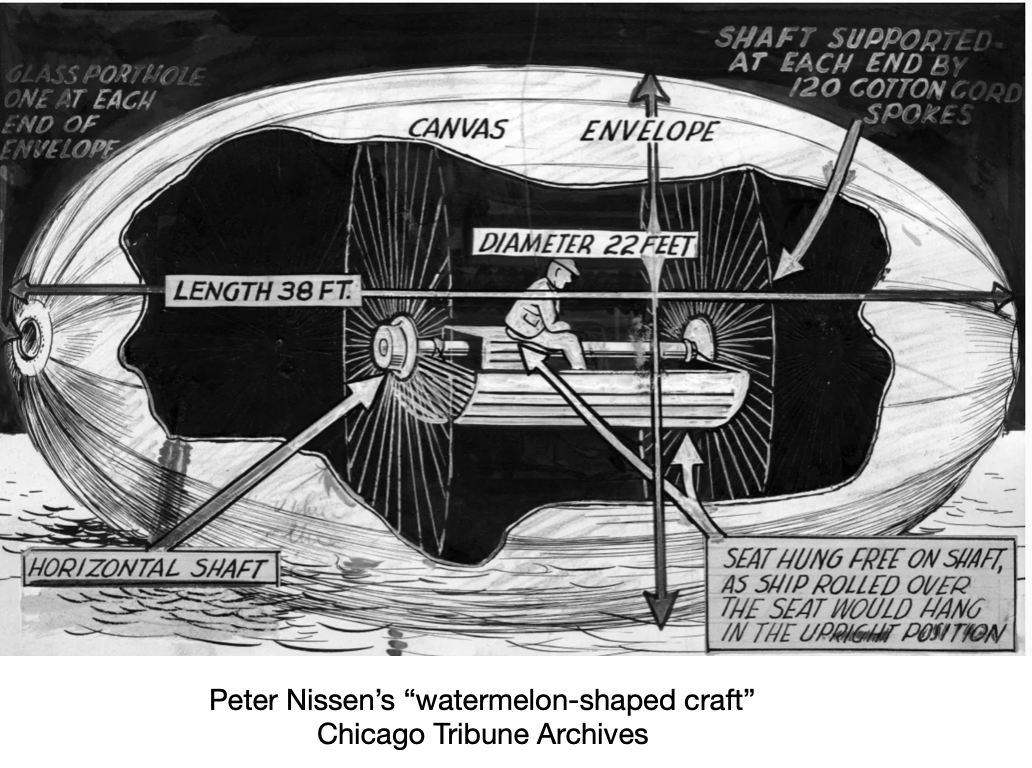
One can only surmise that Nissen decided to tackle his next daredevil feat closer to home and family, and what better body of water to do it on than the great “Lake Michigan?” He planned to use his “Water Blimp” to cross the width of Lake Michigan from Chicago to Michigan, a distance of approximately 65 miles as the Crow Flies, sitting inside the balloon powered only by the wind. (The craft is analogous to a tumbleweed rolling over the desert’s surface.) Foolkiller 3 had no directional controls leaving Nissen at the mercy of the wind and the waves of Lake Michigan.
Because of his local and national celebrity, Nissen’s planned daredevil feat in Foolkiller 3 was photographically documented by the Chicago Tribune.
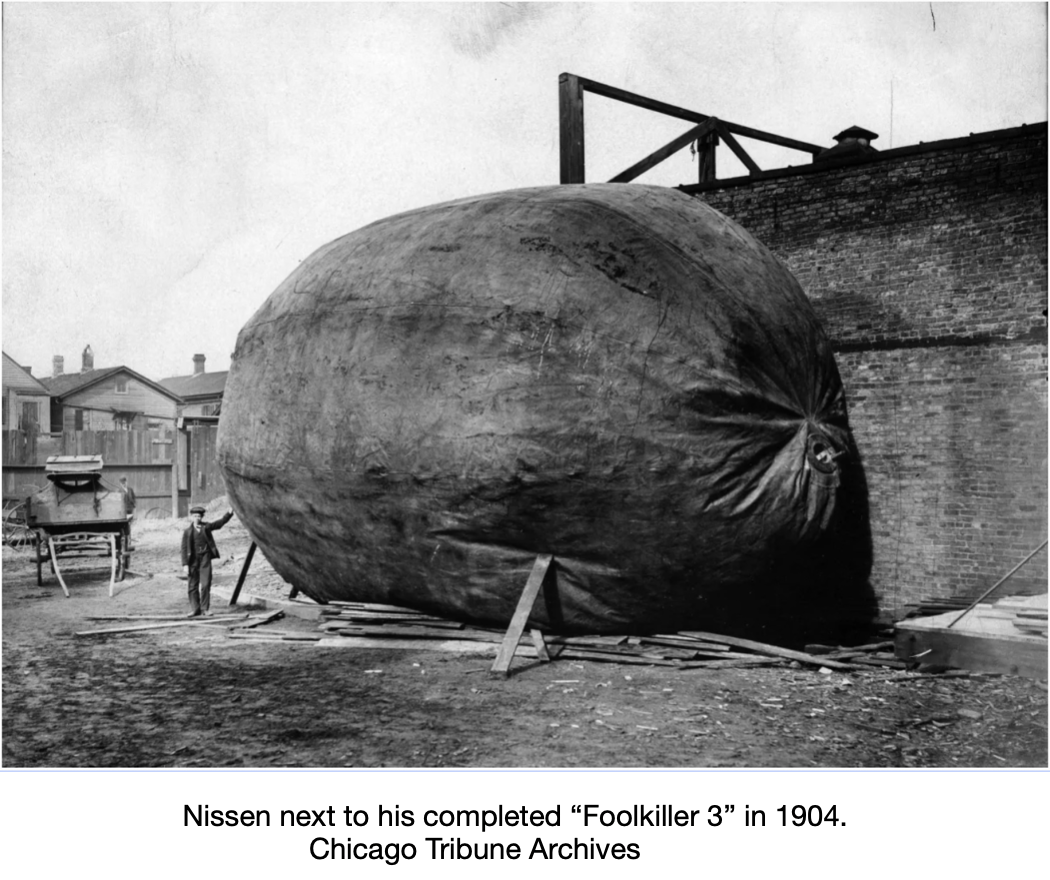
How Nissen found the time and the funds to build his vessels and transport them to places like Niagara Falls or the beachfront of Lake Michigan is impressive. Plainly he was inventive, skilled, fearless and determined.
A demonstration of Foolkiller 3 took place on May 15, 1904. Again, powered only by wind and waves, the “bloated ball failed to roll forward” as Nissen predicted it would. Instead, the “Water Blimp” drifted back to shore. He blamed the failed test on the weather conditions . . . not his poor “ingenuity.”
Being a persistent man, Nissen was undeterred by the failed test run and transported his “bag of air” to Chicago Avenue on November 29, 1904, for a planned trip from Chicago to Benton Harbor, MI, 65 miles across the lake.
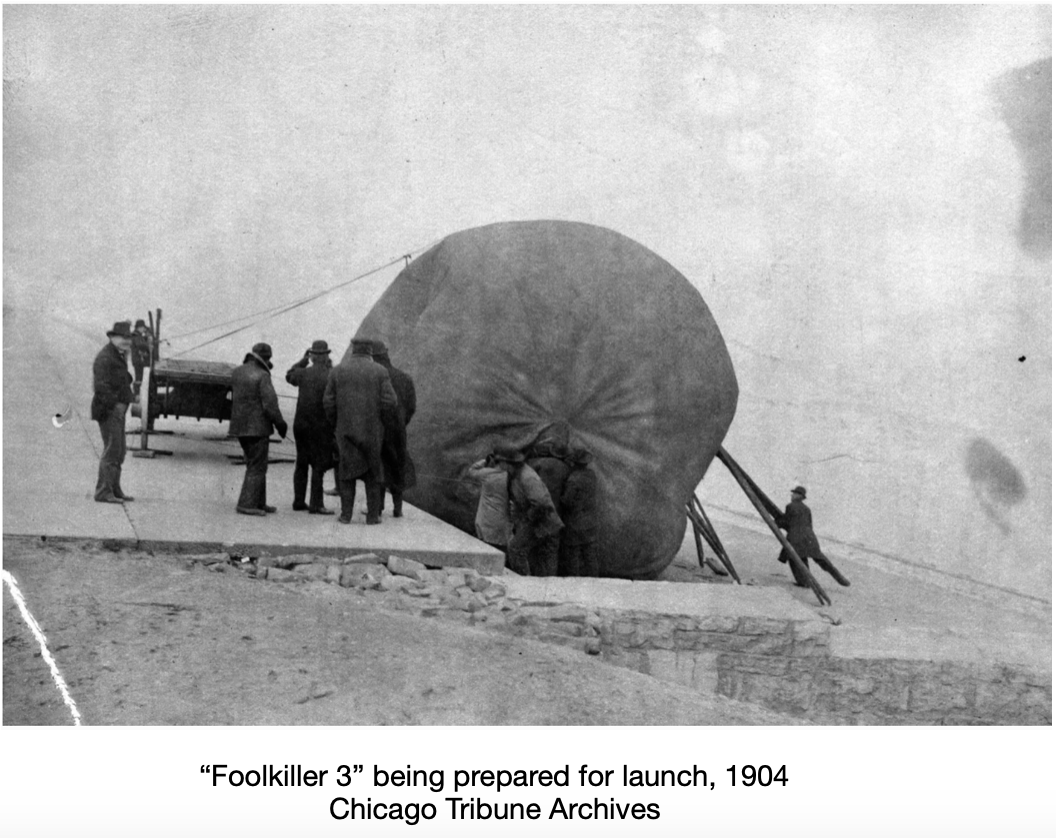
It took one hour to inflate Foolkiller 3 and to load it with “three days of rations of ‘biscuit, cheese, tobacco and water.” Nissen, it appears, was clothed only is normal daytime attire when entering Foolkiller 3 for his eventful trip.
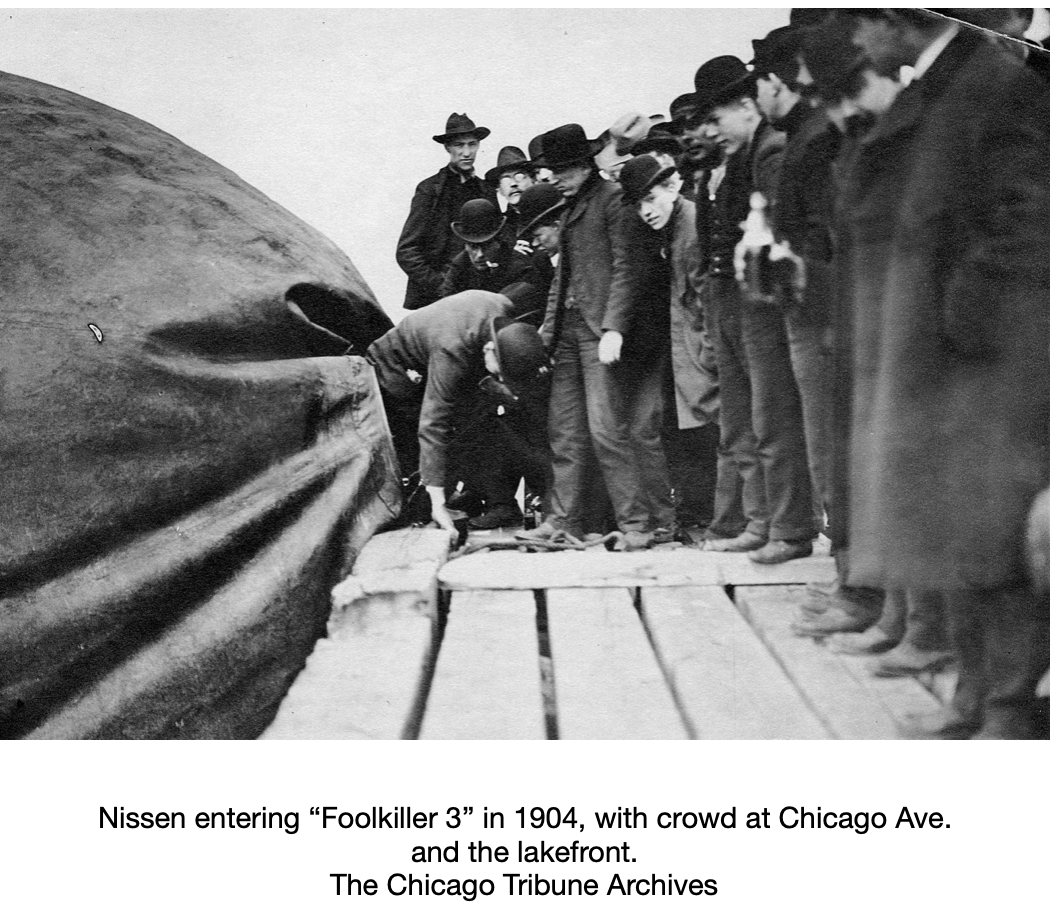
The weather was less than ideal when Nissen set out to float, uncontrolled, across Lake Michigan on November 29, 1904. It was very windy–after all, Chicago is called “The Windy City”!– with snow flurries pelting the canvas cocoon. (Try to imagine what it must have been like sitting inside a canvas balloon with limit air supply, floating across one of America’s Great Lakes without any control over power or direction. Such an experience is not on the Bucket List” of most people.)
An artist’s rendition of the meandering route of Foolkiller 3 across the Lake was published by the Chicago Tribune. Nissen had opportunities to scrub his adventure but decline to do so. He was hailed by a tug boat, Perfection, and later offered to be rescued by the Coast Guard. Once again his “determination” pushed him on to achieve his goal to float across Lake Michigan in an air balloon. Which proved to be a fatal mistake.
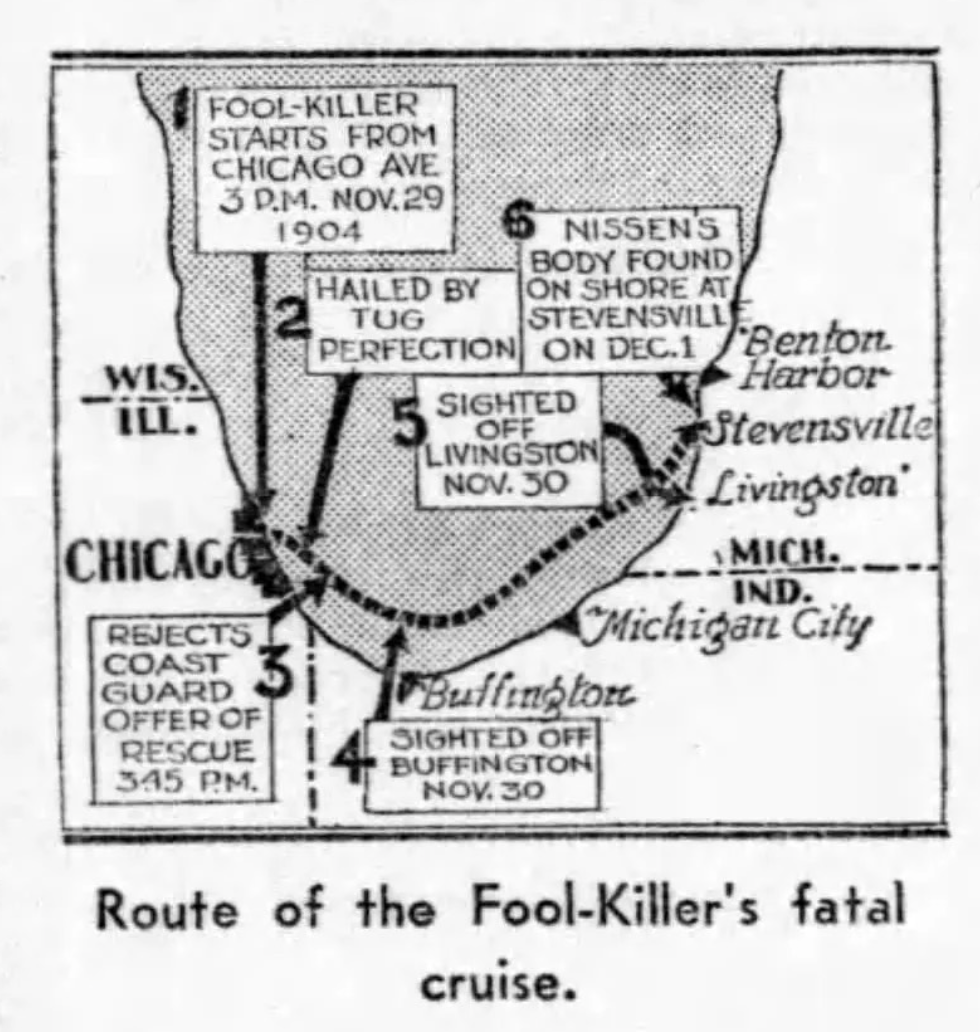
Foolkiller 3 was signed from Buffington, IN, on November 30, 1904, and again that same day from Livingston, MI. The reports of sightings of Foolkiller 3 gave hope to Nissan’s family that he was alive and going to achieve another daredevil feat. Unfortunately, that was not the end of the Peter Nissen’s story.
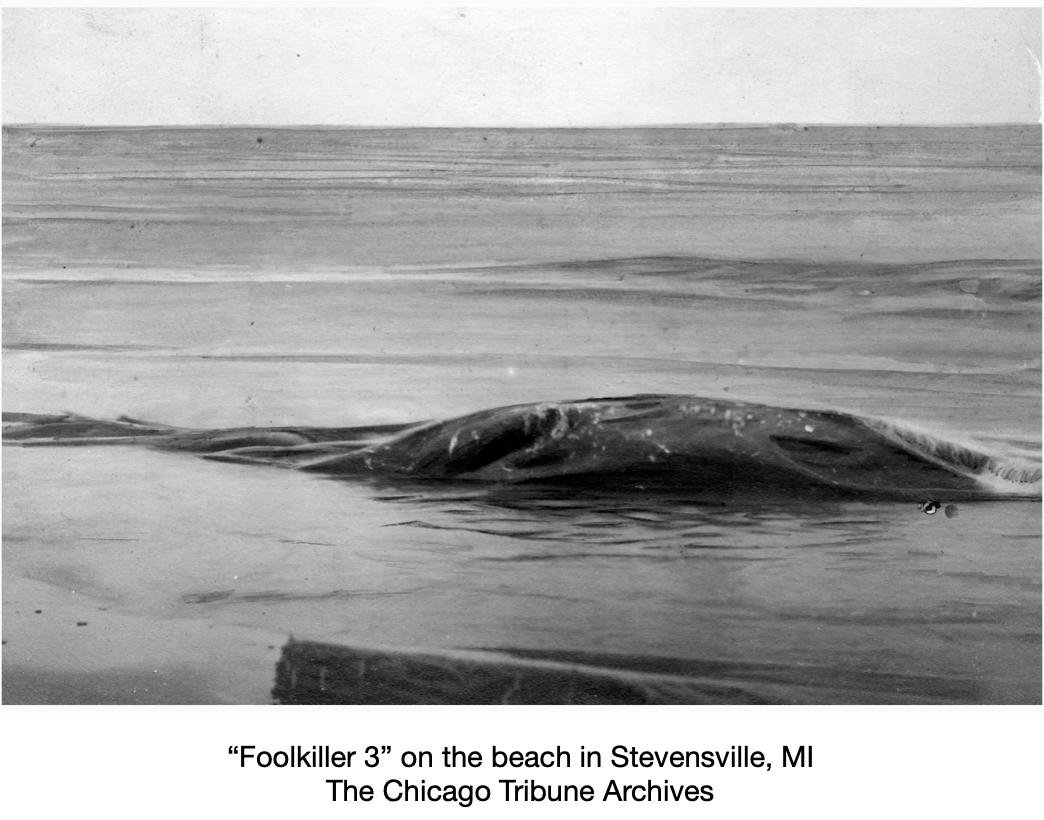
On December 1, 1904, the body of Peter Nissen was found on the beach at Stevensville, MI, just south of Benton Harbor, MI.
In a German language newspaper, it was reported that Peter Nissen, “who fought to traverse Lake Michigan in his balloon-boat, was washed up on the local beach in Stevensville, MI, with his balloon found “20 rods away from him, in a very sorry state.” (20 rods is the equivalent of 330 feet.) The paper also reported that his body was in a “very sorry state,” describing his hands and feet as being frozen and the “lineaments of his face” bearing signs of “infinite distress.” Cause of death was recorded as being from asphyxiation.
Even to the non-scientific mind, it seems that Nissen’s Foolkiller 3 lacked critical components to accomplish his feat of daring. It had no directional controls nor any equipment to maintain the air pressure inside the canvas cocoon for flotation or breathing oxygen. Foolkiller 3, in fact, killed a fool.
 old spirituals