Sam Walter Foss is not a well known American poet. Certainly not to the degree of Robert Frost, who won a Pulitzer Prize for Poetry and the Congressional Gold Medal. Both were New Englanders, born 16 years apart; Foss being the older of the two men. One thing they have in common, apart from the similarity of their surnames and New England heritage, is their ability to write poems relatable to the common man.
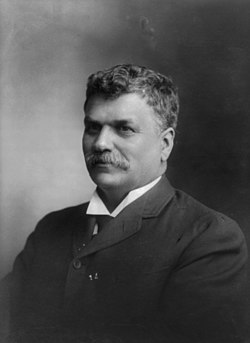
Foss was known for his “humorous and philosophical verse,” while Frost’s poems were more about “everyday experiences, often with a touch of melancholy, even ambiguity.” Frost’s works are enduring classics, while Foss’ works are not viewed in the same manner.
Sidebar: Sam Walter Foss was born in rural Candia, New Hampshire on June 19, 1858. His mother died when he was 4 years old, but that did not curtail his personal achievements. While working on his father’s farm, Foss went to Tilton School, then on to Brown University in Providence, Rhode Island, and graduated in 1882.
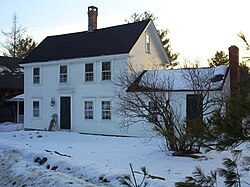
Foss became the librarian at the Somerville Public Library in Massachusetts, married a minister’s daughter, with whom he had a daughter and a son. Frost was purely a poet who attended both Dartmouth and Harvard, but did not graduate from either institution. Frost, too, was married, a union that produced six children. Foss, on the other hand, was both a librarian and a poet. He was so prolific writing poems that he wrote a poem each day for the local newspaper.
Sam Walter Foss poems fill five volumes. His poetry is “frank, simple and cozy . . . of the “ ‘common man’ variety.” The poems he is best known for are The House by the Side of the Road” and The Coming American. Both seem apropos in the 21 century. Only one is included in this post. To read the second poem click the provided link.
The House By The Side Of The Road
There are hermit souls that live withdrawn
In the place of their self-content;
There are souls like stars, that dwell apart,
In a fellowless firmament;
There are pioneer souls that blaze the paths
Where highways never ran-
But let me live by the side of the road
And be a friend to man.
Let me live in a house by the side of the road
Where the race of men go by-
The men who are good and the men who are bad,
As good and as bad as I.
I would not sit in the scorner’s seat
Nor hurl the cynic’s ban-
Let me live in a house by the side of the road
And be a friend to man.
I see from my house by the side of the road
By the side of the highway of life,
The men who press with the ardor of hope,
The men who are faint with the strife,
But I turn not away from their smiles and tears,
Both parts of an infinite plan-
Let me live in a house by the side of the road
And be a friend to man.
I know there are brook-gladdened meadows ahead,
And mountains of wearisome height;
That the road passes on through the long afternoon
And stretches away to the night.
And still I rejoice when the travelers rejoice
And weep with the strangers that moan,
Nor live in my house by the side of the road
Like a man who dwells alone.
Let me live in my house by the side of the road,
Where the race of men go by-
They are good, they are bad, they are weak, they are strong,
Wise, foolish – so am I.
Then why should I sit in the scorner’s seat,
Or hurl the cynic’s ban?
Let me live in my house by the side of the road
And be a friend to man.
I also recommend reading Foss’ The Coming American poem:
https://www.best-poems.net/sam-walter-foss/the-coming-american.html
 old spirituals