The old adage “crime doesn’t pay” certainly rang hollow for many Americans during the 1920s. Prohibition was a literal free-for-all for any young man with ambition, guts, and decent connections. Alcohol – making it, moving it, drinking it – became a national pastime, with plenty of money to go around. This brazen new class of criminals not only stretched law enforcement thin, but often had more than enough cash to pay off the cops (and make potential problems disappear) when necessary.
For those with a foot in bootlegging and an eye on a side hustle (or those just plain desperate for cash), robbery was always an available option. Peruse the newspapers of the time and you’ll see headlines crowded with liquor violations, side-by-side with accounts of the latest brazen hold-up of a local post office, chicken shack, or drug store. In the Minnesota papers I regularly visit, these stories are so common they begin to blur together. The men committing these crimes tend to blend into one another – fringe operators with brash personalities and access to a revolver, rarely rising to the ranks of criminal genius.
There was a new phenomenon in the Roaring Twenties, however, that captured the imagination of the news-reading public unlike anything seen since the days of Pearl Hart, Belle Starr, or Calamity Jane. The Jazz Age was now producing female criminals. Frequently these women were described as girlfriends of two-bit, would-be hoodlums, dazzled, at least at first, by the excitement of their rebellious boyfriends. The shine wore off in time, unsurprisingly, when the inevitable realization came that these feeble feats of banditry led nowhere fast.
And in other cases, their motives were even more desperate. They acted without the influence of a male partner, driven by something more raw and immediate – hunger, the need for a place to live, and to escape abuse.
Here is one such example. On Sunday, January 20, 1924, the Chicago Sunday Tribune reported that eighteen-year-old Charlotte Weiss and her sixteen-year-old friend Irene Piskulska had stolen a revolver from a cleaning establishment the previous Friday.
The next night they walked into a West Chicago Avenue dry goods store owned by Mrs. Freida Bild and asked to look at some lingerie. “They seemed like such nice girls too,” Mrs. Bild would later tell a reporter. But when the proprietress turned her back to retrieve an item, Irene, who was handling the gun, pointed it directly at her and sharply said, “Stick ’em up”.
“Her hand was shaking something awful and I was sure the thing would go off,” Mrs. Bild recalled, and she emptied out the register, hurriedly giving the duo $50 in cash.
The two sprinted out of the door, but a patrolman named Francis McCormick heard Mrs. Bild scream and gave pursuit. Charlotte tossed the money into a snowbank and dashed into a building, where Officer McCormick managed to apprehend her, but Irene escaped through an alley.
After being taken to the station, Charlotte Weiss, weeping uncontrollably, began to talk. She gave her name, confessed to the crime, and identified her partner. An hour later a squad of detectives tracked Irene down to an apartment on North Western Avenue. According to the paper she was “calmly manipulating her bobbed blond locks with a curling iron” when they found her.
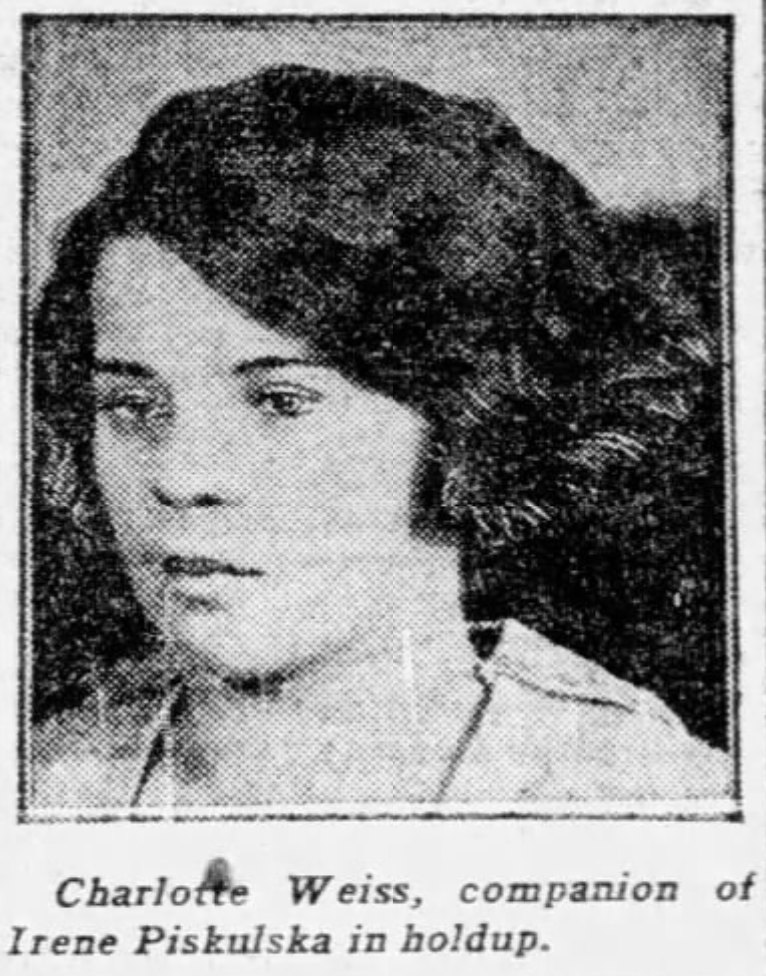
Charlotte did not hesitate to explain their motive.
“It was steal or starve”, she told the police captain. “Irene and I have been down on our luck for weeks. I was working for a Roosevelt Road firm but got layed off [sic] four weeks ago. For days we have had little or nothing to eat and had to sleep in hallways and apartment entrances. Pretty tough – you know how cold it’s been. Of course we could have had plenty to eat and a nice room with fine clothes – but we determined before we would get it that way to step out and hold somebody up. But we’ve had no luck even at that. So I don’t care much what happens now.”
One might infer from her statement that she believed there were easier (and perhaps more degrading) ways for making money than the one they made – which certainly does not stretch the imagination.
As for Irene, who police nicknamed “the hard-boiled one”, she denied knowing Charlotte, refused to admit anything, and glowered at a reporter who tried to snap her photograph.
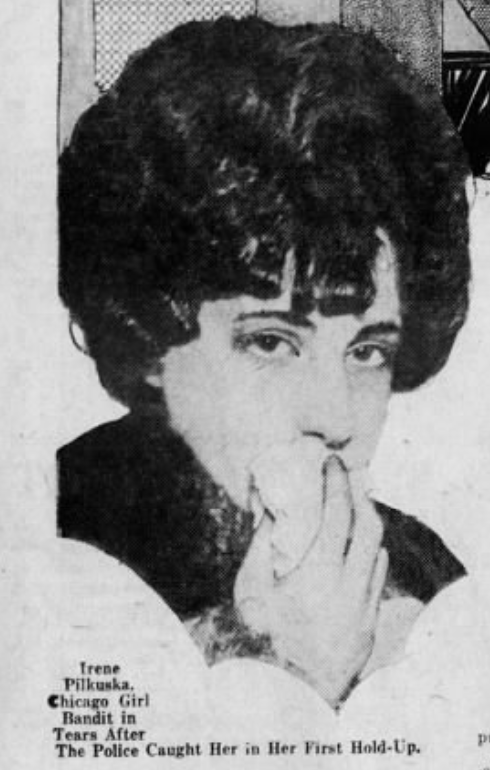
The next day Tribune reporters tracked down their mothers, who each defended their daughters and blamed the other as a bad influence. Both suggested that there were troubling issues in the other’s household. Irene’s mother shared that Charlotte’s brother had been in a reformatory.
Charlotte’s family, in turn, stressed that she had made good money and paid for her room and board. In fact, one explanation for why she’d acted so desperately was that she didn’t want to disappoint her mother with news of her dismissal from her job.
“You see I ain’t always been bad. I never did a thing like this before”, Charlotte tearfully explained. “I must have just got a crazy fit”.
Irene’s mother explained that her daughter had quit school to help support the family (occasionally making enough money to even buy ice cream and bottles of pop for her younger siblings). But there had been trouble at home, including an altercation with her brother that resulted in him hitting her, which led her to leave.
By the second day in custody, Irene had lightened a little and begun to talk.
“My mother says she would rather see me dead than here,” she said with a giggle and a shrug. “You see I am a juvenile case, but I’ll get at least five years, and no telling what they will give her.” She nodded toward Charlotte and let out a laugh, which set Charlotte into another bout of tears.
A pair of teenagers robbing a store would not normally have amounted to much more than a brief mention buried in the local news. But papers pointed out that this was the first holdup in Chicago planned and carried out by females without the assistance of men, and important enough to elevate the story.
And it did. A few weeks later, a feature-style article hit newspapers across the country. The title was wordy but catchy – Taming the Bobbed Haired Bandits With Cook-Books Instead of Bullets: Criminology’s New Scheme to Curb the Increase in Flapper Gun-Toters – “Give Her a Recipe and a Rolling Pin; She’s Got Too Much Energy for Her Own Good”.
Written by Winifred Van Duzer, it opened with these titillating questions:
“Which shall it be – bullets or rolling pins, cold steel or cook books – for the girl bandit? With her bobbed hair, her powder-puff in one hand and a wicked little pistol in the other, her cool daring and her manner of writing flippant notes to the police, she is a country-wide problem.
Is she a ferocious creature, to be shot on sight in the interest of public safety, as certain heads of police departments claim?
Or are there milder ways of taming her?”
Charlotte Weiss’s photograph was featured prominently in the article – all gussied up with lipstick and a bob-haired cut that seemed to confirm the claim in the title. One has to wonder whether Charlotte might have gotten some money for such a prominent use of her image (I hope she did). Irene’s photo was also included, lifted from the Tribune and altered. Her hair was darkened for reasons we can only speculate. There were cartoons as well, giving the piece a breezy, almost playful tone.
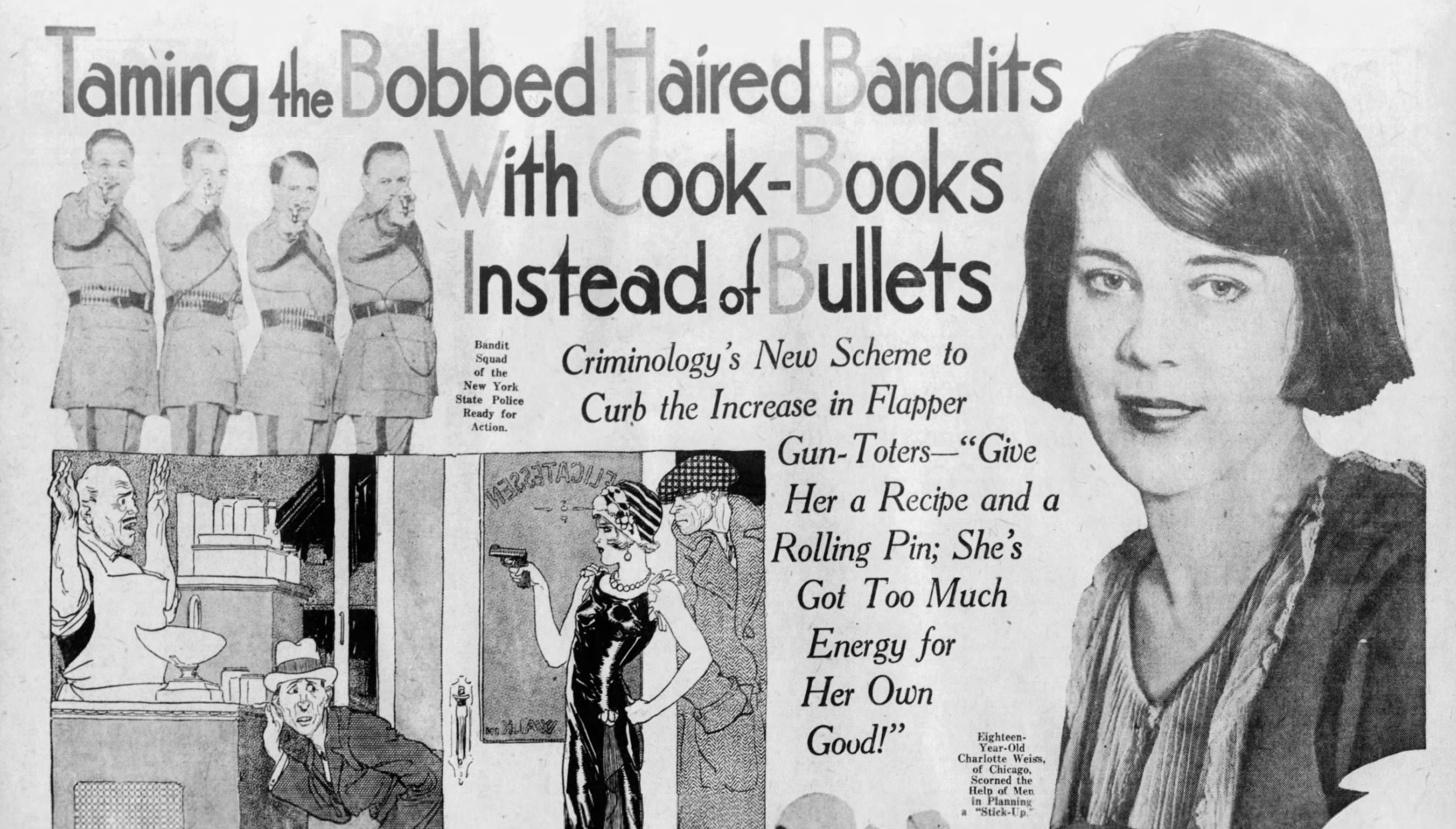
Weiss and Piskulska weren’t the only subjects of the piece – other examples were included of young women who had turned to assorted criminal acts. But the point of it all was clear – regardless of what they had done or how they had done it, society had a special obligation to make sure they were redirected to a “purer” path.
A quote from the article lays out the problem and offers suggestions. “Meanwhile, such institutions as Inwood House, in New York City, are issuing statistics to prove that a large percentage of girls who “go wrong” are driven by superabundant vitality into looking for a “good time.” They point out that girls are not inherently vicious, but are led into vice through wrong viewpoints and lack of experience. “Send the girl to jail and she is sure to become a criminal,” they contend. “But put her in an institution where her misdirected energy may be turned to tennis, basketball, and to learning domestic science and she will grow into a useful member of society!”
It was a neat little solution – less blame but the same subtle warning. The very idea that these two girls posed the same kind of violent danger to society as their male counterparts is hard to swallow. The percentage of women committing crimes was minuscule compared to the wave of male bootleggers, rumrunners, and gangsters shooting each other up across the country.
Lost in all of the gloss of a Sunday feature was the reality of what had happened. Charlotte and Irene had not masterminded anything. They weren’t running with gangs or building criminal empires. They weren’t part of the rapidly growing liquor syndicates that were ramping up to make tens of millions over the course of Prohibition. They hadn’t even gotten to spend the measly fifty bucks they’d stolen.
Instead, it became a cautionary tale – one that seemed less concerned with actual crime in the 1920s, and more with the anxieties surrounding female independence.
The fear of this new-fangled flapper class was real – and the connection between their hair, their attitude, and the supposed slide into degeneration did not seem far-fetched to many at the time. The humor helped soften the message, but it did not hide it. The warning was the entire point.
Sources:
Chicago Tribune. “Girl Bandits Hold Up Store; Both Captured.” January 20, 1924, p. 5.
Chicago Tribune. “Girl Bandits’ Mothers Blame ‘The Other Girl.’” January 21, 1924, p. 4.
Decatur Daily Review (Decatur, Illinois). “Hungry Girls Rob Store; Captured.” January 20, 1924, p. 1.
Minneapolis Star Tribune. “Taming the Bobbed Haired Bandits With Cook-Books Instead of Bullets: Criminology’s New Scheme to Curb the Increase in Flapper Gun-Toters – ‘Give Her a Recipe and a Rolling Pin; She’s Got Too Much Energy for Her Own Good.’” March 16, 1924, p. 77.
 old spirituals