I happened upon some photographs in the Library of Congress by Lewis Wickes Hine. Hine traveled from New England to Appalachia to the South, documenting the working conditions at establishments that hired young children. You can see the poverty on the children and that they were all taking on work that today would be considered out of the question for a child. Because they are children, there is a little hopefulness and innocence in each one.
The photos are fascinating but Hine’s commentary is the most interesting. Sometimes he wrote a terse note and other times he railed in obvious anger at a system that allowed young children to work in dangerous conditions. In most instances, he said nothing about the parents, no doubt recognizing many parents didn’t have a choice.
I’m going to separate these photos into three posts. This post includes a variety of photos, showing children of different ages working in the mills, the fields, and the streets. The next post will be specific to the girls working in the mills and will include an amazing video. No spoilers! The last post will be the photographs that earned the most fiery ire from Hine.
The photographs are in chronological order and most of the commentary is from Hine. I have a few comments in italics.
April 1909. One of the young spinners in the Quidwick Co. Mill. Anthony, R.I. (A Polish boy Willie) who was taking his noon rest in a doffer-box. Location: Anthony, Rhode Island.

Hine, Lewis Wickes, 1874-1940, photographer. (LOC)
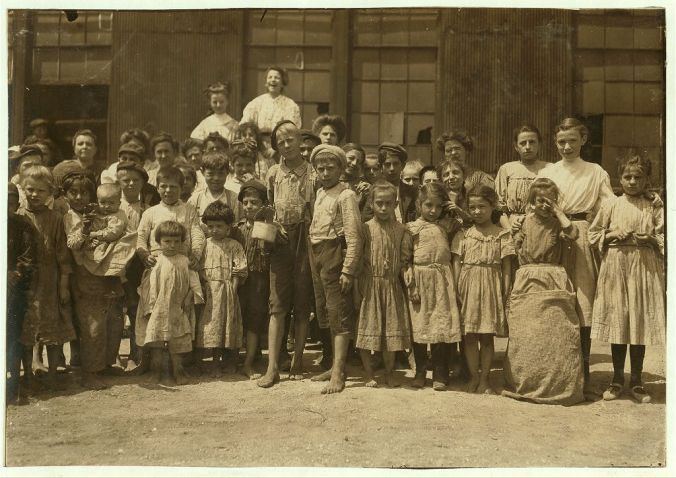
July 1909. Some of the workers in a Md. packing company. Location: [Maryland]
These children are awfully little. There’s an infant in the front row! Can you imagine them inside a packing company, crawling around through box cutters and cardboard?
Hine, Lewis Wickes, 1874-1940, photographer. (LOC)
November 1909. Young negroes working in Cape May Glass Co., N.J. Been there some time. Location: Cape May, New Jersey.
The little boys on the left look way too young for this kind of work.

Hine, Lewis Wickes, 1874-1940, photographer. (LOC)
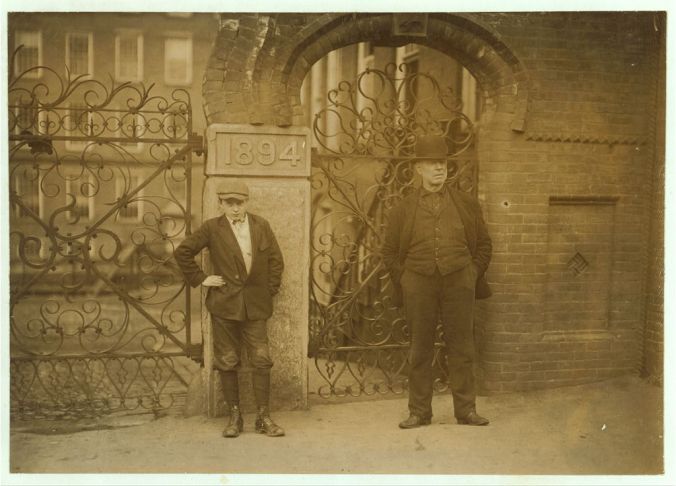
Nov 1911. Watchman Stanislaus Fabara, 59 Exchange St. Works in cloth room. The day before he gave me his name as Frank Fabara and today said it was wrong. “We give wrong names when we think trouble is coming.” Two other boys here acknowledge giving me wrong names also. Location: Chicopee, Massachusetts.
It’s interesting the children knew they were “supposed” to lie. I wonder if the adult on the right was there to keep the photographer from asking too many questions?
Hine, Lewis Wickes, 1874-1940, photographer. (LOC)
May 1912. Some of the young boys working Pelzer, S.C. Mfg. Co. Some of these workers seem surely near 12 years. May 27, 1912. Location: [Pelzer, South Carolina].

Hine, Lewis Wickes, 1874-1940, photographer. (LOC)
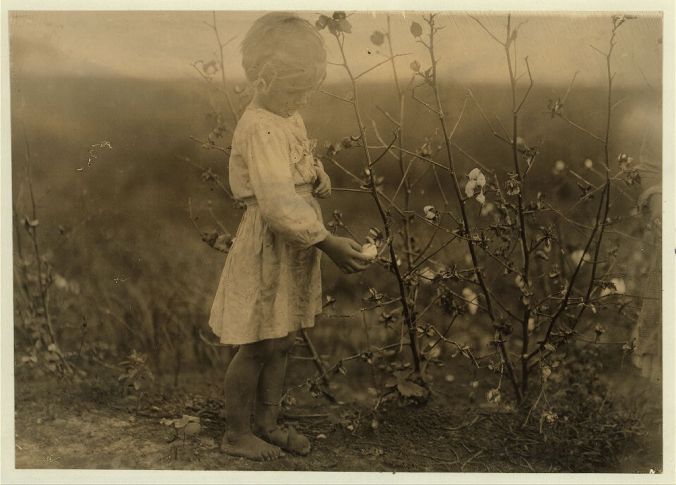
October 1913. Millie. Four year old cotton picker on farm near Houston. Picks about eight pounds a day, regularly. See #3598. Location: Houston [vicinity], Texas.
Four years old. One shoe.
Hine, Lewis Wickes, 1874-1940, photographer. (LOC)
October 1913. The cotton pickers on this farm were temporary neighbors to the owner. Four adults and seven children. The latter as follows: one six year old boy picks one hundred pounds a day. His father said “He picks one hundred pounds every day.” Two children of seven pick one hundred and fifty pounds a day each. One of nine years picks about two hundred pounds. Several from ten to fifteen pick three to four hundred pounds. The whole group picks a bale a day. Location: McKinney [vicinity], Texas.
I have no doubt these adults relied on the children to avoid starvation. I have mixed feelings about the father being proud of his 6-year-old son for picking 100 pounds of cotton a day.

Hine, Lewis Wickes, 1874-1940, photographer. (LOC)
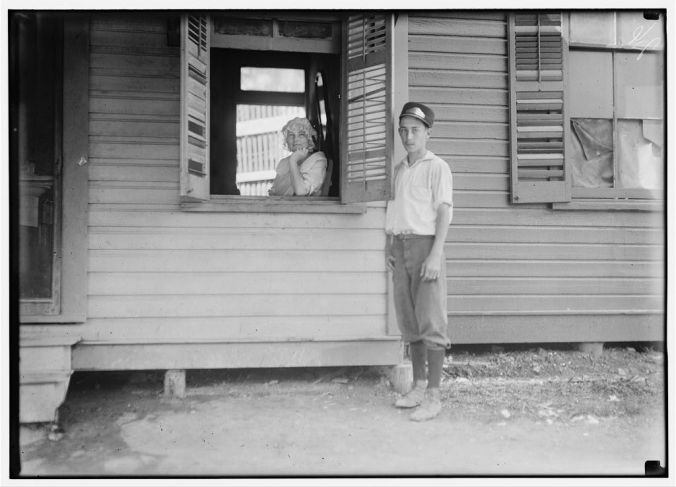
1913. [Messenger?] Location: [San Antonio, Texas?]
This looks like it may be a house of prostitution. I wrote a couple of posts in 2021 about messenger boys who took messages to and from the brothels in the red light districts of the south.
Hine, Lewis Wickes, 1874-1940, photographer. (LOC)
Aug 2, 1917. Group of tobacco pickers in Bermant plantation, 3 were 10 yrs, 3 were 11 yrs, 13 were 12 yrs, 12 were 13 yrs, 2-14 yrs old. The owner said, “They all get $1.25 a day.” Location: Rockwell, Connecticut.
These children look so poor and hungry. I bet you there were a few that were not yet 10 years old.

Hine, Lewis Wickes, 1874-1940, photographer. (LOC)
October 1921. School in Session – (Sunset school). (See Photo No. 18.) Location: [Pocahontas County]–Marey, West Virginia / Photo by L.W. Hine.
See what a difference it makes putting this photo last? If it was first, we would probably judge it pretty differently. As the last one, it’s almost a relief!

Hine, Lewis Wickes, 1874-1940, photographer. (LOC)
 old spirituals
It saddens me to think of how hard life was for those little ones. I know it was a different time and maybe that was the only choice parents had then but still…
We are so very blessed to have never known hardship like folks suffered through back then.
LikeLiked by 1 person
So true! In some ways, kids were better off when they had something real to do and actual responsibilities. Of course this work was much too hard and too many hours. But in general, I don’t know that it’s preferable to spend 10 hours a day gaming instead of working on something…? Completely agree that we are very fortunate!
LikeLike
It is true that having a purpose is a good thing in life. When I was growing up, we had chores. We did the dishes, swept the kitchen, fed the dog and burned the garbage every day. We learned to help out at home. We certainly weren’t over-worked and thought nothing of it really. A little responsibility is a good thing. Those little ones though had a truly hard life. It would be interesting to know how their lives turned out, wouldn’t it?
LikeLiked by 1 person
I wish we knew what happened to these children. They would’ve become adults between 1920-1930. People went off the radar in the Great Depression. So we only have these faint images of them. They’re like ghosts who appeared in the camera lens once and disappeared forever.
LikeLike
I agree this work was too many hours and too hard for very young ones. Times were hard then. Many families suffered the loss of the father, the breadwinner as my dad and father-in-law did at a young age. A good work ethic is positive, but our over indulged young these days makes me pause. Little Millie with the “one shoe” hurts my heart. Wish we knew what happened to all these kids in the photos.
LikeLiked by 1 person
There’s a verse in the Bible that says steel sharpens steel
It’s the hardness of life that casts our character, isn’t it? It definitely would be interesting to see how these children came out!
LikeLike