It’s a well-known but remarkable phenomena that U.S. presidents seem to age in dog years while they are in office. They typically emerge from a 4-year or 8-year term looking decades older.
I came across some pictures of Franklin Delano Roosevelt long before he became our president. It might be these specific photos, but he seemed to age faster before he was the president than during his time in office.
Would you like some musical accompaniment as you peruse these photos? Happy Days are Here Again! was the song FDR selected for his first presidential campaign. In the midst of a years-long Depression, it was a bold choice. But Franklin’s instincts were correct. The country was weary of hunger and uncertainty. This was the message they longed to hear.
We get our first glimpse of Franklin at age 18, in 1900.

National Archives
Here he is 16 years later, at age 34. Sixteen years is a long time and, during that period, all the boyishness seems to have melted away. In 1916, FDR was serving as Assistant Secretary of the Navy. He looks dapper in his suit and bowler hat!

National Archives
Two years later, when Franklin was 36, he posed for his passport photo. FDR seemed to have aged quite a bit in the two years since the last picture.

National Archives
Franklin contracted polio in 1921, which had a devastating effect on his body for the remainder of his life. Here he is, age 45, with Eleanor at home in Hyde Park, New York in 1927.

Wikimedia Commons (FDR presidential library)
We catch Franklin again in 1939. Twelve years have passed and he’s 57 now, but he doesn’t look like he’s aged that much since the last photo, though he had been in office for six years by this point. It could be the camera angle. This is my favorite photo of him!

The last photo is from 1941, when FDR was 59. He doesn’t seem to have aged from the last photograph.
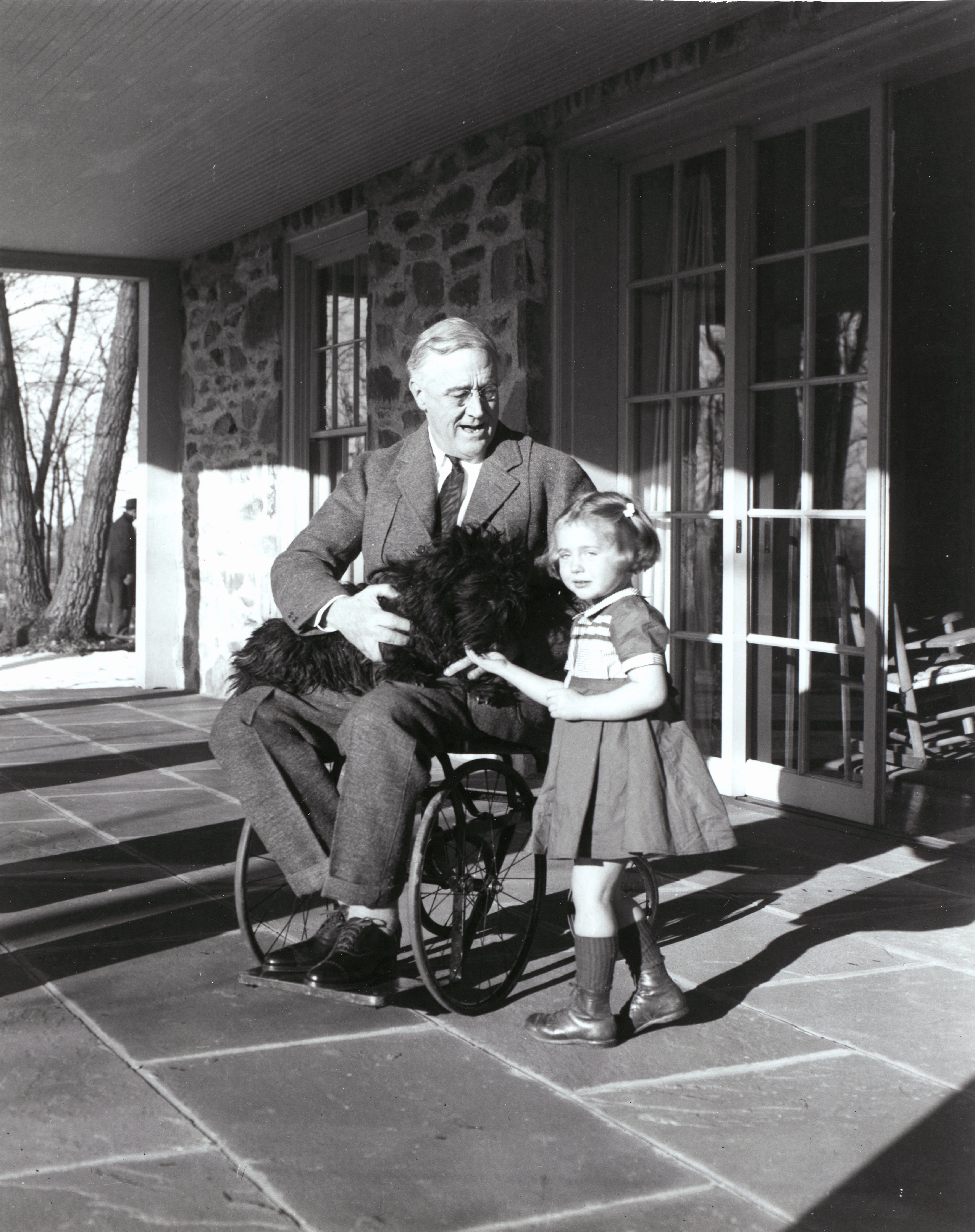
FDR Presidential Library & Museum
Here’s one other FDR-related image I found in the National Archives. It’s a photograph of a massive dust cloud approaching a small village in Rolla, Kansas on May 6, 1935.
It was apparently used as a postcard and mailed to President Roosevelt.

National Archives
The message read:
Dear Mr. Roosevelt,
Darkness came when it hit us. Picture taken from water tower one hundred feet high.
Yours Truly, Chas. P. Williams
Going back to Happy Days are Here Again!, it goes to show FDR had a remarkable understanding of human psychology.
 old spirituals
I suspect The Great Depression and WWII had a profound impact on FDR’s rapid aging, compounded by his disability.
The post card of the dust storm sent to FDR by “Chas. P. Williams” ignited my fascination with the use of abbreviated surname in American history. Obviously, “Chas.” is short for “Charles.” It is an example of the decades old practice of abbreviating a “Given (First) Name,” even on formal documents, to reduce writing and save paper. The practice was commonly used when listing members of a large group (e.g. parish rolls, Census reporting, etc.) to save paper. Several signatories to the Declaration of Independence abbreviated their surname, e.g. “Geo. Walton, Benj. Harris and Abra. Clark.” It was possible because the number of first names in use at that time was relatively small compared to today.
LikeLiked by 2 people
I first came across that phenomena with the name Robert or Robt. It still puzzles me when relatively short names get abbreviated like that!
LikeLike
Possibly the aging came from Eleanor who was a whirlwind! Lol Joking aside, my dad escorted Mrs. Roosevelt in the late thirties when she came to speak in Beaumont, TX. My dad was a policeman before he went into the Navy when America joined the war. He told me Mrs. Roosevelt was a very gracious lady.
LikeLiked by 2 people
Oh wow!!! Your dad met her!! That’s so cool!
LikeLike
Franklin Roosevelt was a “God” to the “Greatest Generation” and the “Silent Generation.” He got lead them through the “Great Depression” and WWII. He was an idol. He did it by starting Federal welfare through his “New Deal.” Many programs under the “New Deal” are in effect today, e.g. Federal Deposit Insurance Corporation, the Securities and Exchange Commission and the Tennessee Valley Authority. His “Second New Deal” created the Fair Labor Standards Act, the National Labor Relations Board and the Social Security Administration.
LikeLiked by 1 person
Yes! My people were so poor and his work programs quite literally saved them from starving to death. Before she passed away a few years ago, my grandmother still spoke of him reverently.
LikeLike
Franklin Roosevelt was a hero in our family. My grandparents spoke of him with reverence.
LikeLiked by 1 person
Me too, Ruby! I have a great uncle Frank named for him (Franklin Delano).
LikeLike