Often people were very serious in photographs from the turn of the century.
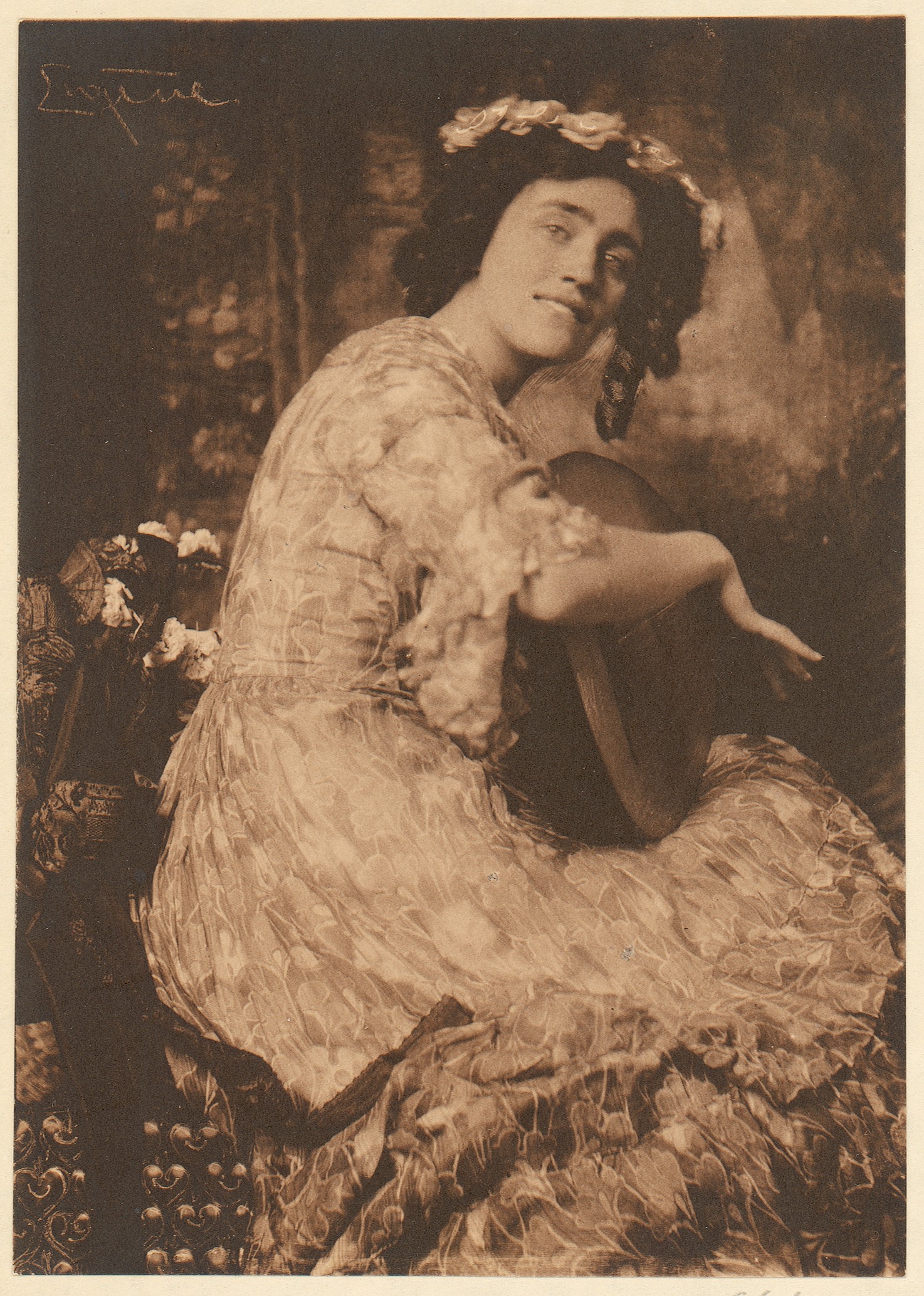
These pictures were highly unusual in that respect. This photo, The Guitar, was made by photographer Frank Eugene in 1908.
From Archive.org
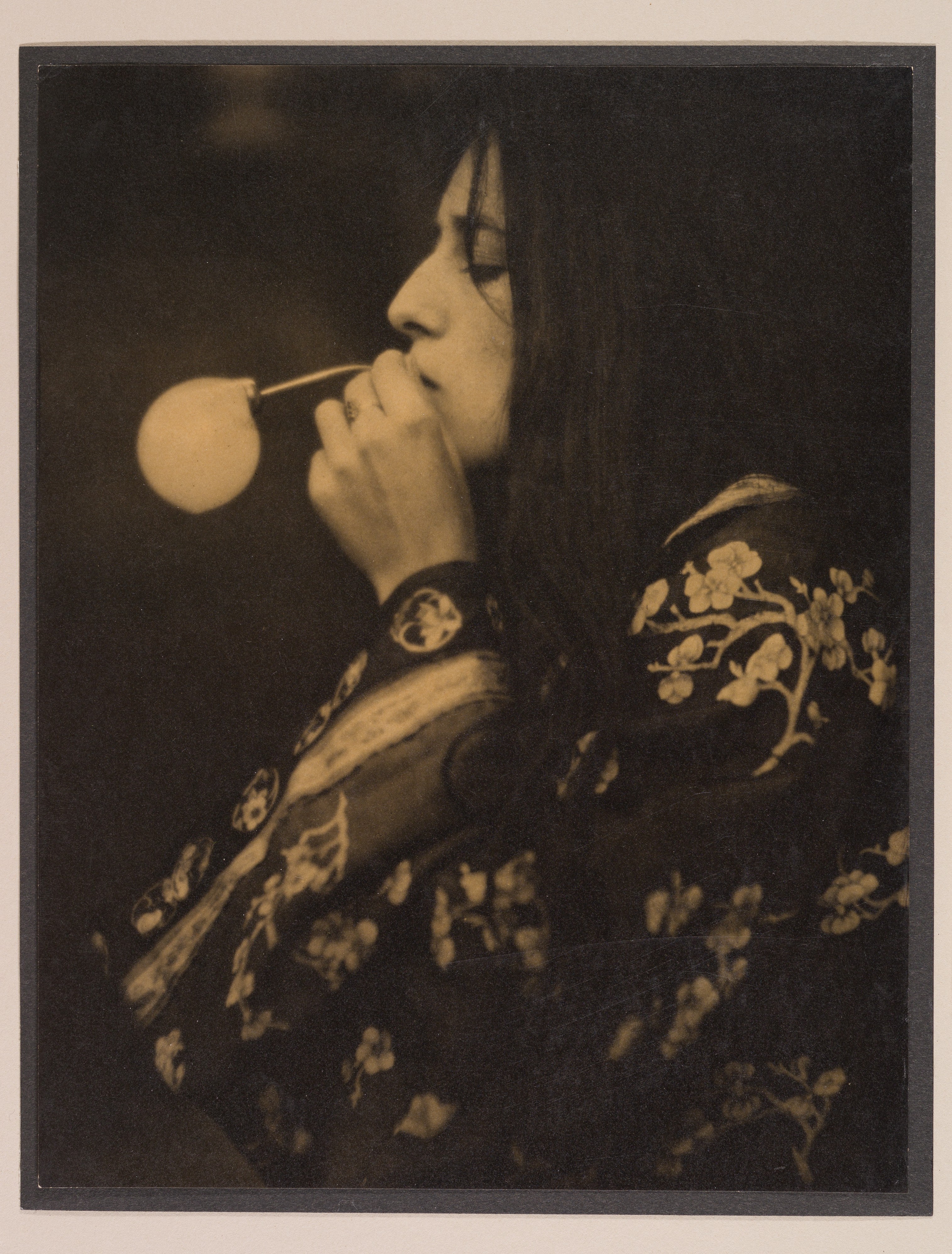
The second photo was made by Alvin Langdon Coburn in 1908, He named it The Bubble. The titles of the photographs weren’t too creative but the pictures were unusual enough to capture interest on their own.
I love this girl’s kimono! I’m curious what she’s blowing into– and is that a balloon?
from Archive.org
Going back to people tending to be serious in photographs….A lot of speculation exists about why this is but I’m not sure if there’s one right answer. One explanation is that the subject had to remain perfectly still for a long time to avoid blurring in photographs and it’s hard to hold a genuine smile that long. Another reason is that photographs were so expensive that many people only had a few photos made in the course of their lives. Maybe they thought that grinning in their picture was too frivolous.
My theory is that it was related to the Victorian love of mystery. You can tell a lot about people by their smiles and they were reluctant to reveal very much. Maybe that is why they are still so fascinating so many years later!
 old spirituals
I’ve always assumed that many people just didn’t have beautiful teeth or possibly it just wasn’t done when being photographed. (smiling) The lady in the first photo should smile. Her teeth are beautiful. I love the flowing dress and the grace the photo portrays. I have no idea what that bubble is in the second picture, but I’d love to have a kimono like that!
LikeLiked by 1 person
Yes, the first woman is graceful. That is a good word for her! I wonder if she was singing when the photo was taken?
LikeLike
Photographers call a photo of an individual “a portrait,” likely a carryover from the decades long practice of hiring an artist to paint “a portrait.” I do not recall seeing a vintage “painted portrait” with the subject smiling. The exception is possibly the “Mona Lisa smile.” An unemotional expression was continued into the early days of photography. Not to be morbid, but there were photographers who specialized in photographs of deceased family members, alone and with living relatives. No smiles in those photographs.
The 1908 Coburn photo is puzzling. Called The Bubble, one has to assume it is in fact that . . . an early 20th Century “soap bubble.” However, the density of the bubble appears to be unusual. It appears to be more like a balloon.
LikeLike
It appears to be too dense to be a soap bubble that was common in the early 20th Century. It has a balloon like appearance. Well after 1908 there was a product sold in a tube that was a tacky material, rolled into a small ball, placed on the end of a narrow tube and blown into a balloon. One brand was called Plastic Bubbles; another was called Bloonies.
Photographers called a sitting for a picture “a Portrait,” a term that originated when artist painted a person’s image. The only portrait I know that the subject had anything close to a smile is the Mona Lisa. That unemotional face was the norm and likely a carryover from portrait painting. Not to be morbid, but Victorian era people often took photographers of and with a deceased family member, particularly a child.
LikeLike
It appears to be too dense to be a soap bubble that was common in the early 20th Century. It has a balloon like appearance. Well after 1908 there was a product sold in a tube that was a tacky material, rolled into a small ball, placed on the end of a narrow tube and blown into a balloon. One brand was called Plastic Bubbles; another was called Bloonies.
Photographers called a sitting for a picture “a Portrait,” a term that originated when artist painted a person’s image. The only portrait I know that the subject had anything close to a smile is the Mona Lisa. That unemotional face was the norm and likely a carryover from portrait painting. Not to be morbid, but Victorian era people often took photographers of and with a deceased family member, particularly a child.
LikeLike