Her case made the L.A. Times.
In 1928, a Los Angeles clerk named Mrs. Lolah Wheeler startled the court. The 28-year-old stood convicted of eight counts of issuing checks without sufficient funds, and she would have undoubtedly gotten parole—had she completed the application. But Mrs. Wheeler twice refused to do so.
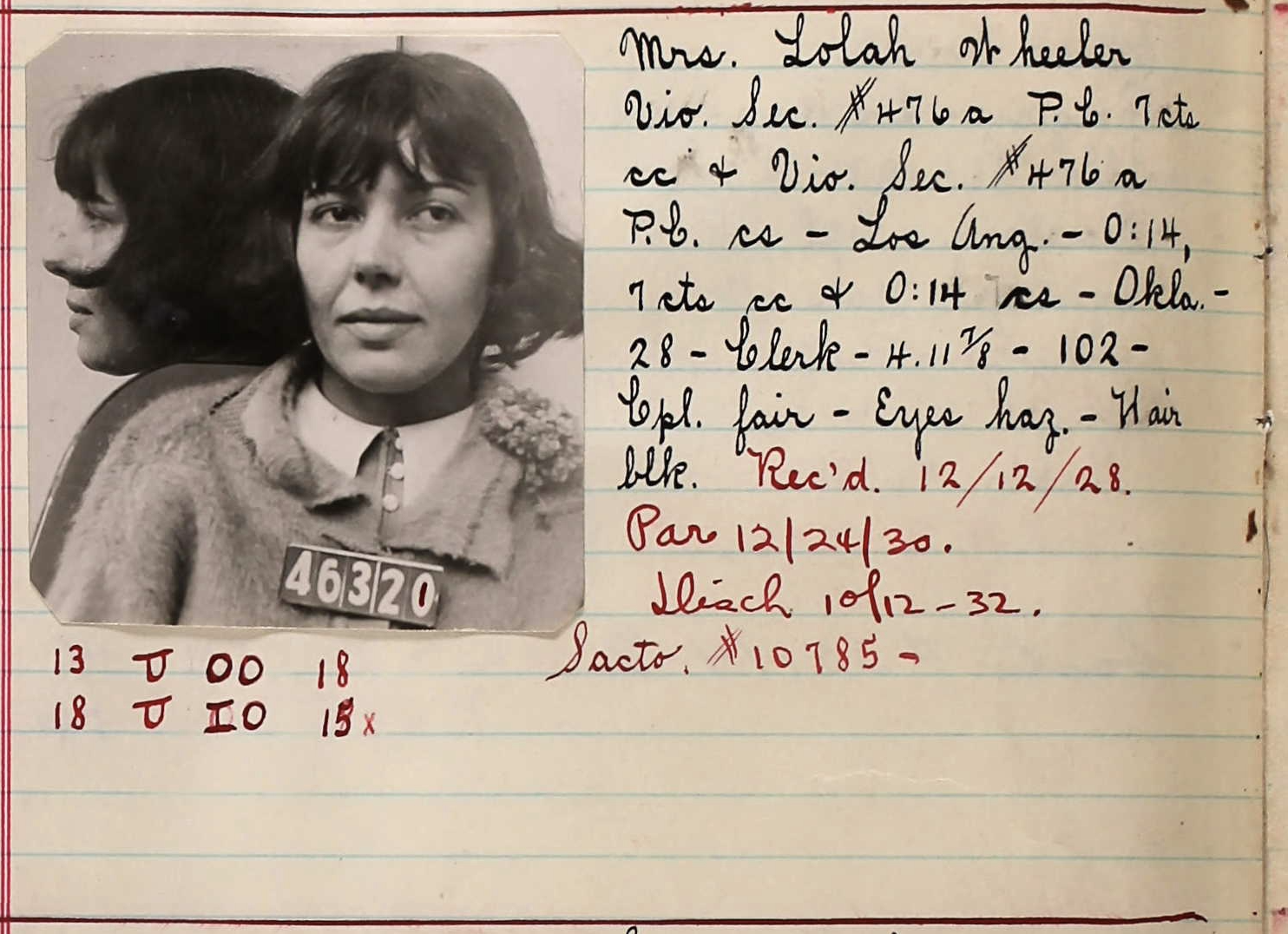
Judge Hardy was loath to issue a prison sentence to a first-time female offender who passed bad checks. “Why don’t you file the application?” he asked.
“It won’t do me any good,” Mrs. Wheeler replied, adding, “I’d just as soon be sentenced.”
Judge Hardy granted her wish. Lolah Wheeler was sentenced to 2 – 10 years in San Quentin. She began her sentence on December 12, 1928 and was paroled two years later on Christmas Eve of 1930.
I wonder why she didn’t want to go on parole, and if she regretted her decision.
Bonus: Double Trouble!
The side-by-side mugshots of Eugene Cereghino and Charles Lowell note that each is the pal of the other.
The February 3, 1901 edition of the San Francisco Call and Post unfolds their story: “Charles Lowell and Eugene Cereghino, boys, were sentenced by Judge Lawlor to serve one year in San Quentin on each of two charges of burglary, the sentences to run concurrently. They broke into a freight car of the Southern Pacific Company.”
Lowell and Cereghino, ages 20 and 19 respectively, seemed to be a package deal. They were sentenced together in San Francisco on two counts of second degree burglary on February 3, 1901; processed together into San Quentin on February 10, 1901; and released together on December 16, 1901. But their story didn’t end with these San Quentin mugshots.

Cereghino and Lowell were both convicted of burglary again the following year. Cereghino was using the alias William Kelly and Lowell was using the alias Charles Crandell. They both received 15-year prison terms that began on March 25, 1902. But this time Cereghino was sent to Folsom Prison, whereas Lowell returned to San Quentin. Separating this petty crime duo was probably a wise idea!
 old spirituals
Lolah Wheeler did not complete the application for parole because in prison she would be provided a place to live, a bed and 3 meals per day. Otherwise, she would have to continue as a miscreants to survive. Remember, this was the year before the Great Depression that historians say ran from 1929 to 1939. Everyone had difficulty obtaining employment.
Cereghino and Lowell are a real life version of Dumb & Dumber. Their mugshot makes them look older than age 20 and 19, but not wiser. Separating them likely didn’t make either of them more intelligent.
LikeLiked by 3 people
That’s very possible about Lolah! I thought she wanted to avoid something (or someone) at home. Just judging based on their looks I would not trust Cereghino or Lowell with anything but if I judged on their pictures alone, I’d guess Cereghino was more easily led and would do whatever his friends did. Being away from Lowell’s influence might help…then again, he was at Folsom so he probably wasn’t surrounded by Boy Scouts in any case. Lowell would be trouble no matter where he went or who was around.
LikeLiked by 1 person
I tell you, the guy on the right of Double Trouble should not be trusted with anything, ever!
LikeLiked by 2 people
100% agree!
LikeLiked by 1 person
I believe you are right about Lolah Wheeler. How sad!
LikeLiked by 1 person