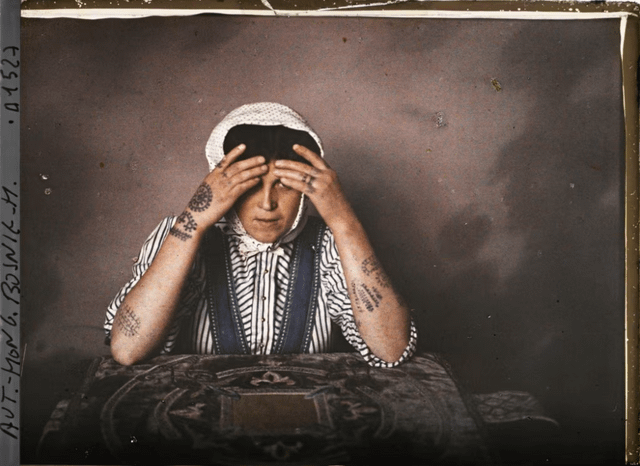
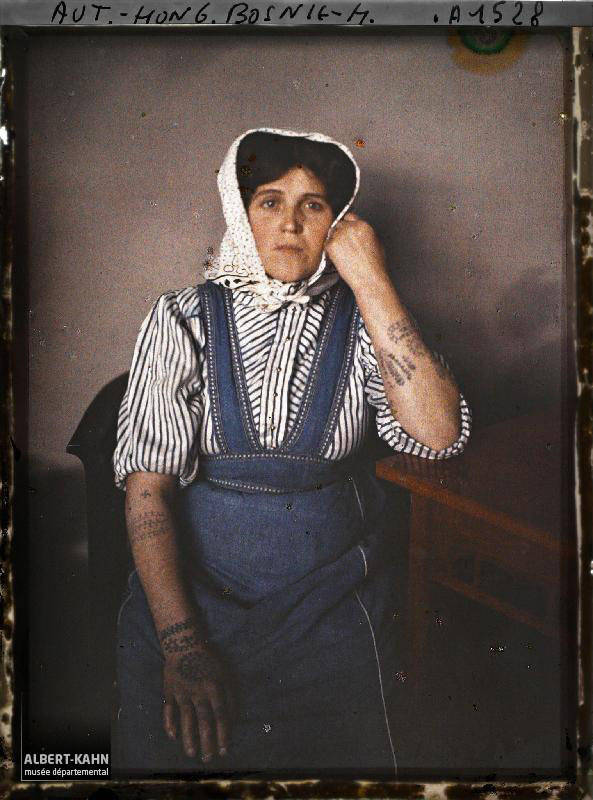
Who do you suppose this mysterious woman is? The photo was taken in Sarajevo, Bosnia in 1912. The metadata states the woman is Catholic.
Allrhatsinteresting.com
Who do you think she was? Most women did not get tattoos in the 1910s, let alone lots of highly visible tattoos. In the first photo she looks distressed. Any ideas?
 old spirituals
This photo offers many clues. The imprinted name Albert Kahn is that of a well known American architect who lived from 1869 to 1942. Kahn designed a myriad of manufacturing and institutional buildings for Henry Ford, the University of Michigan and governmental buildings. He even designed the Edsel & Eleanor Ford House. He was sometimes called the “Father of Industrial Architecture.” HOWEVER, there is another famous Albert-Kahn, a Frenchman, who I suspect is the one connected with this photo. The French Albert-Kahn was a French banker and philanthropist.
The Musée Départemental, also imprinted on the photo, is a museum in Northern France that has a collection of Albert-Kahn’s photographic images. I highly recommend visiting the site. As a military history buff, I particularly appreciate the color photos of World War I, French soldiers, but the collection includes far more than those photos. The old movies are amazing.
Bosnia-Herzegovina was part of the Australian-Hungarian Empire in 1912. It was comprised of at least 3 ethnic groups and a number of religious, the most prominent being Muslim. The other two were Orthodox Christians and Catholics. The tattoos were used to identify as a Catholic. My theory is support by The Catholic Asperfillum:
We even find Catholic tattooing traditions: during the Muslim conquest of the Balkans (1463–1878), the Ottoman Empire had the custom of taking boys as blood tax (devşirme), and girls as slaves, so Catholics in Bosnia and Herzegovina developed a tradition called sicanje, which consisted in tattooing crosses and other patterns on the hands, arms and chests of children (between 12 and 16),⁴ so that they would preserve their confession as Catholics.
Another tradition is found in Egypt, among both Catholic and Orthodox Copts. The tradition started during the Islamic conquest of Roman Egypt in the 7th century, when the Muslims branded the side of the inner right wrist of Christians and Jews who didn’t convert, in order to identify them as dhimmi —non-Muslims—, and levy the jizyah —the tax for the dhimmi to live in Muslim territory—.⁸ This brand turned into an identification; a symbol of resistance and perseverance for Copts, who till this day continue tattooing their children’s inner wrists with a cross, despite the fear of being persecuted,⁹ to prevent them from apostatizing.
LikeLiked by 2 people
That’s some great detective work! Very interesting stuff 😍
I’ll check out that site!
LikeLike
The modern continuance of Bosnian tattoos in clothing. . . . .
LikeLiked by 2 people