Saturday, December 9, 1916, started like a typical day in the life of Gaetano Gangi. At age 56 (according to news reports, but ancestry.com reports he was 55 ), Gaetano, a Sicilian immigrant living in Lynn, Massachusetts, the day did not end as usual after his day of work at the Illinois Leather Company in Peabody, Massachusetts.
Sidebar: Peabody, Massachusetts in 1916 had a flourishing shoe industry and in 1919 was recognized as the world’d largest producer of leather shoes, earning itself the title of “Leather Capital of the World.”
Gaetano married his wife, Maria, back in the “Old Country” and the two produced three children, all of whom were born in Sicily. (Gaetano and Maria had another child, Filipa, born in 1902 but died that same year.)
Gaetano immigrated in 1906, established himself and returned to Sicily to spend time with his family in the intervening years. His family immigrated to American on April 29, 1912, aboard the S. S. Principe Di Piedmonte from Palmero.
The Investigation – “Just The Facts, Mam”
The Gangi children were young adults on the fateful day that jolted the life of the entire family. Grace, Grazia in Italian, the oldest, was 23 and her brother, Santano (who they called “Sam”), and his twin sister, Rose, were two years younger. In December 1916, Rose (Fiaccaprile) was already married, living outside the Gangi home.
Grace was employed by her father managing the boarding of Italian immigrants renting rooms in the building, responsible for collecting rent, general housekeeping, cooking and sundry duties; she also assisted her mother in maintaining the family’s home. Tony, on the other hand, worked for a shoe manufacturer in the area. Both children lived with their parents, an arrangement that appears to have been a cause of ongoing contention.
The Daily Evening Item reported on December 11, 1916 that the Gangi family was well known and respected by the Italian community in the area. They were also well known for regular nightly arguments that were heard by all the neighbors. In fact, the Lynn police had been called on prior occasions to investigate the disturbances at the Gangi residence. So when the police were called the evening of December 9th, it was not the first time.
Gaetano was usually the cause of the fighting, frequently over the amount of money paid to him by his children. Grace shared the profit from room rentals with her father and Sam paid a portion of his factory earnings. On the night in question, the father accused his son of refusing to support the family. It was reported that Sam had injured his foot and not reported for work at the same leather factory, and Grace defended her brother for not going to work.
Grace Gangi told police “ . . . that she took the part of her brother in the argument, with the result that the father turned his wrath upon her, called vile names and finally order her to leave the house,” according The Portsmouth Herald on December 12, 1916.
The Boston Globe wrote that Grace “. . . procured a revolver for the purpose of frightening him, as she stated, she said that if he did not take back his insults she would shoot. Instead of retracting, the father added more names to those he had already called her and maddened by the insulting phrases she pulled the trigger, the bullet striking her father in the forehead and causing almost instant death.”
Another paper, The Portsmouth Herald, wrote a similar story about Grace’s role in the shooting, “ [She] went into her father’s room, where she took a revolver from the bureau. Holding the weapon behind her she returned to the kitchen, pointed the gun at her father and told him that if he continued his abuse of her character she would shoot.” As reported by the Herald, “The father . . . then becomes more violent in his language and, rising from his chair, attempted to seize his daughter.” The paper declared that “. . . the girl fired, and the father fell dead with a bullet through his head.”

Grace’s Jurisprudence
Grace was arrested and held for arraignment before Superior Court Judge O’Brien, according to The Daily Item on Saturday, December 23 1916. Judge O’Brien made his decision based on the repeated word from the interpreter, a Miss Angelia Necosa. Sequence of events were reported in more detail at the arraignment, for instance that Grace told police, “I returned home from the moving pictures and found my father arguing with my brother and mother. My brother had injured his foot and my father was finding fault because he had not gone to work at the same factory where he was employed in Peabody.”
According to The Daily Evening Item, it was further attested by Grace:
“My father threatened to put us all out into the street and he told me to go out and become a bad woman. He also threw a knife at me and was about to throw another knife, when I went into his bedroom and got his revolver form under his pillow. I kept the revolver from under his pillow under my dress when I returned to the kitchen. In my own mind I decided to kill him if he insulted me again. I asked him if he meant what he said about my becoming a bad woman and he said he did.”
“I told my brother to leave the house. I went down stairs and told a woman there that my father had committed suicide. I told police the same story when they arrived.”
“The knife, which the police allege was thrown in the kitchen, was presented in court. It is an ordinary silver table knife and very dull.”
“Atty. Richard Sisk, who appeared for the defendant, started to question the interpreter, when the court stated that it would be necessary for him to hold the defendant upon the evidence presented and that it would be useless to devote any more time to the case in the District court.”
“Attorney Sisk brought out the fact that the victim was strong and muscular and, from his questioning, it appeared that self-defense might be the defense in the higher courts.”
“Miss Gangi showed no emotion in court. She sat with her head down during the hearing.”
Grace Gangi remained incarcerated until her indictment by the grand jury in Salem, Massachusetts. Among the Lynn, Massachusetts cases, The Daily Evening Item reported on page 8 of its January 13, 1917 issue: “The other charges [presented were those against] Grace Gangi with the death of her father, Gaetano Gangi, on the night of December 9, at the Gangi home, Union street.”
A few days later, The Daily Evening Item reported on page 1:
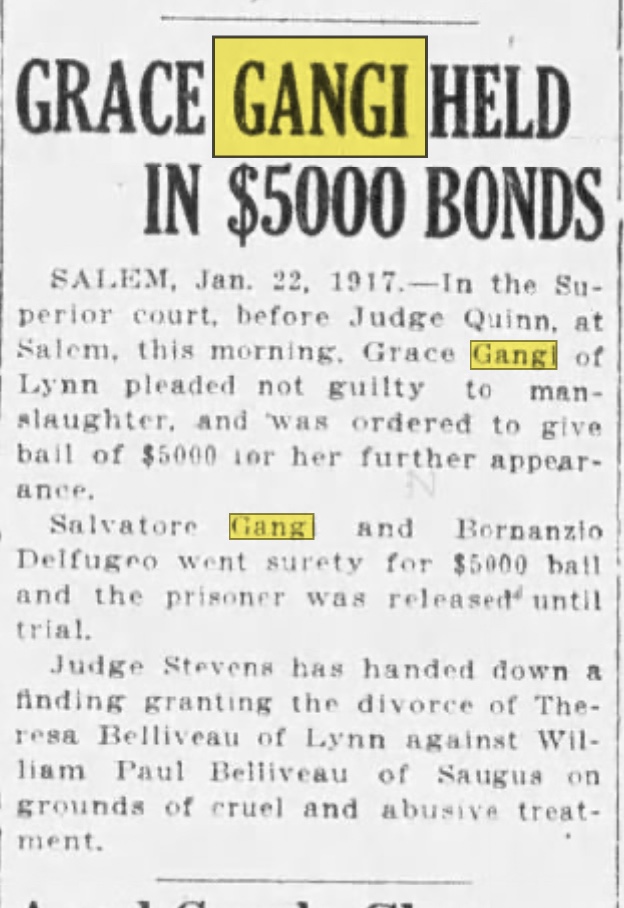
Identified as a “Special Dispatch” by The Boston Globe, Grace Gangi’s legal ordeal was reported to have ended in a manner one might not expect. The Court was sympathetic and applied leniency in deciding Grace’s ultimate disposition.

Without much fanfare, it seems that Grace Gangi was placed on probation by the Judge after admitting she was guilty. One can only speculate that her good behavior while out of prison on bond, attested to by Lynn Police, and the abuse and threats by her father garnered sympathy from the court. The length of her probation was not specified in the newspaper stories.
Postscript
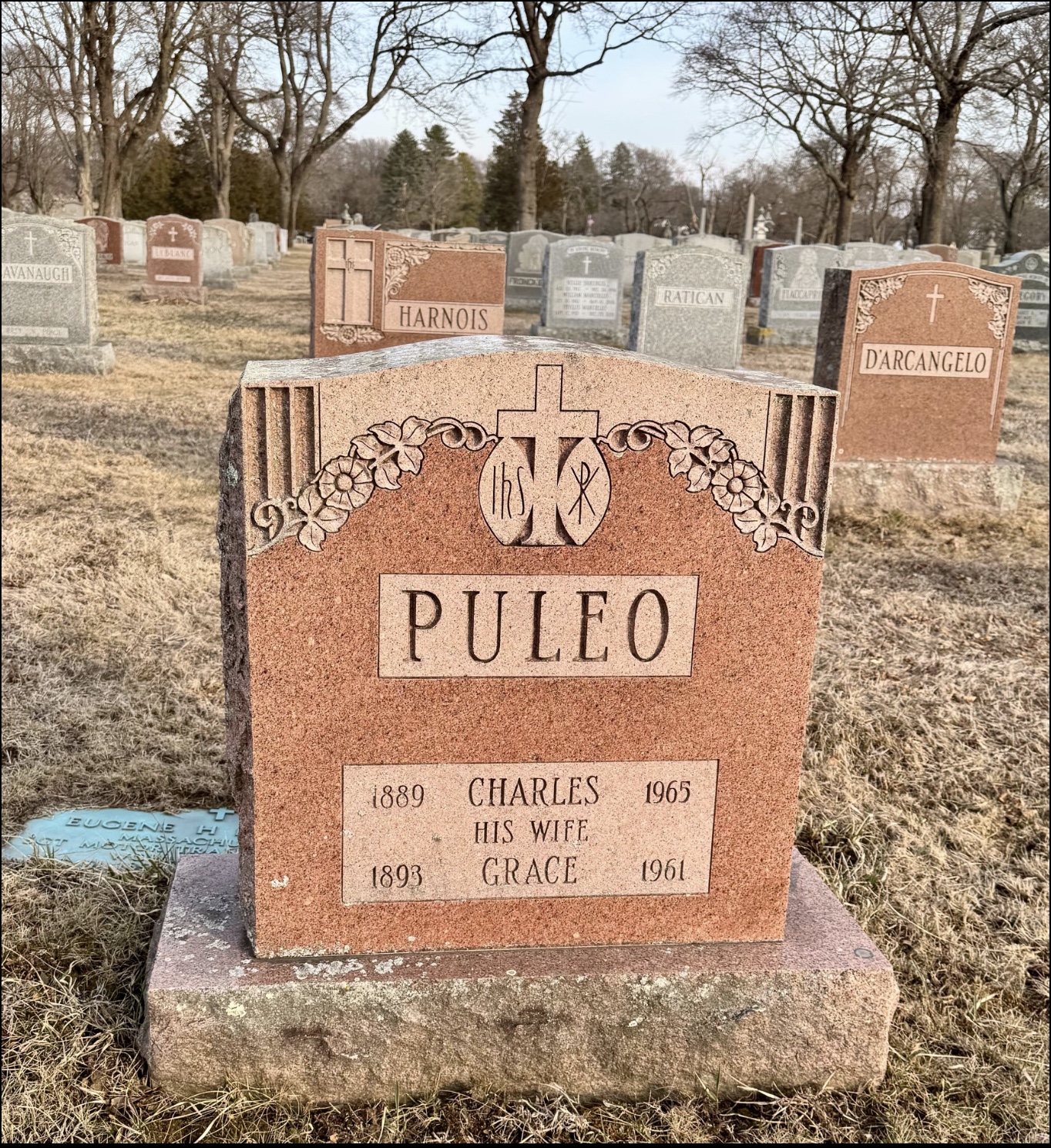
Grace (Grazia) Gangi did go on to live a normal and, one might say, prosperous life. She married Charles Puleo, also Sicilian, a plasterer by trade, in 1921. The couple had six (6) children and 14 grandchildren. The 1930 Census reports a 7th child, a boy, but he is not shown on subsequent census documents, so Grace may have lost a child. It is important to mention that Grace named one of her male children Gaetano, her father’s name.
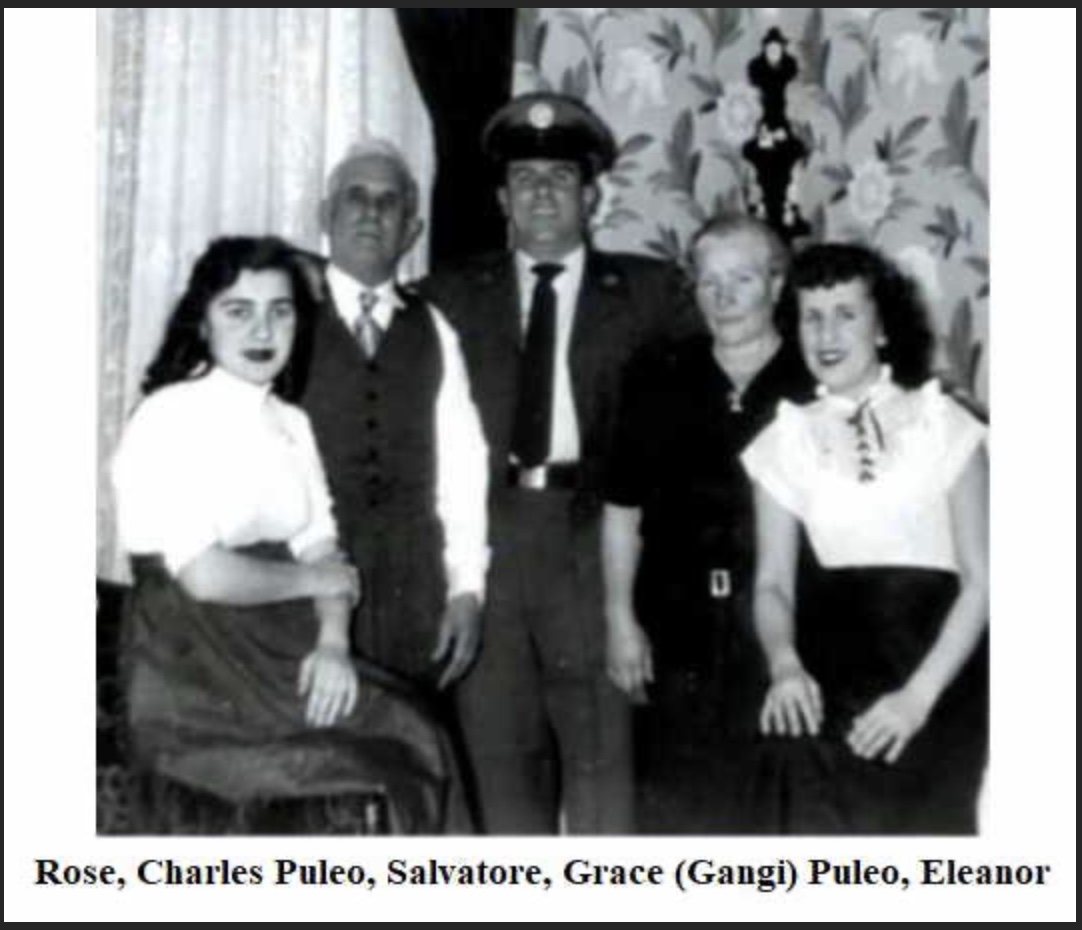
Available to members is this photo of Grace (nee Gangi) Puleo on ancestry.com. Grace, predeceased by her husband, died on May 26, 1961, leaving behind a family who loved her.
The Lynn Police initially arrested Sam for the murder, concluding no one else had a motive to shoot Gaetano. Back at the police station the evening of the murder, Lynn Police interrogated the entire family for over 6 hours, eventually intimidating Grace to admit her father did not commit suicide and tell the truth. Despite her admission of guilt and desire to protect the other family members, the police held Sam on a $500 bond as a material witness. Grace’s mother, Maria, always tried to protect her children from their father, without success. Census records indicate that Maria lived with her son, Sam, until the day she died September 12, 1945, at age 72.

Do you think the penalty meted out to Grace for “parricide” was proper justice? I invite your thoughts and comments.
 old spirituals
Grace wasn’t a threat to the community and had suffered enough from her father’s abuse. I think justice was served appropriately and I’m glad Grace and the rest of the family went on to have happy lives.
LikeLiked by 2 people
I agree. Also, I suspect the newspapers failed to detail the full extent of abuse Grace received from her father.
LikeLiked by 2 people
I agree. Also, I suspect the newspapers failed to detail the full extent of abuse Grace received from her father.
LikeLike
not surprised grace took drastic measures. insults that refer to women and their virtue used to be taken far more seriously before feminism became popular. and the knife throwing probably contributed
LikeLiked by 3 people
That is so true.
LikeLike
I agree the knife throwing was definitely a contributing factor!
LikeLike
I can attest to the fact that not all immigrant fathers were or are like Gaetano. Most immigrant Italian fathers were and are very protective of their daughters, as were and are brothers protective of sisters.
LikeLike
Great post, Nicola!
LikeLike