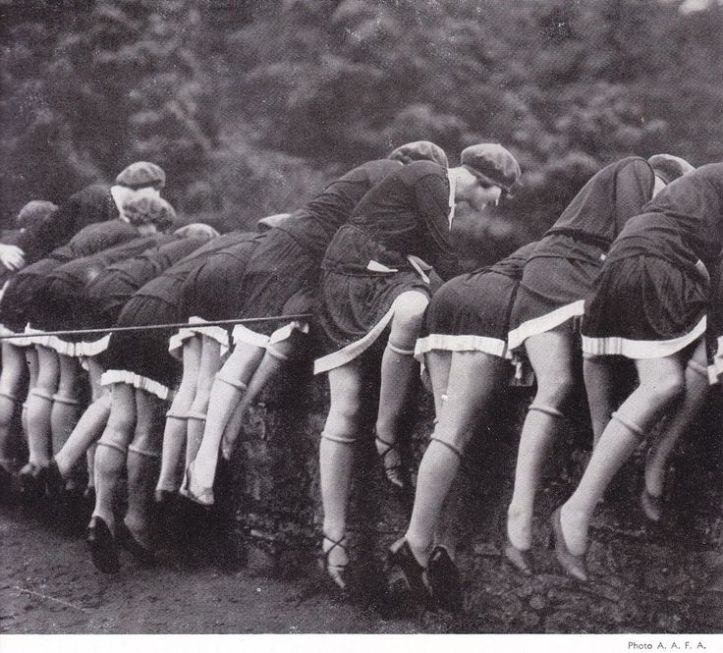
As the flapper dress style became more popular in the 1920s, women’s hemlines rose. With that trend ladies also rolled down stockings to just below the knee. Exposed knees were suddenly deemed to be sultry – a perfect physical attribute to use to draw attention.

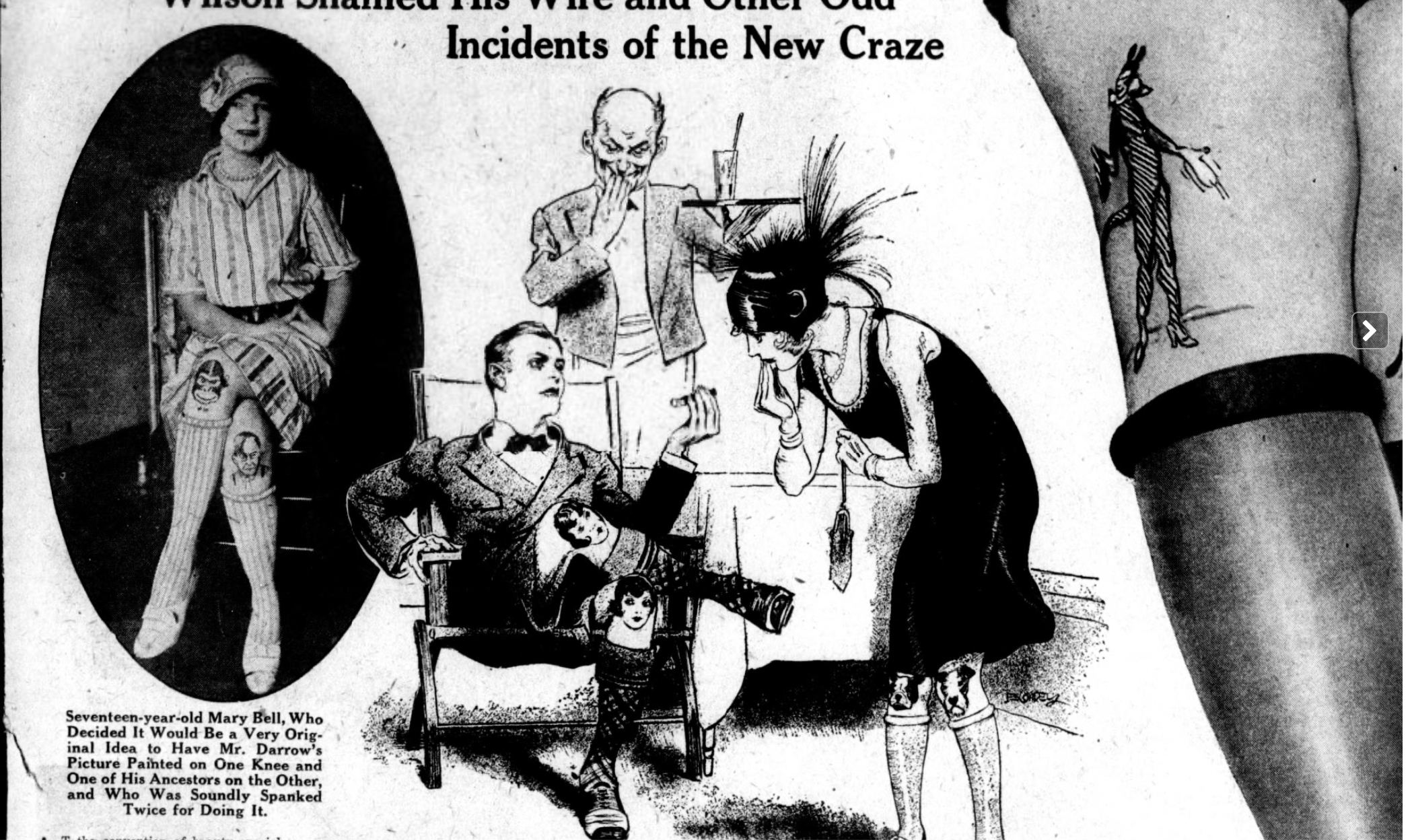
Headlined as Surprising Results of the Painted Knee, a full-page story in the Chicago Tribune’s American Weekly Magazine (reproduced nationally), reported the latest fad in woman’s styling and cosmetology – including some anecdotes that were suspected not to be credible.
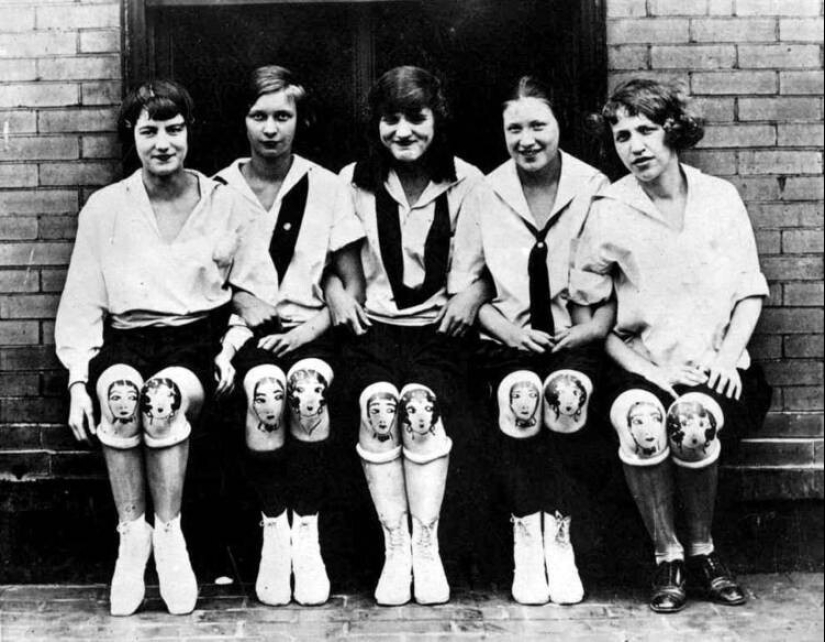
It opened mentioning that at the 1926 national convention of “beauty specialists held in Chicago it was decreed that the very latest and smartest thing for the well-dressed young women to do was to paint dainty little pictures on her knees.” Knees, it pointed out, have come into their own as one of a woman’s natural charms. “Because of rolled stockings and short skirts they, like their fair owners, are emancipated. Their possibilities should not be neglected.”
“It is the very latest thing,” said Miss Ruth Maurer, who presided at the meeting. Miss Maurer was promoting the opportunity suddenly available to women to bring attention to their legs, especially their knees, by using them as a canvas to display art and beauty. Her promotion was published in every newspaper in the County, from The Chicago Tribune to Scandia, Kansas and The Sanger Herald, Sanger, California.
The article told of an incident involving Mrs. Clarice Wilson, wife of Arthur X. Wilson, the owner of a “prosperous coal mine near Carlisle in Pennsylvania.” Arthur’s business, the story claimed, “keeps him pretty busy. . . he never has quite been able to keep up with the latest wrinkles in the smart world of fashion; but there was no reason why he should try to.” The fable went on to say, “His attractive young wife, Clarice, promptly and faithfully went in for every one of them as fast as they came along.”
Arthur Wilson was described as being “a bit old-fashioned, but he is not narrow-minded.” So when Clarice announced several years earlier “that she was going to bob her hair he was depressed. But after she finally did it he made the best of it, as so many other husbands have done.”
A few months prior to the latest fad, Clarice surprised Arthur by adding “two small and particularly ugly dogs” to the household. Arthur hated dogs, particularly small dogs. Clarice insisted on keeping the dogs, but rather than actually doing what he threatened (she had to decide between him or the dogs), he backdown to keep peace, which “he did under protest, at a great sacrifice of self-respect.” To make matters worse, Arthur’s daily duty included walking the two dogs, which he did under protest that caused him to “loathe them with a deep and growing bitterness.” He swallowed the embarrassment believing there was nothing new left Clarice would “take up.” He was wrong.
A few weeks before the national story was published in the papers, Arthur returned home from work, walked past Clarice who was “sitting on the davenport reading a novel,” when he said to her, “Hello, dear!” Looking up from her book, Clarice pleasantly replied, “Hello, dear!” At that very moment he had to close his eyes tight and looked at her again. See, Clarice had “one pretty knee thrown carelessly over the other one. Her stocking were, as usual, rolled. And on the knee was painted a living, speaking likeness of one of the dogs Mr. Wilson so hated.” Arthur hung his hat, looked back and was even more “stupefied to see glaring at him a picture of the other dog” on the other knee after Clarice uncrossed her legs.

Arthur asked, “How are you, darling?,” but made no mention of Clarice’s painted knees, and began to tell her what his day had been at work. As he talked she furtively pulled up her skirt another inch or so to insure Arthur saw the cute little picture on her knees. Arthur paid no attention.
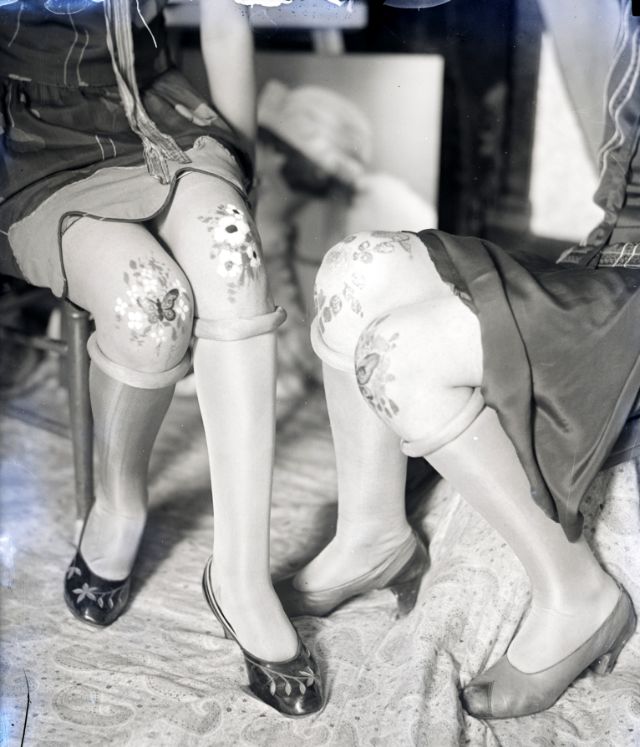
As the story alleges, ” . . . at the country club the next afternoon Mrs. Wilson’s painted knees were a brilliant success. Almost all the other fair young matrons on the veranda also had adopted the new fad. But they had only thought of conventional designs, like butterflies and flowers.” It seems that Clarice had “gone them one better.”
“But just as the enthusiasm was at its height a hush suddenly fell. Someone gave a gasp and pointed to a man who had just come out of the clubhouse and sat down at a table. Mrs. Wilson gave a squeak of dismay. It was her husband.”
“Without glancing at the horrified crowd of ladies . . . he picked up a magazine and started to read. In horror Mrs. Wilson looked at his knees. His knickerbocker were rolled up and his stockings were rolled down. Painted on the bony and powerful but not very pretty knees . . . . were the startling likenesses of two of the popular young women of the town.” By nightfall, Arthur Wilson was the talk of the town and painted knees are no longer the fad among the ladies of the city.
Two other anecdotes about the painted knee craze were included in the story. Suffice it to say both involved teenage women living in Omaha, NE, and Madison, GA, both living under their parents’ roof. One was supposedly spanked for her painted knees done for a dance she attended and the other, having painted the faces of two different interested boys, tried to use the painted knees to communicate her preference to accompany her to a dance. Well, the communication failed and she ended up with the wrong boy.
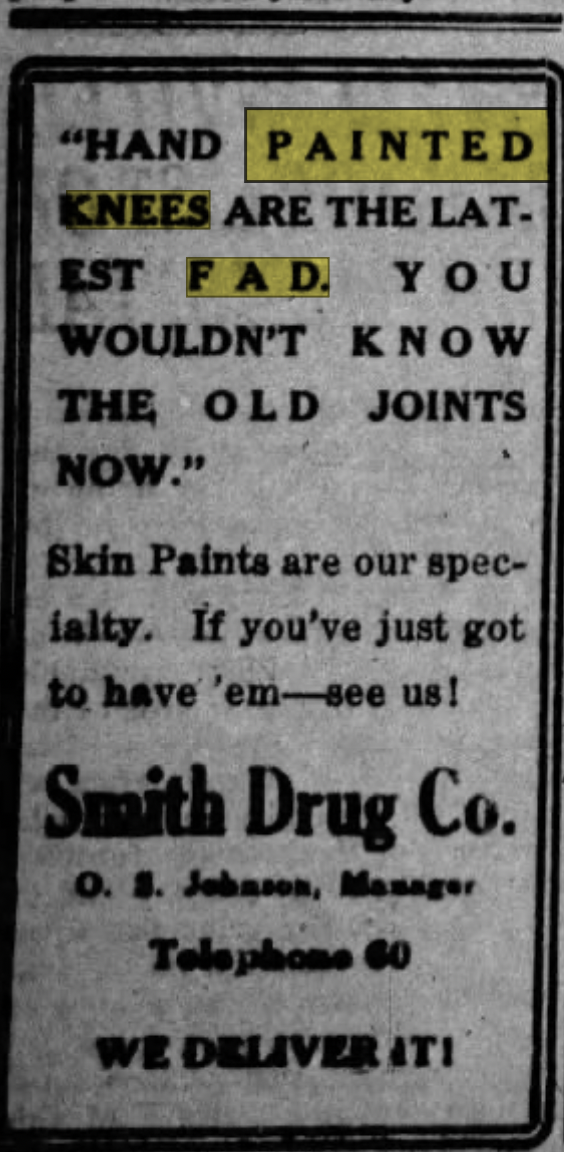
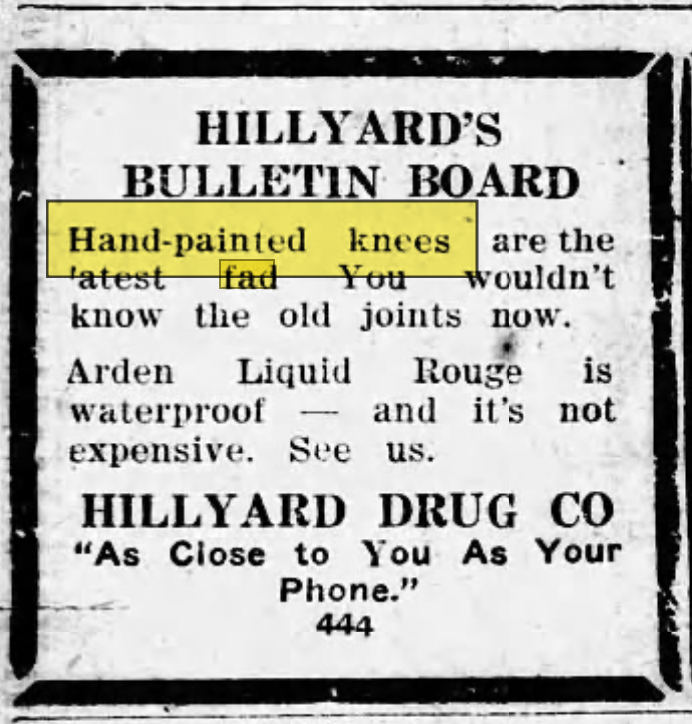
Painted knees were so popular it motivated the sellers of women’s cosmetics to advertise specifically to attract women who wanted to paint their knees. Some apothecaries and drug stores completely sold-out the cosmetics used to paint knees. Some beauticians hired artists to work in their salon to paint the scene a woman wanted on her knees.
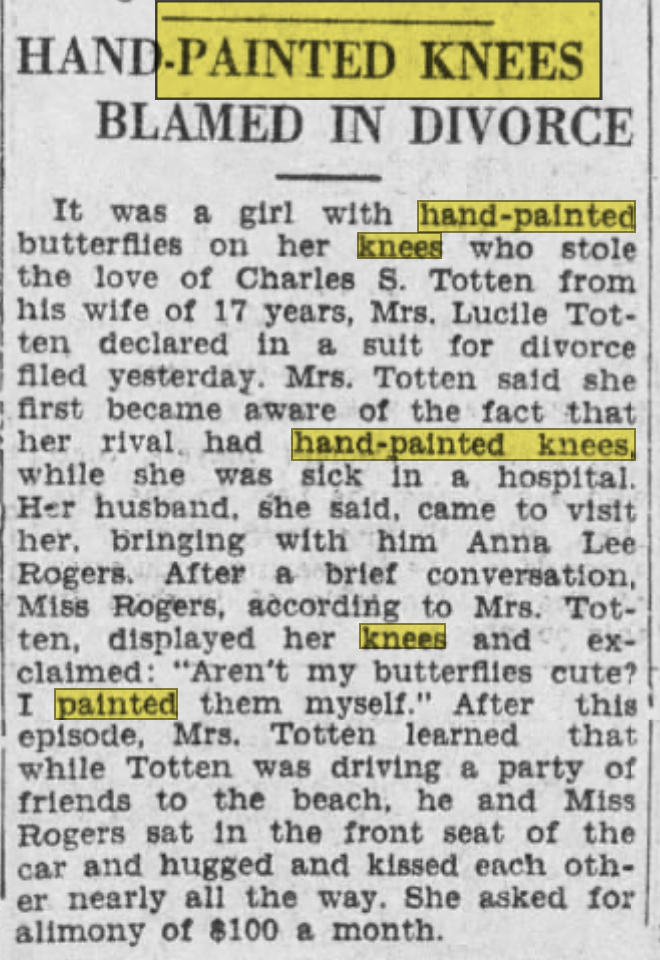
Painted knees also caused marital dissolution.
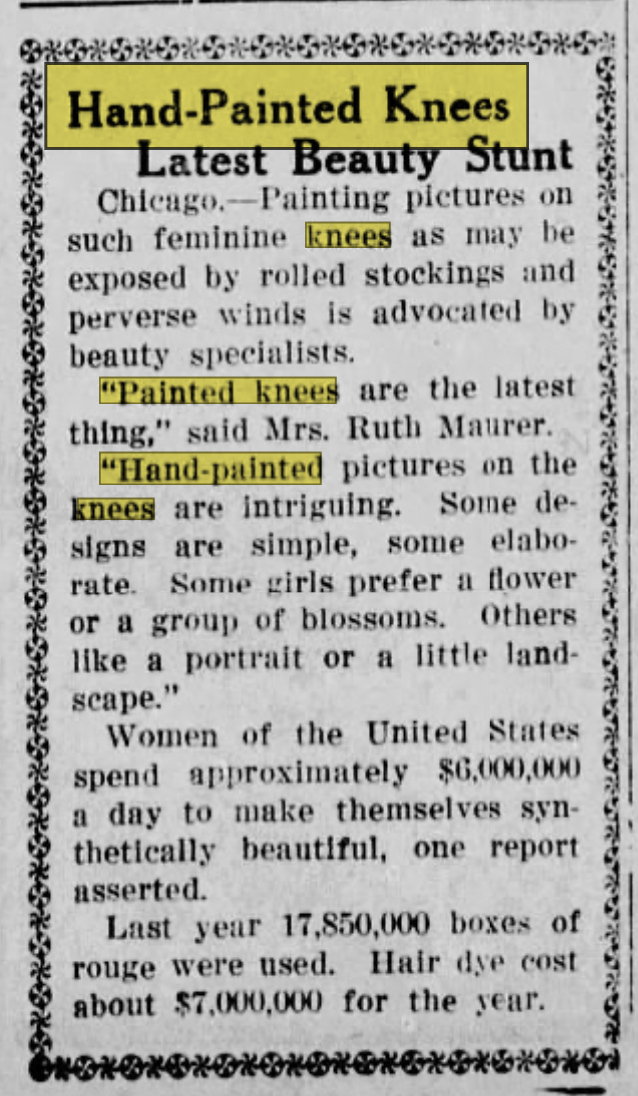
In the end, the one entity that benefited from the painted knees craze was the cosmetic industry, and perhaps some artist.
As early as 1910 woman painted their legs, at first it was on their stockings, evolving over the years to the bare leg. It again gained some popularity in the 1940s and in the 1960a, with a more modern look such as a long lashed eye. Today, painted knees are ancient history. Like the horse-and-buggy, the idea has been replaced with a permanent adornment – the tattoo – everywhere and anywhere.


So glad this is out of vogue!
LikeLiked by 1 person
me too!
LikeLike
that article—why bring that girl with hand painted knees to see his wife in the hospital? the poor woman had enough to bear
LikeLiked by 1 person
Molte grazie for the feedback.
The mindset was so different in the late 19th and early 20th centuries. Perhaps even an air of innocence . . . of naïveté. There is an element of entertainment in reading stories from those eras . . . though some may cause you to feel downhearted.
LikeLiked by 1 person