I’ve got something a little different today – for me, anyway. What follows is an article printed in the Saint Paul Globe on March 23, 1902, page 18, buried in the back of the Sunday edition. I love this article, and it has nothing to do with true crime at all (shocking, I know). It’s about one night at St. Paul’s food trucks, or, as they were called in 1902, lunch wagons. They weren’t exactly new; Andrew P. Low had been running his wagons on St. Paul’s streets for twelve years. But they were still interesting enough that the Saint Paul Globe devoted a full feature to how they operated and who ate there. Perhaps it was because most St. Paulites were long asleep when the lunch wagons were at their busiest, and the article offered a naughty peek at the night owls who roamed and worked the downtown streets?
We’re accustomed to our drive-throughs now, but in 1902 it was still a curiosity (and very often a nuisance – people actually complained about the odors), and that’s part of why this article is so much fun.
A note about the history of lunch wagons: they definitely weren’t created in Minnesota. In 1872, Walter Scott started selling sandwiches and coffee from a horse-drawn freight wagon parked outside the offices of the Providence Journal in Providence, Rhode Island. Scott wanted to feed the hungry night workers in the area long after restaurants had closed. Throughout the 1880s and ’90s, ambitious entrepreneurs in Massachusetts began assembling lunch wagons and shipping them across the United States. The lunch wagon was the forerunner not only of the modern food truck but of the American diner, since many of these wagons had interior seating.
And as far as the prices go, a nickel for an egg sandwich in 1902 is about $2 in today’s money – still a great value.
I’ve read this article more times than I can count. I actually have it bookmarked on my browser. It’s just something that brings me a little bit of comfort, this tiny, happy, delicious snapshot in time. And the descriptions of the sandwiches always make me hungry too, even without the now mandatory slice of cheese!
A few period terms:
- Gamins: street kids/urchins
- Shines: bootblacks, the boys who shined shoes
- Rounders: habitual late-night carousers
- Roisterers: noisy, boisterous partiers out drinking and carousing
- Hack drivers: drivers of horse-drawn cabs
- “Ham and”: a ham-and-egg sandwich
- “Con”: the streetcar conductor
- Raison d’être: French for “reason for being”
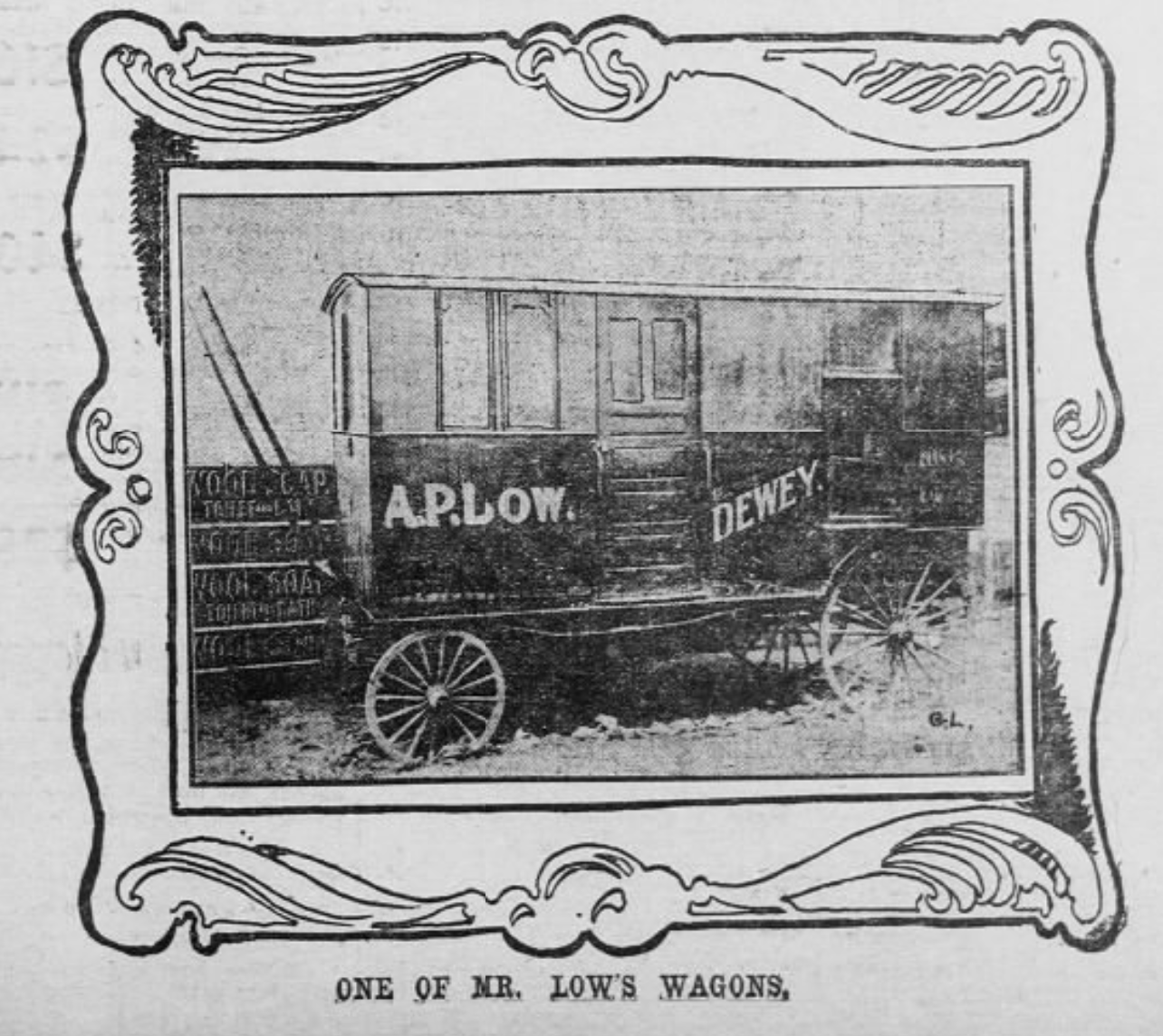
Lunch Wagons That Cater to Street Trade
All Classes of People Patronize Them in St. Paul.
Not the least honored of the names that have gone down to posterity are those of men who have risen to fame and power through their ability to create epicurean dishes that tickled the palate and banished all care and worry. More than once kings have made cooks their favorite and the chef in his kitchen has a monarchy more absolute than that of the most despotic sovereign of the Orient. The power of the cook is made evident every night in St. Paul on the different down-town corners of the city, where little houses are perched precariously upon four wheels, out of which there float appetizing odors.
These are merely lunch wagons, in which a white-coated man stands over a tiny range dexterously tossing “ham and” sandwiches into the air, while the customer waits on the sidewalk enthralled and hungry. From 7 o’clock in the evening until the new day has a good start there is a constant stream of these wagons and from them they go munching one of the many kinds of sandwiches that have been developed until they top the highest pinnacle of culinary art. Rich and poor, fashion and rags meet at the lunch wagon on the common basis of five cents for an egg sandwich, and the man in the dress suit and the bootblack nondescript eat their purchase to the last onion with the same satisfaction and contentment.
The raison d’etre of the lunch wagon as given by the genius who presides within is that man is in a hurry all the time, and is hungry the greater part of the time, and from this has risen another subdivision, the itinerant restaurant, which consists of two large cans that are carried on the arms. These are the “hot tamale” and “chicken sandwich” men, whose lusty voices continually rise above the roar of the street traffic and the clang of the car.
There are an even dozen of the lunch wagons in St. Paul and each one has its clientele of patrons who regularly come during the hours of the night for their favorite sandwich. They sell nothing but sandwiches, but there are enough of these sold in St. Paul to demonstrate that pie is no longer the national edible. There may be many devotees that worship at the shrine of the apple and custard, but the new cult of sandwich has had an unparalleled growth, as can be seen by watching the pilgrims that nightly adjourn to their Mecca, the lunch wagon.
Are Dexterous Jugglers.
The sandwich has some spectacular features that the pie has not and this perhaps is one reason for the reformation. The speed with which it is compounded is one of the delights of its followers, who nightly watch it thrown into the air and cleverly caught on the skillet. A lunch car man would scorn to turn an egg over the way mother does with a ladle. When he considers that the egg is properly finished on one side, he seizes the skillet, and with the movement of a lacrosse player, jerks the egg high in the air, where it turns around a couple of times invariably coming down right side up.
To the weary wayfarer of the streets this is indeed a pleasing sight, second only to the sensation of the actual consumption. The sandwiches are always generous in size, and nothing but the best is used in their construction. Frills in the shape of small onions or pickles are always added, and these with the piping hot delicacy, make a tempting lunch.
About 7 o’clock every night each lunch wagon is surrounded by a crowd of newsboys and bootblacks, who long ago learned that their nickel or dime cannot be expended to any better purpose than in purchase of a sandwich. The tastes of the gamins are simple, rising to no higher flights than a ham and egg sandwich, which can be purchased for 10 cents. Others may go in for hamburger sandwiches, and even some for oyster sandwiches, but these are considered by the “shines” to be the prerogatives of the dilettanti.
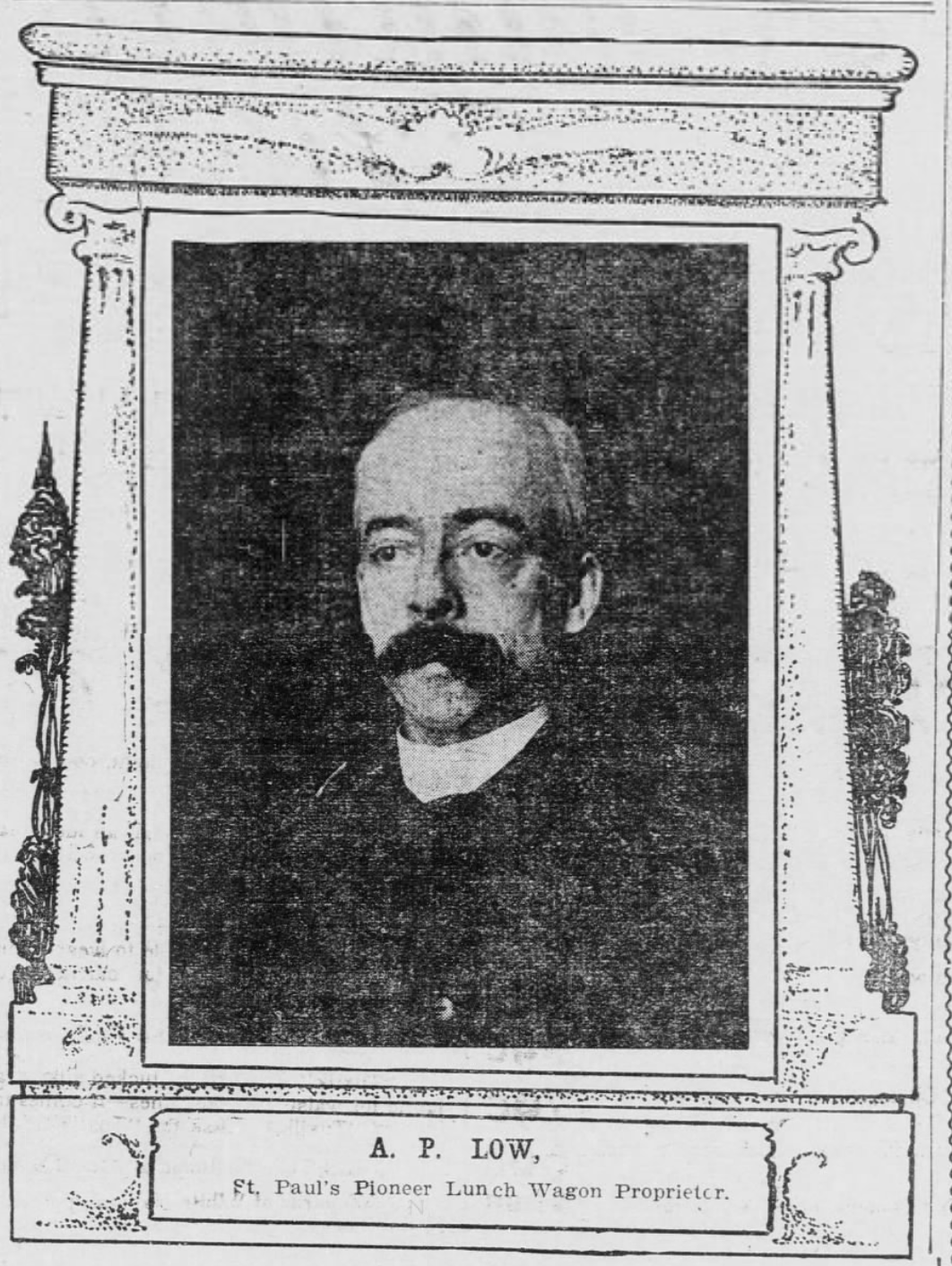
The dean of the profession in St. Paul is Andrew P. Low, who for the past twelve years has had his wagons nightly on the street, handing out morsels to the hungry passersby. “Andrew” is the favorite of the newsboys, and they congregate around one of his three wagons every night, clamoring for their supper with their professional voices. Andrew knows them all by name, and each one gets a little larger piece of ham or an extra onion thrown in, with a cheery inquiry as to how many papers they sold, or how badly they were “stuck” by the day’s transactions on the street. During the years he has been attending to the wants of the hurrying public, Mr. Low has seen newsboys grow up and become citizens of worth in the community, while their places were immediately filled by new recruits with the commercial instinct.
As the theater hour draws near the class of trade that patronizes the lunch wagon changes. The newsboys have all slipped away to wherever they sleep, and the theater-goer begins to appear with his hunger for a sandwich. Like everything else, the lunch wagon has its patrons who never go anywhere else, and the man inside, the minute he sees an old acquaintance, knows immediately what kind of a sandwich is wanted, and the peculiar style of cooking that best conforms with the desires of the customer’s palate.
Ready for Theater Crowd.
When the curtain rises in the theater, there is a lull for a short time, during which the lunch wagon man begins cooking his chicken for the after theater patrons. There is no place on earth where a half chicken can be purchased for 10 cents that tastes so good as in a lunch wagon, and the romantic idea of devouring fowl on the street corner utterly oblivious to the passing throng adds an unexplainable zest to the appetite. When the crowds surge out of the opera houses, there is a line drawn up in front of the narrow window of the lunch wagon, like at a country postoffice. This is where the swiftness and the dexterity of the chef comes into play. He listens to the clamoring of the line outside for chicken sandwiches, ham and egg turned over, oyster sandwiches, without deigning to look upon them. From the range there arises a medley of culinary odors and the air is filled with somersaulting sandwiches of every description, while the skillets sizzle and sputter with every movement. As quickly as a circus cashier making change, the wares are doled out, the man requiring a “ham and” gets it, hands over his money and backs hurriedly out of line, to let the next man get up. His order was taken without his knowing it, and about the time he gets ready to make his wants known, he is handed what he desires. In this way the line grows shorter as each one is served, until finally the last one departs, biting out half moons. The lunch wagon stock has been sadly depleted by this raid, but the chef knew that it would be, so he settles down for the late night work.
Night Owls Come Last.
About midnight the “night owls” begin to flutter around for the bite. These are all old friends of the lunch wagon man, and they discuss every topic under the sun, the choice being left entirely to the customer. Hackdrivers from nearby stands slide up, glad of an opportunity of getting inside a cozy place, for the St. Paul lunch wagons have accommodation for those who wish to eat inside. There is a stove and two short benches at the disposal of those who wish to use them. Once more the various skillets are all occupied, while the pepper and salt and mustard are rushed at intervals.
This class of trade lasts into the early hours of the morning. Most of it is regular, but there is enough variety in the shape of belated roisterers to keep away all thoughts of monotony. The callow youth who has imbibed more than his per capita share of beer, comes careening up for a sandwich of sobering properties and the ancient “rounders” knows the medicinal value of this diet from long years of experience.
All the sandwiches sold from the lunch wagons are not eaten there, as there is considerable “wrapping” trade. This is mostly transacted through the medium of the fleet messenger boy. No. 142 slouches into the wagon with an order for “one ham and one egg, turned over, three chickens and an oyster, with lots of onions and mustard.” This order is to be taken to some nearby room where there is a hungry party. The chef once more gets busy and in less time than it takes the messenger boy to roll a cigarette he has the order ready, neatly wrapped up in a paper, with a pinch of pepper and salt deftly stored away for the pleasure of the eaters.
When asked what brought the lunch wagons into existence, Mr. Low paused in bisecting a chicken and pondered:
“Well, I suppose it was the necessity for some sort of service where a man could get a good sandwich in a short time for a fair price. In the first place, the restaurants are not catering to a 5 and 10 cent trade, and then again they cannot do the work as quickly as we can. A man walks into a restaurant, takes off his hat and coat, hangs them up and sits down to a table. The waiter, nine times out of ten, is attending to the wants of some other person, and it is a minute before he is free. He then goes for a knife, fork, napkin and a glass of water before he gets the order. He may be stopped a couple of times before he gets to the kitchen, and then there are possibilities for delay after the cook knows what is wanted. All this is too much trouble for the profit off a 5-cent purchase and it takes considerable time. With us the opposite is the case. We are on the street, with everything we sell at our finger ends, and we can give a man a sandwich before he could be comfortably seated in a restaurant.”
A street car conductor stuck his face in the window asking for an egg sandwich, and the chef ceased all talking to attend to his customer’s wants. In less than a minute the “con” was tearing down the street to catch his last car, with an egg sandwich in his hand and mouth.
Final Note: The happy feelings didn’t last long. On August 7, 1902, less than five months after this article ran, the Minneapolis Tribune reported that St. Paul’s city council had adopted an ordinance making it unlawful to do business from lunch wagons. No more, the paper opined, would the smell of fried onions and hamburger steak greet the midnight pedestrian. The paper didn’t spell out the council’s reasoning, but one might deduce that the lingering odor of fried onions had something to do with it.
Source: “Lunch Wagons That Cater to Street Trade: All Classes of People Patronize Them in St. Paul.” The Saint Paul Globe (St. Paul, Minnesota), Sunday, March 23, 1902, p. 18. Transcribed from the original print; spelling and punctuation follow the 1902 text.
Final note source: “Lunch Wagons Must Go.” Minneapolis Tribune (now the Star Tribune), Thursday, August 7, 1902, p. 7.
Additional sources for the introduction:
- The History of Diner Cars & Lunch Wagons, Art in Ruins
- How the Lunch Wagon Became the Diner, Atlas Obscura

