The SOS signal turned 117 years old this month!
On October 3, 1906, the SOS signal was established as an International Distress Signal by the British Marconi Society and the German Telefunk organization. It was formally introduced on July 1, 1908.
The SOS signal was created for maritime use, to begin transmissions requesting aid when loss of life or catastrophic loss of property was imminent. Since its introduction, the SOS signal has been used successfully in all kinds of situations—lost hikers and stranded drivers, for instance.
The three letters in Morse code are signified by three dots, three dashes, then three dots (· · · – – – · · ·). The accompanying sound is “di di di, dah dah dah, di di di,” which is easily recognizable.
I thought the SOS signal was much older than it is. But it only appeared 62 years after the first successful wireless transmission.
American inventors Samuel Morse and Alfred Vail invented the electromagnetic telegraph, a device that could send signals between remote stations via Morse code, a language they invented consisting of dots and dashes that corresponds to the Latin alphabet and numbers 0 through 9. This enabled people to send instant messages across long distances. Vail and Morse tested their electromagnetic telegraph on May 24, 1844. Morse, who was in Washington, D.C., used the code to type the message “What Hath God Wrought?” and sent it Baltimore, where Alfred Vail received it and returned the same message back to Morse.

Morse (L) and Vail (R)
“What hath God wrought?” gives you the impression Morse and Vail understood that communicating instantly across long distances had tremendous implications for humanity—-yet they were afraid of what the consequences of such an ability would be.
I find it interesting that they attribute the ability to send messages this way to God. They were the inventors, weren’t they? If today’s text messages are the fruit of Morse and Vail’s invention, why can’t I chalk up all of the questionable decisions I’ve made via text message to the will of God?

What hath God wrought?
Many people think SOS stands for Save Our Souls, but that isn’t the case. No meaning was attached to the letters. The three dots, three dashes, and three dots was just an easy code and one that was difficult to misinterpret.
Fun fact: Save Our Souls is a backronym, or a meaning assigned to an acronym after it is in use. The USA Patriot Act of 2001 is another backronym. Uniting and Strengthening America by Providing Appropriate Tools Required to Intercept and Obstruct Terrorism Act.
The first time the ‘SOS’ signal was used in an emergency was on June 10, 1909, when the RMS Slavonia was wrecked off the Azores, 10.5 nautical miles off course and traveling at an excessive speed for the prevailing conditions. Two nearby ships picked up her signals and hurried to help. Happily, everyone aboard was rescued.
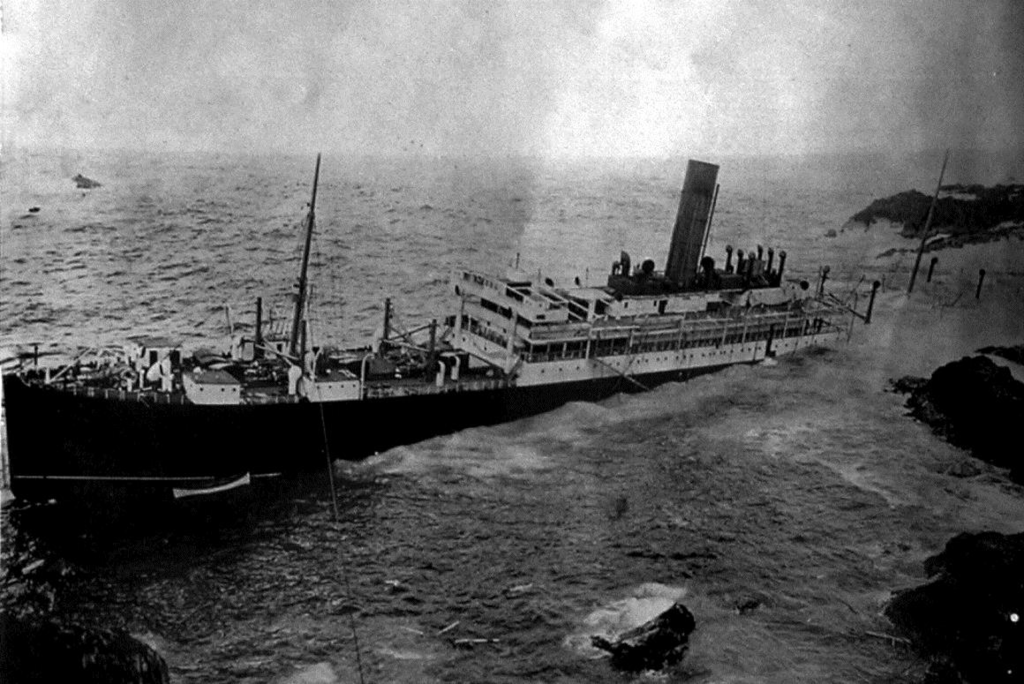
The Slavonia was photographed as she was sinking
Before the SOS signal, there was the CQD signal. On January 7, 1904, CQD was adopted by the Marconi Company as a radio signal that could be used by ships in distress to request aid.
CQD originated by combining CQ, which alerted stations that a message was incoming, with D for “distress.” Like SOS, CQD was destined to have an associated backronym, which was “Come Quick Danger.”
Three years after the Slavonia first used the SOS signal, the Titanic used the SOS and CQD signals after it struck an iceberg on April 15, 1912.
The SOS code is still in use and has saved countless lives. Last year, the U.S. Coast Guard rescued two men who were hiking in Oregon when a heavy snow came down and stranded them. The men were reported missing and a search team was deployed in a helicopter. The searchers spotted the letters SOS in the snow and rescued the men, who were unharmed.
 old spirituals