There’s a sense that all of life’s wonders are accessible via your iPhone. Of course that’s not true. Many things are only accessible by an experience, or through deep meditation, for instance.
Advertisers and creators are always looking for ways to capture and sustain our attention. Businesses buy our data, profile us, and create content designed with someone just like you in mind. Companies vie for the most user friendly site, the brightest colors, and the most recognizable logo. The images on their sites are showcased in high resolution and bright light.
There’s so much competition, so many options available, our attention span is now comparable to a goldfish. So advertisers saturate the environment. The idea is that if their name, their brand, and their logo is everywhere, and enough people are talking about it, eventually a lot of followers will follow.
But what if the overexposure is making people lose interest? What if the ads and recommendations and instant access are making things too common, too mundane, too easy?
I’m not really looking for less convenience. But I do want more mystery and more privacy. When a question is posed, it should engage your imagination rather than be something you can quickly answer with a Google search or ChatGPT. Humans need something beyond the factual and the commercial. Perhaps people long for something mysterious or mystical or secret.
People who create historical databases definitely don’t subscribe to the idea of making everything easy to access. Most of them probably write tax law in their spare time. Records are inconsistent and each county in each state has a different criteria for what records are kept, how they’re named, where they’re stored, the process to see them, etc. The text of old newspapers isn’t searchable the way you might search your local paper’s website to find a story. The archives show you a picture of one copy of the newspaper—the same view you could pull up on a microfiche. Copies are sometimes dark or smeared or damaged. There are no keywords or hashtags. The newspapers do have a search function called Optical Character Recognition (OCR) to find terms but if the copy is damaged, OCR won’t be able to find it. The most common problem is being unable to locate the information you’re looking for. Maybe it was never documented, or the records were lost, or no one ever knew what happened. Or maybe you haven’t looked in the right place!
A little mystery goes a long way. I don’t like historical research because of the usability or because everyone is talking about something that happened in 1904. It’s the mystery of the story, that it’s been forgotten, that there’s often a forbidden feeling around it, and the possibility that I may rediscover some lost, fascinating thing always draws me back. The shadowy and indistinct will always have a greater allure than the most perfect artificial creation.
With that, I give you today’s picture from 1912. This is Glass and Shadows by Baron Adolph de Meyer.
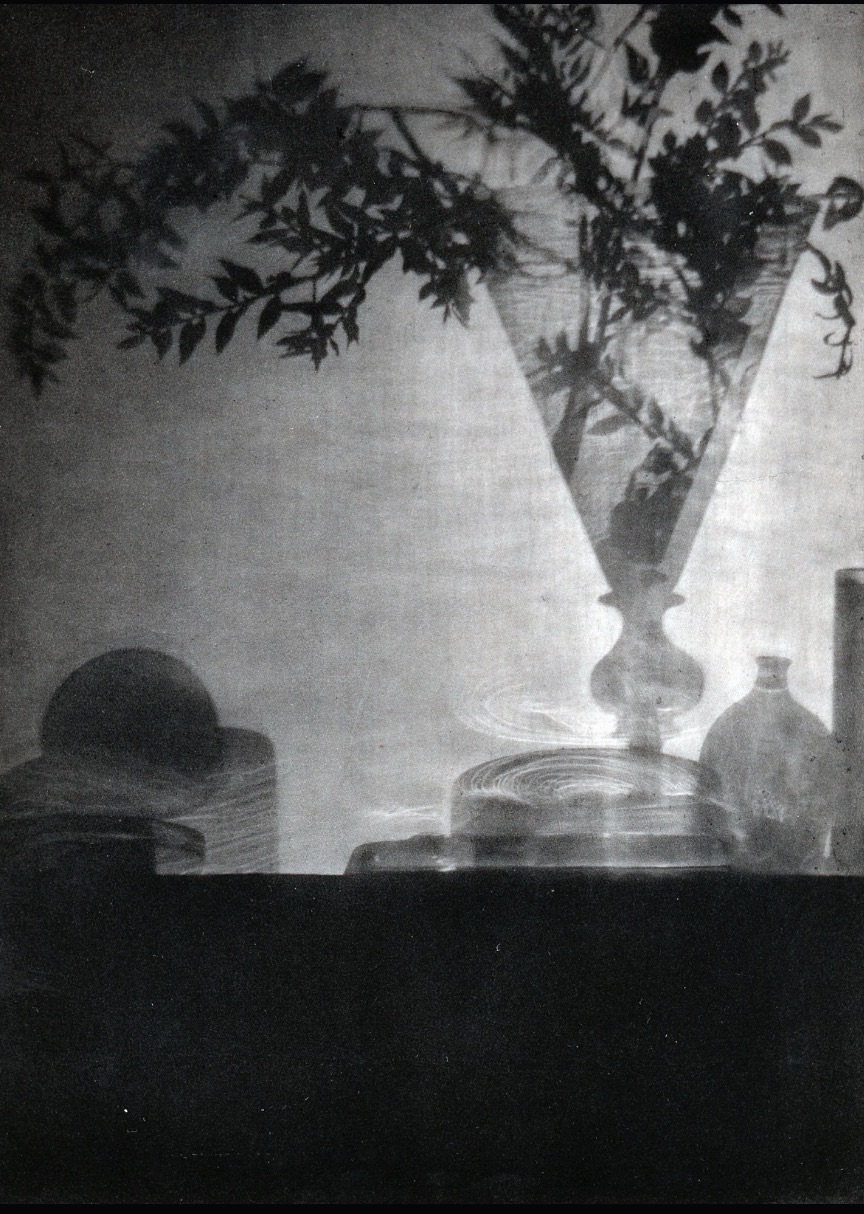
Archive.org
 old spirituals