The first crack in the case appeared in July of 1900. A prominent woman in Berwick society named Harriet Jones was walking home from church and fell in step with a neighbor. As they walked, Mrs. Jones told her friend the details of a recent scandal. The woman didn’t betray any surprise but she was struck by Mrs. Jones’ statements because they were identical to the accusations made in an anonymous letter that a prominent businessman had received a few days earlier. The neighbor bid Mrs. Jones goodbye but she was suspicious enough to repeat the conversation to her husband.

One of the beautiful churches in Berwick
“The postal authorities were then notified of the suspicion attaching to Mrs. Jones,” the Honolulu Republican reported, “and to obtain evidence as to whether or not she was the guilty person they began by selling her marked postage stamps, and specimen of her handwriting was obtained by sending her registered letters, for which she was obliged to sign receipts.”
It was a clever sting operation. Cruel letters continued to appear, still unsigned but no longer anonymous. Unbeknownst to Harriet Jones, the marked postage stamps betrayed her identity. On January 9, 1901, Postal Inspector Duryea and the local postmaster Bowman confronted Harriet Jones at her home and accused her of authoring the poison pen letters.
She was an unlikely suspect. Born Harriet Jamison at Lime Ridge, a small town just a few miles from Berwick, she came from a well-to-do family. She and all her siblings had married well. Harriet’s husband, John Jones, was a superintendent in the Pattern Department of the American Car and Foundry Company. The Joneses were prominent members of society and the papers had this to say of her appearance: “She is a handsome woman of 40 with fine black eyes and hair but she is ignorant and unschooled.”
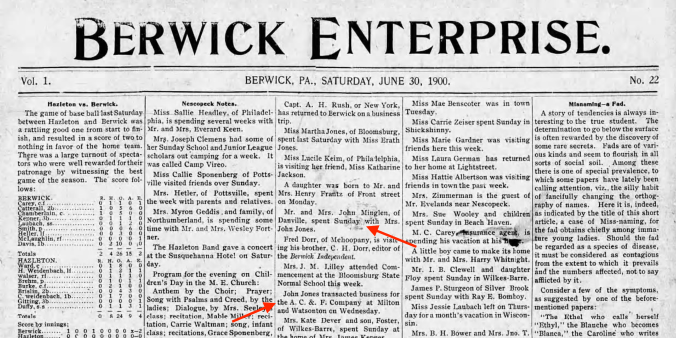
The Joneses were regularly featured in the society columns
Mrs. Jones hotly denied the accusation and defied the men to prove their charges. She even threatened to file a lawsuit against them for casting aspersions on her character before ordering them to leave.
The authorities left, but they were not at all worried that they had falsely accused an innocent woman. They knew Harriet had written the letters. “Curiously enough she made no attempt to disguise her handwriting,” the newspapers revealed. “It was very poor and there were many inaccuracies in the spelling. The blunders were always the same.”

As word leaked out that Harriet Jones was the author of the poison pen letters, some cases became particularly egregious. Ray Jamison, the bookkeeper for the Berwick Store company, had received a letter that contained terrible accusations about his coworker’s daughter. Ray Jamison was Mrs. Jones’ own nephew.
Another woman remembered how upset she had been after receiving a particularly vicious anonymous letter one morning. Later that afternoon, she had happened to see her friend Harriet who was “pleasantness itself.” She was at a loss to understand it.
In what seems to be the worst case, a young lady received an anonymous letter the night before her wedding in the spring of 1900. It made such “grave accusations” against her fiancé, W. G. Fowler that early the next morning, the bride’s alarmed parents hired a detective to investigate the man who would, within hours, become their son-in-law. Between this and the normal confusion that was to be expected on the morning of a wedding, Mrs. Jones herself stopped by the family home to bring a gift to the bride. Observing the girl’s shaking hands and red-rimmed eyes, Mrs. Jones laughed and asked, “Did Mr. Fowler go back on you?” Mr. Fowler was later exonerated of all charges made against him in the letter.
There were a few people who refused to condemn Mrs. Jones, though they did not seem to harbor any idea that she was innocent. Mrs. Ida Fowler, who lived across the street from the Joneses, said, “I received a letter intended to estrange me from a friend, but the Jones family and myself are neighbors, so I have no fault to find.”
“The most terrible thing was that all the letters were so obscene,” another woman lamented. “I’ve heard it said that no man would have written such terrible letters, but I will not permit anyone to say such a thing in the presence of a woman. I believe in being loyal to one’s own sex.”
 old spirituals