One of our favorite readers, Jax Saggezza, brought up the legendary Robert Johnson in the comments the other day. He inspired me to write a post about this mysterious, fascinating man. I’m including a few of Johnson’s songs, including my personal favorite, Love in Vain Blues, if you want to listen to his music while you read!
Robert Johnson was born on May 8, 1911. Not much is known about Robert Johnson’s life. He’s truly a figure shrouded in mystery.
What we do know is that he had an unstable upbringing and bounced from home to home. I’ve read his stepfather was abusive to him. He married a girl named Virginia who later died in childbirth.
By the time he was 19, Robert was into music and his guitar-playing. One night in Robinsonville, Mississippi in 1930, he was at a joint where Son House was playing with Willie Brown (Son House isn’t nearly as popular as he ought to be. His song Death Letter is fantastic.) Son House was on a break and Robert saw his chance, picked up a guitar and started to play. The crowd didn’t like it—they didn’t like it so much that the owner told Johnson to leave.

According to the legend, Robert Johnson just disappeared after that. No one saw him. No one heard from him. He was gone at least a year. Some people say it was longer—about three years. Fast forward to another delta night, this time at a different club in Banks, Mississippi. It was another Son House gig, with Willie Brown. And who should walk in but Robert Johnson with his guitar on his back.
Most people there that night didn’t know who Johnson was. Son House and Brown remembered Robert’s humiliation in being thrown out of the club when he tried to play and they laughed when they saw him. You wonder what that did to Robert Johnson. I don’t know how many people have heroes, but I bet most people have never met the people they idolize. But imagine if your heroes laughed at you. You’ve probably heard the story about how astronauts Neil Armstrong and Eugene Cernan criticized Elon Musk—who idolized them—and he cried. Well, Robert Johnson was humiliated in front of his heroes and then they laughed at him.
But that didn’t last long. Johnson pulled out his guitar, which he had somehow fitted with an extra seventh string.
And then he played.
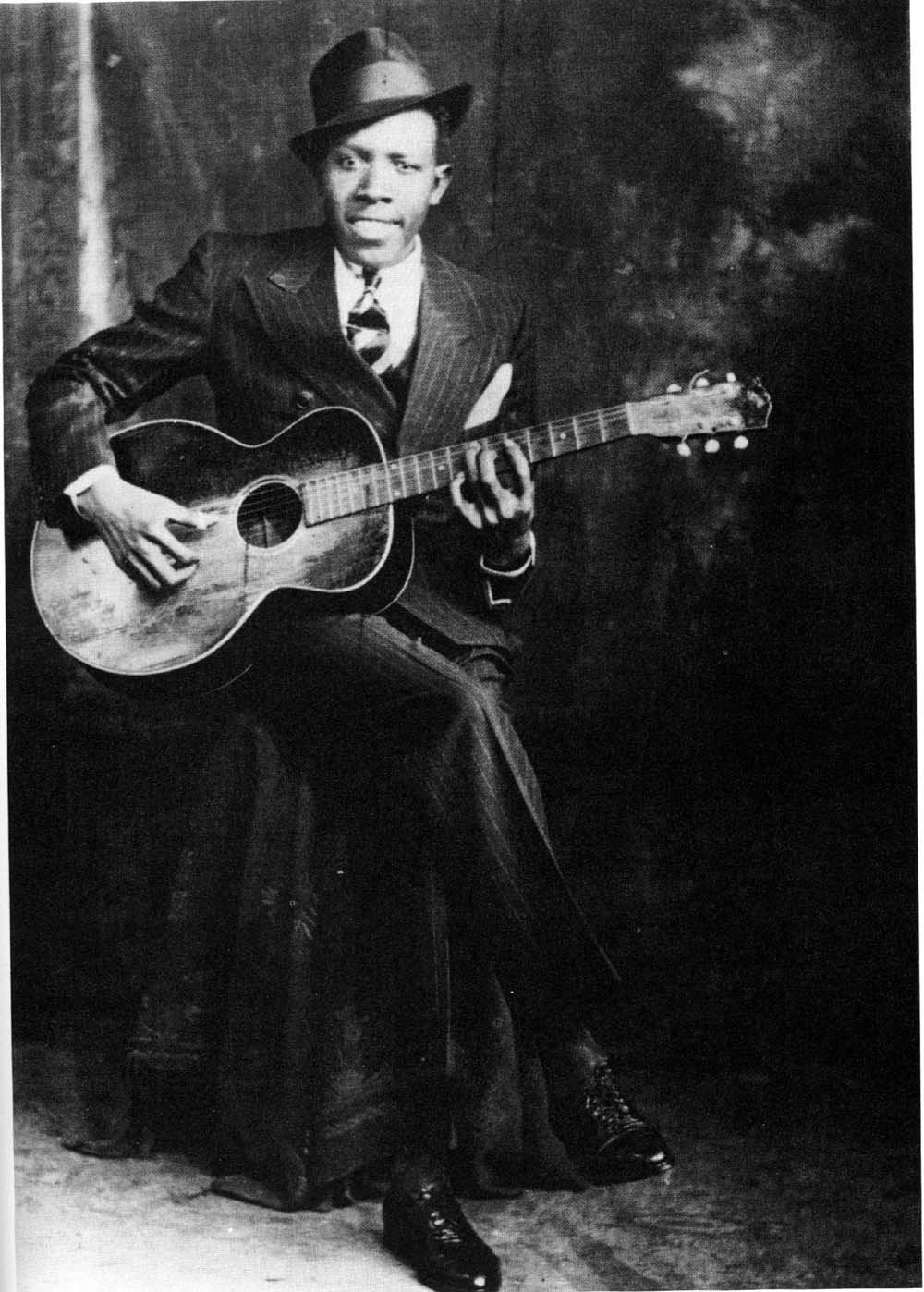
Somehow, in a short time, Johnson had an almost supernatural level of skill and a completely new technique nobody ever saw before. When he played, it sounded like several people were playing at the same time. Nobody has ever been able to play like Johnson.
So a legend grew up around him. People said Johnson had gone to the crossroads in Clarksdale, Mississippi where Highway 61 and Highway 49 meet. and sold his soul to the Devil for musical genius. Robert Johnson might have been the first person to tell that story about how he got his talent. If he didn’t come up with it, he leaned into it with songs like Me and the Devil and Crossroads Blues and his lyrics painted a picture:
I went to the crossroad, fell down on my knees
Asked the Lord above, “Have mercy, now, save poor Bob if you please”
Johnson recorded just 29 songs and there are only two known pictures of him, which greatly adds to his mystique. There are one or two other pictures, but their authenticity is disputed. Only two are for sure. Do you notice, in this day of a million selfies, that pictures are the opposite of mystique? People want to be mysterious and fascinating but they make themselves too common.
Some people think Johnson’s musical genius was at least partly from a medical condition. If you look at the full-length shot of him and focus on his fingers, you’ll see they’re unusually long. That certainly would give you a big advantage in playing musical instruments! No one knows for sure but the very long fingers suggest Johnson might have suffered from a genetic disorder called Marfan syndrome. Composers and pianists Sergei Rachmaninoff and Niccolò Paganini are also thought to have had Marfan syndrome.
Robert Johnson died at age 27 on August 16, 1938. Alan Lomax, the great music archivist, tracked down Johnson’s mother and she told him: “Some wicked girl or her boyfriend had give him poison and wasn’t no doctor in the world could save him, so they say.”
This story became the basis of the official story. Johnson was playing at a dance in Greenwood, Mississippi. The story goes that he was dating a married woman whose husband owned the bar where the dance was taking place. The jealous bartender made a drink for Johnson and his wife took it to him, not dreaming it was laced with strychnine. That’s the official story. But this, like all things Robert Johnson, is uncertain.
At the time of his death, Johnson was virtually unknown. It wasn’t until 23 years after his death that he became a major figure in music history, coinciding with the release of a collection of his recordings in King of the Delta Blues in 1961.
 old spirituals