The last major aftershock of the great April 18, 1906 earthquake was at 8:14 a.m. Soon afterwards, people began to emerge, assess the damage, and help their neighbors.
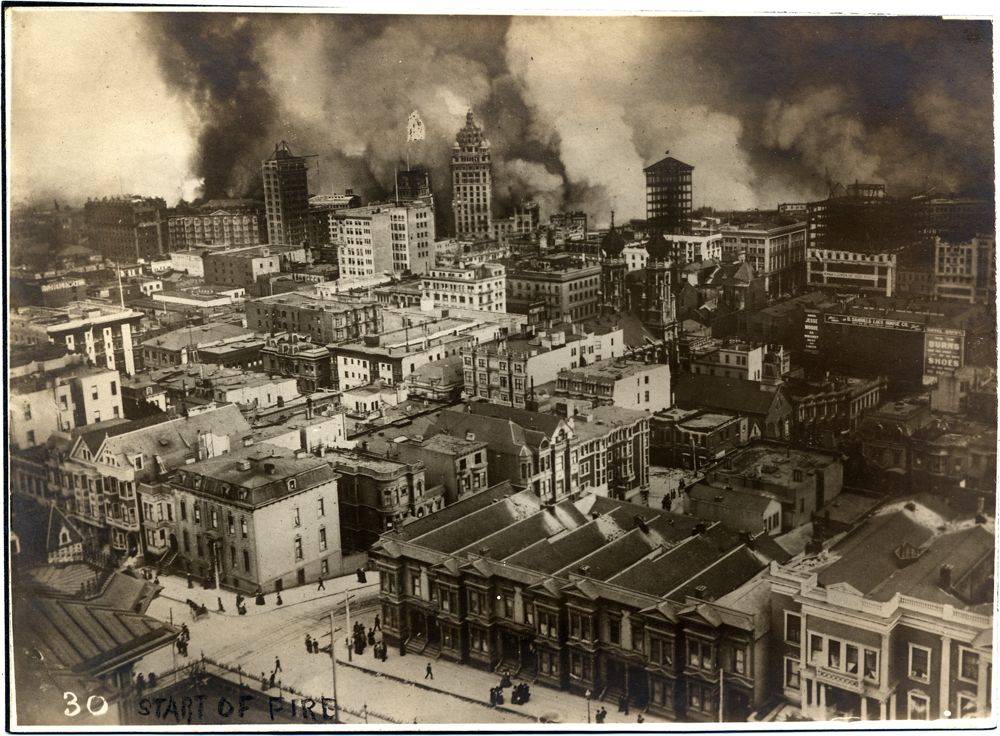
At 10:30 a.m., a woman who lived at the corner of Hayes and Gough lit her stove to prepare breakfast, unaware that her chimney was badly damaged. San Franciscans employed a little gallows humor, naming the fire she started after her doomed breakfast: the Ham and Eggs fire.
Early pictures of the fires:
digitalsf.org

Despite the disorder in the streets, the firefighters arrived in time to put the fire out with minimal damage. Only then did they learn the damaged infrastructure had cut off the water supply to Hayes Valley. The fire grew, consuming one building after another, with the beautiful new City Hall directly in its path.

digitalsf.org
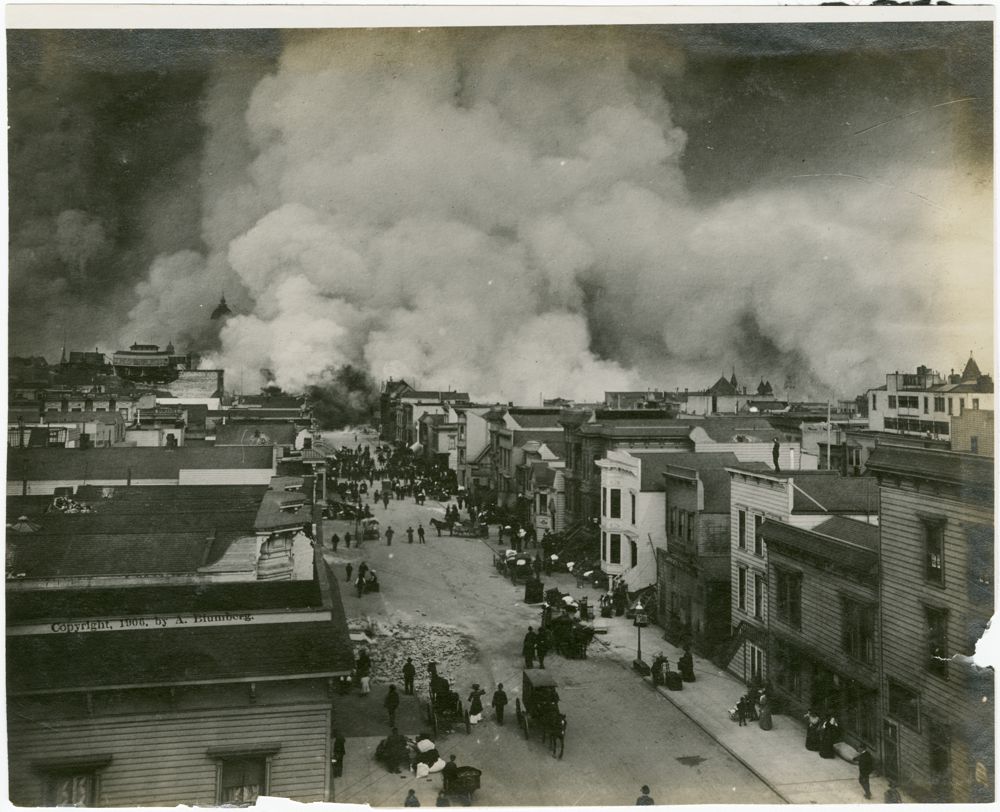
This shot from Folsom Street gives you a good picture of what the firefighters were facing:
digitalsf.org
Confusion reigned in the streets. The roads were crowded and strewn with debris. Desperate efforts were underway to extract the wounded and dead victims from the wreckage. Homes lay in ruins and there were cries of pain in all directions. Looters were stuffing their pockets with stolen goods.
Meanwhile a huge blaze was consuming the city and the water supply was cut off in some areas. The exploding gas line added to the deadliness. The firefighters were the last hope of the people and those brave souls charged into the inferno with only their fire wagons.

digitalsf.org
Man watches the approaching fires:

digitalsf.org
The mayor of the city in 1906, Eugene “Handsome Gene” Schmitz, was notified of the approaching fire. We’ve covered Handsome Gene before and there’s a photo of him from that time in an earlier post.
Schmitz was notified that the federal government had aid en route to the city. Throughout the disaster, Congress and President Theodore Roosevelt responded with remarkable speed, sending all the aid possible. But the mayor was on his own for most of the first day until aid could arrive, and he ordered that buildings surrounding the fire be dynamited in the hopes of stopping the blaze in its tracks. The blaze however was fueled by the dynamite.
Quick aside: I don’t know anything about the technique Gene was trying to use. It seems like it would be a miracle if dynamite did not accelerate a fire. Maybe he thought the fire would be scared off by the loud noise. No, I’m sure there was more to it than that. Gene may have been dim-witted but you’ll see this technique was tried repeatedly by different people during this time though it was never successful.
City Hall was destroyed by the Ham and Eggs fire, along with everything else in a 30-block area.
The fires burned on Market street. Look how calm the people are!

digitalsf.org
At 11 a.m., the Winchester Hotel at Third and Stevenson streets collapsed in flames. An hour later, the Hearst Building caught fire, and the fire threatened the Mechanics’ Pavilion and St. Mary’s Hospital, where many of the wounded had been taken. The patients were evacuated to Golden Gate Park and to Oakland, and within an hour the pavilion and hospital were on fire, along with the entire Financial District. The Central Fire Alarm Station in Chinatown had to be abandoned.
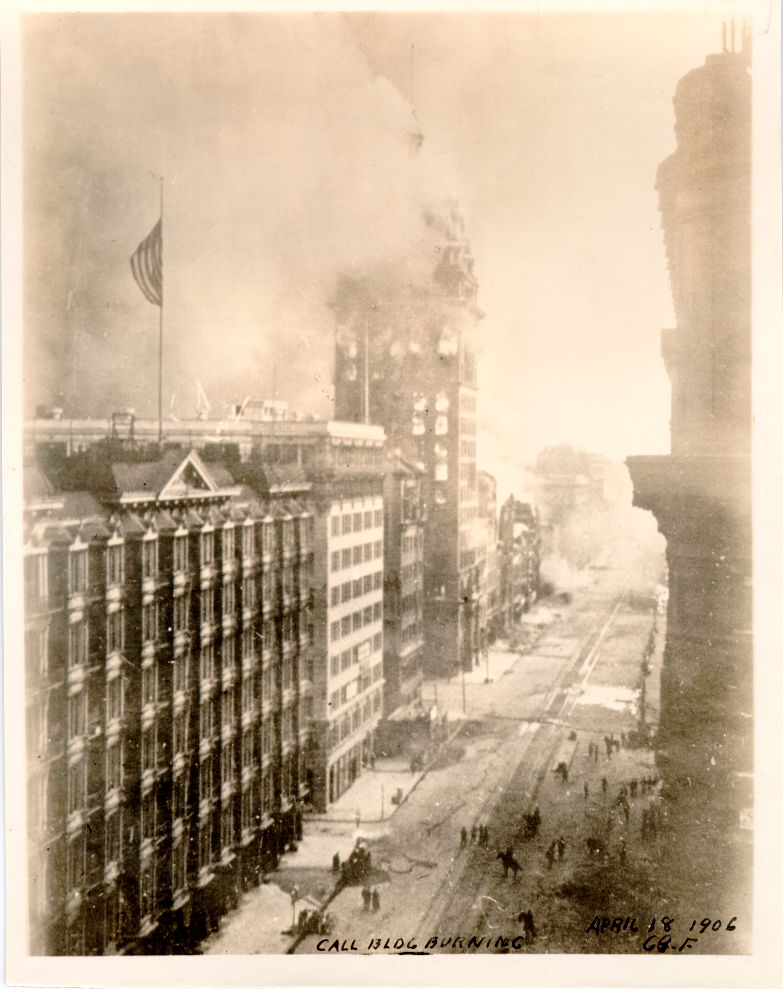
At 2 p.m., the San Francisco Call offices in the Spreckels Building caught fire. It’s on fire in this picture:
digitalsf.org
At 2:30, firefighters were instructed to use the dynamite technique again around the U.S. Mint in hopes of creating a firebreak. Poor fellows! They had no training to handle dynamite. As before, it resulted in more fires.
At 3 p.m., Mayor Schmitz released this statement:
“Let it be given out that three men have already been shot down without mercy for looting. Let it be understood that the order has been given to all soldiers and policemen to do likewise without hesitation in the cases of any and all miscreants who may seek to take advantage of the city’s awful misfortune.”
At 8 p.m., things seemed to be settling down when, according to sfmuseum.org, “a possible arsonist set fire to the Delmonico Restaurant in the Alcazar Theatre Building on O’Farrell near Stockton, and that blaze burned into Downtown and to Nob Hill.”
From Telegraph Hill:

digitalsf.org
Another quick aside. Wherever there are major fires, there are always firebugs who, for some demented reason, want to make the fires worse. Since living here, I’ve noticed that many of the bad fires are made worse by arsonists—we saw that during the L.A. fires this year and in the 2018 Camp Fire. But are the arsonists worse than the government and corporations whose job it was to prevent and minimize fires? They extracted massive sums of money via city and state taxes and utility rates from the very people who lost everything in the fires. The spectacular failures of the government and PG&E are more deserving of the people’s wrath than the pathetic firebugs. Argh, I’m way off-topic.
At 9 p.m., firefighters attempted to stop the fire along Powell St. between Sutter and Pine streets but it surged past them, up Nob Hill.

digitalsf.org
Firefighting efforts continued throughout the night but more disasters cropped up at every turn. 24 hours after the earthquake, much of the city was on fire.
The Grand Hotel Palace Hotel:

digitalsf.org
Prisoners in the city jail were hurriedly moved to Alcatraz, as the fires reached Van Ness Avenue. Army Lieutenant Freeman attempted to use saltwater from the Bay to fight the fires but his hose connections didn’t fit those of the Fire Department. The army dynamited mansions along the street in another failed attempt to build a fire break.

digitalsf.org
The next morning, April 20, sixteen soldiers and two officers from the U.S.S. Chicago rescued 20,000 refugees fleeing the fire. It was the largest evacuation by sea in history, supervised by just 18 men! By evening, the fires finally began to subside but they still menaced the Mission.

digitalsf.org
On Saturday, 3,000 volunteers armed only with knapsacks, brooms, and the little water remaining in the hydrant at 20th and Church battled, and ultimately stopped, the fire in the Mission. The firefighters, the soldiers, and these volunteers are the heroes of this story.
By Monday morning, April 23, the disaster was over. An Imperial decree on the 30th Day of the Third Moon from Empress Dowager of China arrived, promising to send 100,000 taels as a personal contribution to the relief of San Francisco. President Roosevelt proudly declined this and all other offers of help from foreign governments, declaring, “There is no need for assistance from outside our own borders.”
Governor Pardee stated, “The work of rebuilding San Francisco has commenced, and I expect to see the great metropolis replaced on a much grander scale than ever before.”
 old spirituals