This is a good example of a post that went off the rails! I intended to just post this picture, Church is out, from the New York Public Library.
It was taken in 1939 and features Edward Jones escorting Pat Roberts and Edna Dean home from church, in Harlem, New York City.

New York Public Library Digital collection
I love the photo and the ways these kids are dressed, but I soon got pre-occupied with how clean the street around them was. Two things I always notice when I look at old photographs of people in public are: 1) how are they dressed? and 2) what does the environment around them look like? And I nearly always find the people match their environment. That’s true of these kids.
If you look at 1884 in Kansas City, for instance, you might see people in rough but neatly mended clothes dodging horse-drawn vehicles on a broad, muddy avenue, with bustling shops on either side. It would be a very different crowd that we see in this 1911 footage taken in New York City by a Swedish company.
There are differences in American style but we dress very casually regardless of where we live. The dirtiness of our streets and the clutter are omnipresent too. Is it because we now dress casually that our cities have become so dirty? A contributing factor? Or a coincidence? I don’t point this out to be negative but to identify what could be done to regain our cities’ lost beauty. Some changes are good but cities used to be more livable. To examine it more closely, I look at the genre of photography that’s called Then and Now. It shows a set of photographs at the same location in different time periods.
There’s an explosion of signage, posts, and structures on every street—and garbage cans. You’d think I’d be pro-garbage can since I want cities to be cleaner. But in old pictures of cities, there are no garbage cans and the streets were immaculate. Today, unsightly garbage cans are everywhere and the cities are dirtier. What can account for that? Another curious thing is the lack of homelessness. It would be difficult to find a set of pictures from a city near me that doesn’t include tents and people living on the street. I started to create one of the Tenderloin in the 1910s versus today but the problem is so amplified in California, it’s not a good example of a city trend.
This set of pictures of Cleveland’s Terminal Tower is a good example. The tower has not changed at all. The pavement looks lighter and smoother in the old picture. The cars parked on the street and the tall buildings on either side give the 2019 image a claustrophobic feel. I like the older street lighting fixtures, with the globe-shaped lights and tall wrought iron.

barnorama.com
Sometimes it’s so different, it’s hard to know where to start, as with this image of the North side of Chicago in 1890 and 2020.

From barnorama.com
The intersection of Grand Ave and Prairie in Brookfield, Illinois. The first photo is from 1953, the second is in 2021.

Barnorama.com
Hopping across the pond, we have a not quite apples-to-apples comparison of Rue de Flandre in Paris.

This alley in the Casbah of Algiers in Algeria is much more appealing in 2016 than in 1905. The color in the image helps because the 1905 image looks like a wall of people and buildings. Not being able to see the sky gives me a suffocating feeling.

barnorama.com
This view of Most Kłodny in Poland has changed so much, only the presence of the river and the two towers in the background betray it as the same place.

Demilked.com
In this view of the Quais des Nations in Paris, I have a preference for the warm tone of the 1900 photograph. There are many differences beyond that though!

Demilked.com
Another view of the Eiffel Tower. This is a great set of photos for comparisons of significant changes.
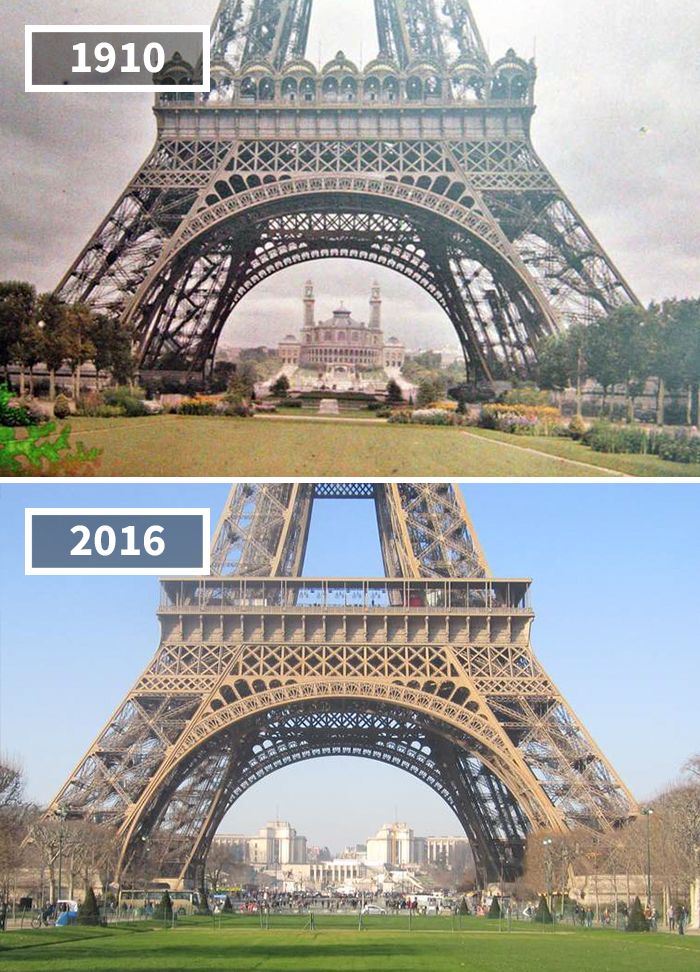
demilked.com
Karlstor, Munich, Germany. Are the streets really so much narrower?
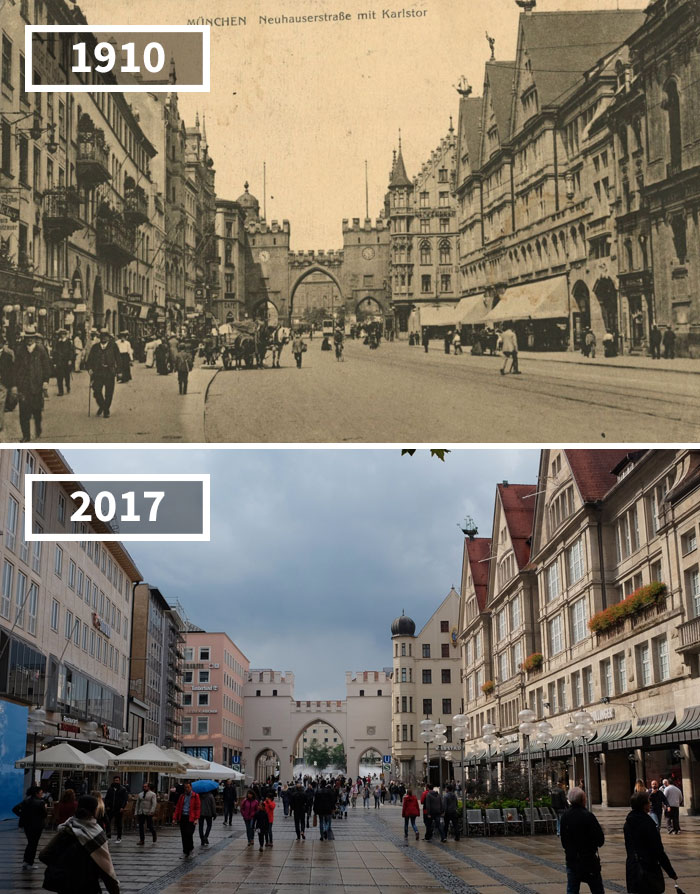
demilked.com
Moulin Rouge, Paris, France. The color photograph throws me because the red is so gaudy in comparison to the surrounding buildings. It may have been the same was in 1900 but it’s impossible to tell. The 2016 image also has a lot more street signs, cars, traffic lights, and clutter that makes it feel more cramped.
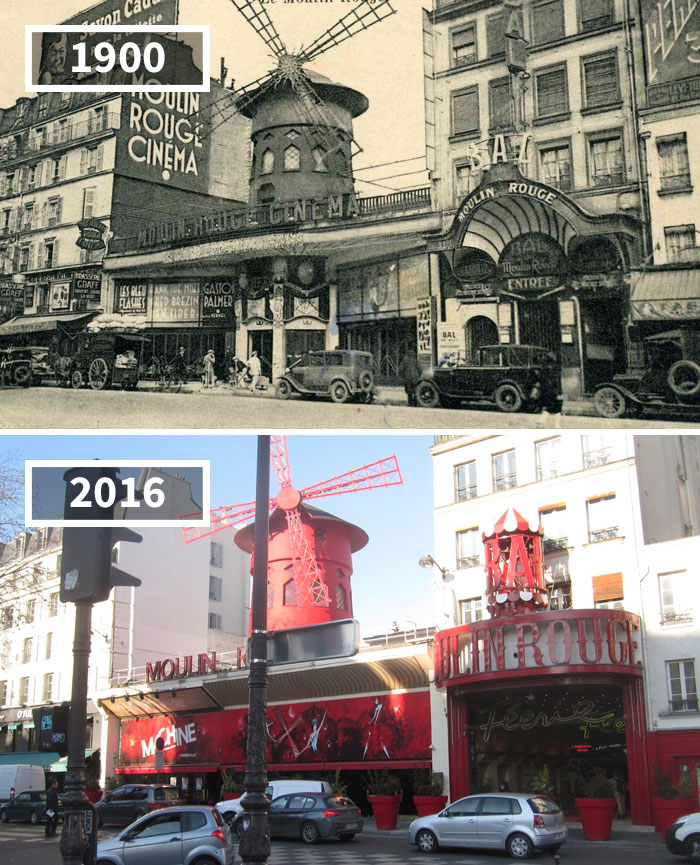
demilked.com
Nieuwmarkt in Amsterdam. Very little has changed except the many street signs and posts.
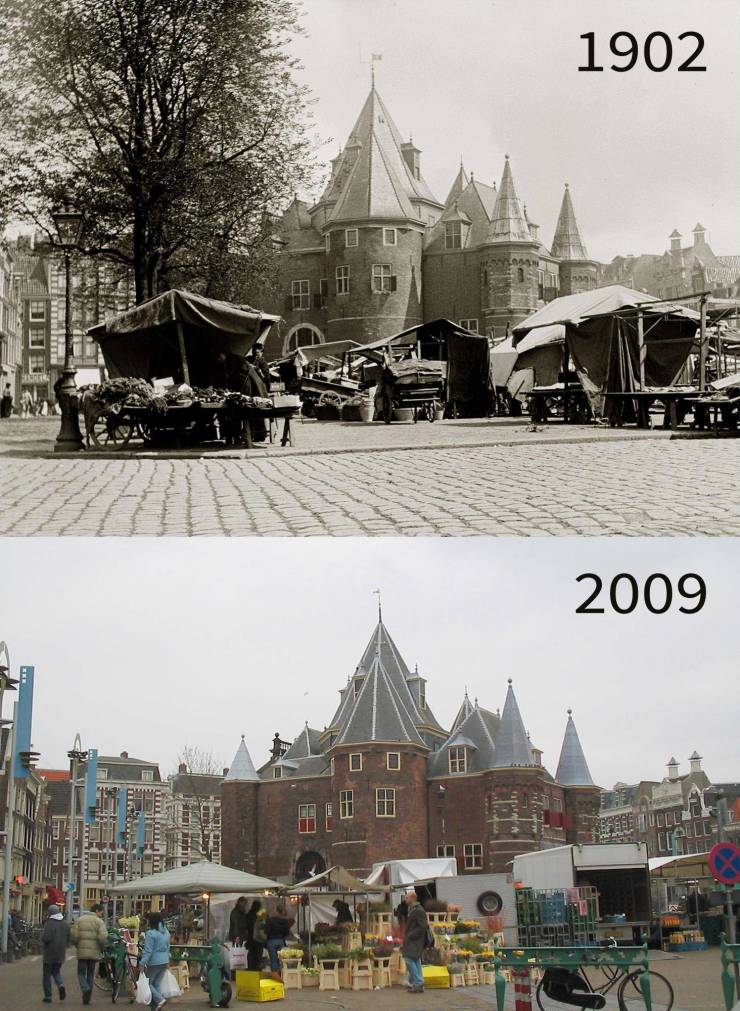
barnorama.com
Hofbräuhaus München in Germany. The light cobblestone and fantastical roofs are the same. I can’t tell if any of the businesses were cafés before, but they unmistakably are now. Unlike most of these pictures, the horses were replaced with people instead of cars.

Demilked.com
A great example of a street scene with people taken from identical angles in Norway, on Karl Johan Street.

Demilked.com
 old spirituals