I’m sure I’ve mentioned Delia Green in my posts about murder ballads, but I don’t think I ever told her story.
I’m going to add some songs about Delia if you’d like to listen while I tell you her story. Something about her murder caught at the public imagination and her story was turned into music by luminaries like Blind Willie McTell, who also hailed from Georgia, Johnny Cash, and Bob Dylan.
I couldn’t find many details of Delia’s death on Wikipedia and other sites, but I was able to find a lot of information by researching the contemporaneous newspapers. To most people who know about her, she’s a character in a story, not a real person. But Delia Green was very real. In 1900, she was 14 years old and living in Savannah.
Savannah is one of the most beautiful cities in the United States. Delia lived in the Yamacraw neighborhood, which has been called the oldest black residential neighborhood in Georgia history. Its name comes from the Yamacraw Native American tribe, formed by the Yamasee and Lower Creek people. The Yamacraw existed from the 1720s-1740s in the area we now know as Savannah. I couldn’t find a good contemporaneous picture from the neighborhood but I found one on Pinterest from the 1930s that gives you an idea of what the place was like.

The short version of the story is that Delia Green was shot by Moses Houston on the evening of Christmas Eve 1900 and died early in the morning of Christmas Day.
It surprised me to learn Delia’s murder was one of many that occurred in Savannah that day. Strangely, that’s also the case with Billy DeLyon who was murdered by “Stagger” Lee Shelton in St. Louis on Christmas in 1895 and became the subject of another famous murder ballad. I read somewhere that his murder was one of eighteen that took place in St. Louis that night. I wrote about Stagger Lee back in 2016.

Dec 27, 1900 edition of Columbus, GA’s Ledger-Enquirer
The February 9, 1901 edition of the Savannah Morning News told the story, along with the news that Delia’s killer, Moses Houston, had been indicted. “The homicide was committed on Harrison street on the day before Christmas and from the evidence of the state’e witnesses appears to have been absolutely without reason or provocation. The girl, it seems, had been accepting for some months Houston’s ardent attentions, but when he pressed her to admit a preference for him above all others, she evaded the point. Her coquetry aroused in Houston a passion of a different sort from that he had been feeling towards her. Her constant refusals drove him almost wild, and when he could bear her taunts no longer, he drew a revolver and fired. The ball entered her right groin, inflicting a wound from which she died the following day.”
The next month, on the eve of Moses’ trial, the Morning News expanded on the cause of the murder. “On the night of the homicide when, possibly, his brain was somewhat inflated with Christmas good cheer, he went to the girl and manifested a greater claim of proprietorship over her than she cared to endure. She resented it and denied, somewhat emphatically, that he had any claim on her whatever. Maddened by this treatment Houston, according to the evidence of the witnesses, drew a revolver and shot the girl…Houston was arrested by bystanders and turned over to the police.”
Emma West and Willie West were witnesses to the murder, which they declared was absolutely without provocation, save some contemptuous words used by Houston’s victim, and that [the attack] was as cowardly and brutal as it was unprovoked.” Willie West owned the house where the murder happened and Delia was staying there at the time. Emma and Willie said Della had been on intimate terms with Moses for months but on the night of the homicide, the two had quarreled.
Moses Houston’s defense contradicted the witnesses. He admitted he and Delia quarreled but it was over when she was shot. Her killing was an accident. “He said that he had been asked by Willie West to bring his revolver home from the repair shop, where it had been left, and did bring it to West on Christmas Eve…He explained to the jury that he and Eddie Cohen, another boy of about his own age, had been indulging in a good-natured scuffle for the possession of the revolver which was lying under a nap kin on the center table of the room. In the scuffle the weapon had been discharged, but he had not known until some minutes afterward that Della had been shot.”
After his conviction, the Morning News noted Houston’s cheerful countenance and his apparent intelligence. He was very calm throughout the proceedings. “He certainly gave no outward indication of being possessed of the ‘abandoned and malignant heart,’ which the law says shall be inferred to exist when a killing is committed under circumstances such as surrounded that with which he was charged.”
The jury convicted Houston and recommended mercy. The judge then had the unenviable task of sentencing the 15-year-old defendant.
“Houston,” said Judge Seabrook, “you’ve been indicted and tried for the crime of murder. The jury has seen it to accompany its verdict with a recommendation to mercy, and it now becomes my duty to impose the sentence directed by the law. I perform this duty with some pain and reluctance; I dislike to condemn one of your youth and apparent intelligence to life imprisonment. In so doing I exhort you to be a man, even in confinement, to repent of your past evil deeds and strive to earn the confidence and respect of those placed in authority over you.”

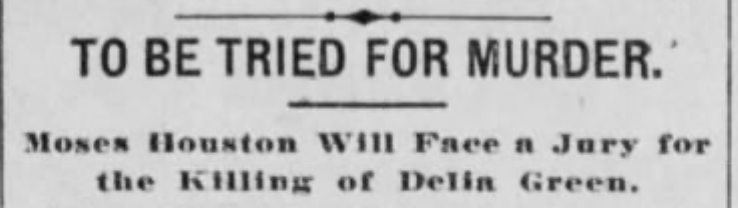
March 15, 1901 headline related to Moses Houston’s conviction
Mrs. Houston, the defendant’s mother, was present when Judge Seabrook sentenced her son to life in prison, and she wept bitterly for her boy. Moses merely said, “Thank you, sir.”
Moses was taken back to sheriff’s office where one of the deputies asked him how he liked the verdict. Moses said, “I don’t like it at all but I guess I’ll have to stand it.”
I couldn’t find anything about Moses Houston after this, though Wikipedia says he was paroled in October 1913 by Governor John M. Slaton, which he would’ve been 28 years old. The same article said he died in New York City in 1927.
Delia was buried in an unmarked grave in Laurel Grove Cemetery South. Later a marker was put up for her. By then, nobody knew where she was buried. It’s a strange feeling to see something tangible related to Delia Green. It brings home the fact she wasn’t just a “blues muse” as the marker describes her. She was a 14-year-old child who died for the stupidest of reasons. Poor Delia. She inspired some wonderful music that immortalized her. But she deserved to live and have her chance in life.

Picture by Enocha Van Lierop-Edenfield on 16 Feb 2022
 old spirituals