Click here to return to Part 1 of the Murderous Dreams of Mrs. Mather!
Now that Fred Fanning had been exonerated, Mrs. Mather’s psychic dreams were also called into question. She had came to Topeka with tales of her visions and managed to apprehend a murderer. Now “she is very, very angry at the local officials because Fanning was found to have confessed to something that he did not do.”
Mrs. Mather insisted the authorities worked to discredit her and the following day, she appeared at the courthouse in a cloud of swirling accusations and abuse, like a human tornado. “Standing in the upper corridor of the courthouse and in a voice that could be heard all over the building [Mrs. Mather] denounced the city, the county, all the officials and the heads of all who have had anything to do with the famous case.”
Though admitting she had no legitimate reason for believing that Fred Fanning murdered her sister, Mrs. Mather insisted he was guilty. “I believe the whole case has been a concocted scheme from start to finish and that there never was any attempt on the part of anybody to prove the guilt of that murderer!” she shouted. “And during my stay here I have been insulted and abused as never I was in the history of my life!”
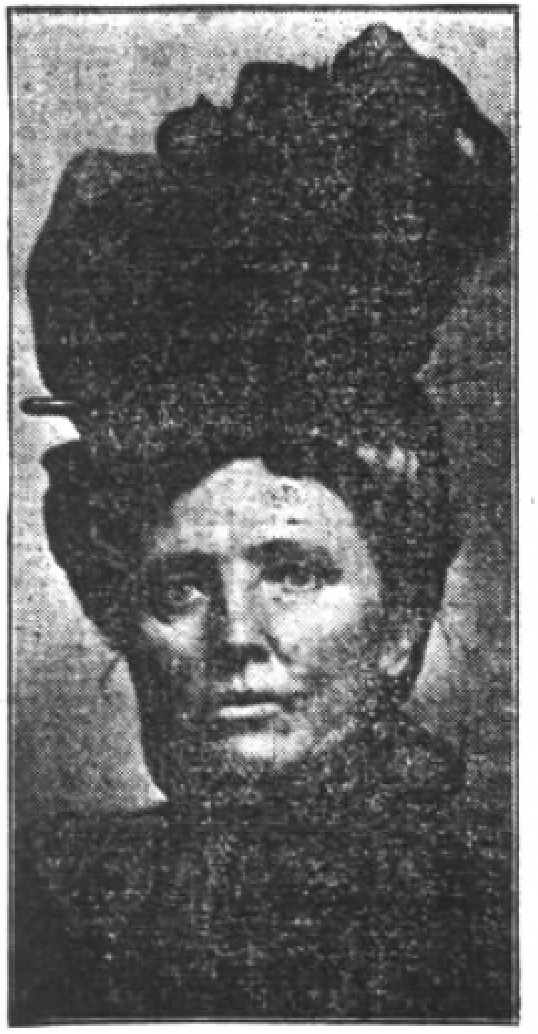
Mrs. Mather
But why had Fred Fanning made a false confession and why didn’t he recant it now? The answer was a simple and tragic: He was insane. When Mrs. Mather accused him of murdering her sister, he believed her.
“The spectacle of Fred Fanning, the shattered wreck of a stalwart man,” as the papers described him was a sorry one indeed. At the inquest, he was “ignorant, illiterate and a victim of weird religious beliefs, hallucinations and terror, the man stumbled along where led, trembling in limb and body while his face twitched from agony of mind.”
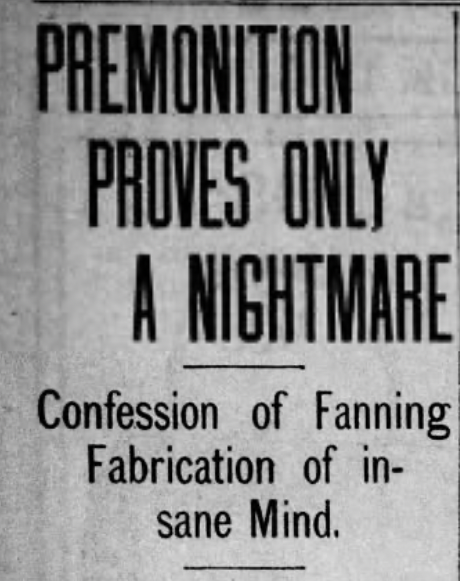
A doctor examined Fanning after the inquest, noting that he was dirty and disheveled. “He trembled that his chair creaked as big tears dropped from his closed eyes.”
The doctor put his fingers on Fred’s wrist to take his pulse.
Fred shrank back. “Who are you? What do you want?”
“I’m Dr. Keith,” the doctor answered in surprise. “Don’t you remember me?”
Fred didn’t recognize him but the doctor’s diamond ring caught his eye. “As uncertain as a child, the terrified man nervously reached toward the gleaming stone, and touched it. ‘What is it? What is it? What is it?’”
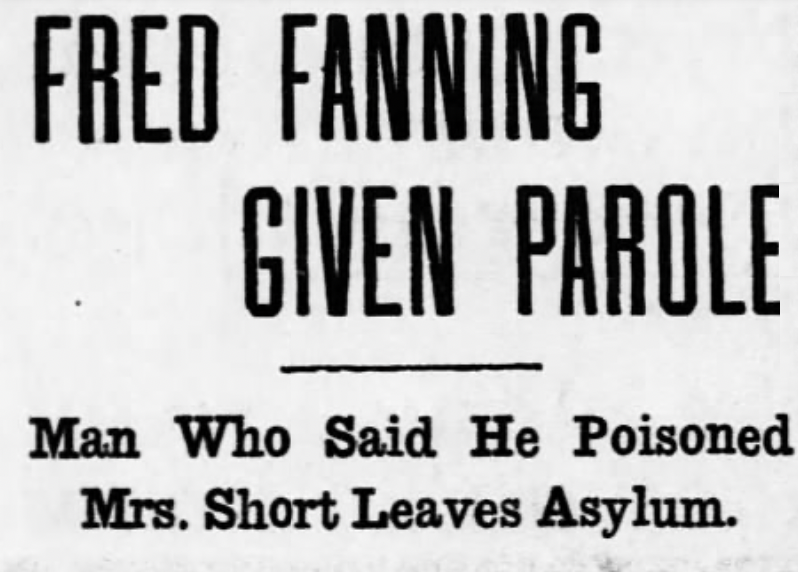
A lunacy commission committed Fanning to the state hospital for the insane in December 1909, where he stayed for three months. On March 30, he was paroled by Superintendent T. C. Biddle. “Fanning has worked ever since he has been at the hospital and seemed to be improved,” said Dr. Biddle. “I consider him more of an imbecile than an insane person and believe he will be better off with his people than to be kept here supported by the state.” Fred was sent to home to Illinois where his family lived, which is the last we know of him.
Mrs. Mather presumably went home to Seattle. She was not mentioned again.
This story is absolutely preposterous and if it was written in a novel, people would dismiss it contemptuously as too unrealistic. Readers expect a certain degree of logic and plausibility in fictional stories, but these are not requirements in real life.
Poor Fred, though. I imagine him as child-like. He was probably very scared when Mrs. Short died–after all, she was his only friend in Topeka. Maybe his only friend anywhere. His mind was wavering under her loss, and along comes Mrs. Mather who accuses him of killing her sister, brushing away his denials with absolute certainty. She even held herself out as a religious emissary. It’s too easy to see how he could be made to believe it.
As for Mrs. Mather and her premonitions, she may have really sensed her sister’s grave illness. People can feel things over great distances. Mrs. Mather was probably truthful when she initially told the police about her dreams, but it annoyed her when they dismissed her. She became determined to prove she was telling the truth. She probably got carried away with the media coverage and attention. Even so, her actions proved to be very cruel. She pushed a fragile man over the edge into an abyss of insanity–not to mention falsely depicting Mrs. English as a scheming murderess when she was innocent of any wrongdoing.
Mrs. Mary Short was no victim at all, just an unfortunate woman with a bad heart who died in Topeka, Kansas in 1909.
Those are my conclusions, but I’m curious to read what you think in the comments!
 old spirituals