This is Part 2 of the story of the missing lighthouse keepers. Click here to read Part 1.
The Board sent superintendent Robert Muirhead to Eilean Mòr to conduct the official investigation on December 29. It was a heavy responsibility for Muirhead. He had known all three missing keepers well—had recruited them for their jobs at the lighthouse, in fact. He had also been aboard the last relief vessel to visit the island before the tragedy. “I visited Flannan Islands when the relief was made so lately as 7th December, and have the melancholy recollection that I was the last person to shake hands with them and bid them adieu,” he recalled.
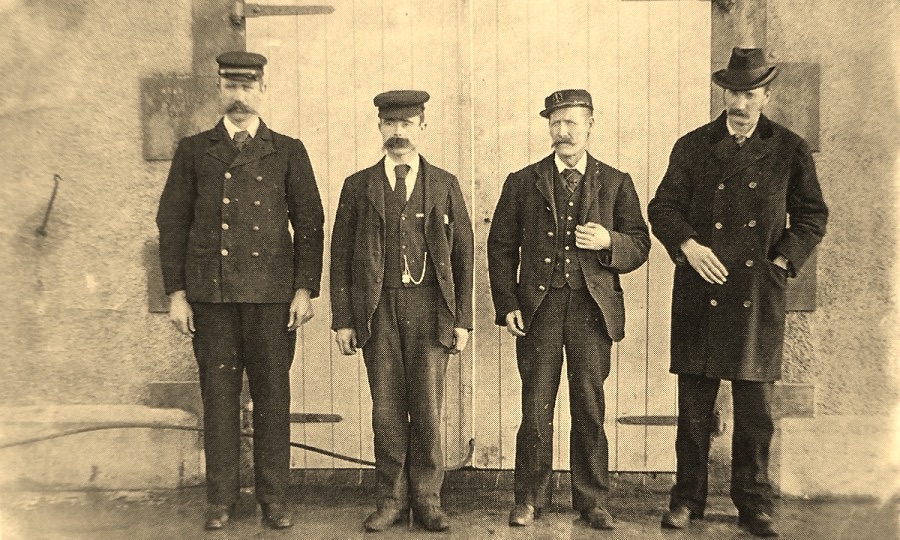
The last photo of McArthur, Marshall, and Ducat taken on Dec 8, 1900, with Robert Muirhead on the right
After thoroughly examining the lighthouse and the damaged west landing, Muirhead concluded that Ducat and Marshall had put on their oilskins and gone out into the storm to secure their equipment. McArthur must have ran out in the storm in his shirt sleeves. “The men had been on duty up till dinner time on Saturday the 15th of December,” Muirhead wrote, “that they had gone down to secure a box in which the mooring ropes, landing ropes etc. were kept, and which was secured in a crevice in the rock about 34 meters above sea level, and that an extra large sea had rushed up the face of the rock, had gone above them, and coming down with immense force, had swept them completely away.”
The superintendent’s explanation satisfied no one. The strangeness of the disappearance, combined with Eilean Mòr’s eerie reputation, seemed incompatible with something as simple as drowning. And no trace of the men’s bodies had been found. Rumors that the crew of the Hesperus had discovered an overturned chair and half-eaten food fueled wild speculation of sea serpents and pirates but it was baseless. Moore, the relief keeper, stated everything had been orderly in the lighthouse.
A more plausible explanation was that, while Ducat and Marshall were working outside to secure their equipment, MacArthur spotted large waves approaching the island. He ran out without his oilskins to warn the others, but he was too late and all three were swept away. Or perhaps one of the men was tossed into the sea and the other two tried and failed to rescue him, leading to all three drowning in the fury of the storm.

Steps leading down from the cliffs. Image by Chris Downer/Wikimedia Commons
Unbeknownst to the public, there were other reasons Muirhead’s conclusion didn’t ring true. The lighthouse rules strictly prohibited all three keepers from leaving their posts at the same time. Even if MacArthur had seen the waves approaching and ran out without his oilskins to save the others, was it likely he would have taken the time to close the door of the lighthouse and the door to the courtyard?
Joseph Moore, the relief keeper and the first man on the scene after the disappearance of the keepers, also disputed Muirhead’s timing. He noted that “the kitchen utensils were all very clean, which is a sign that it must be after dinner some time they left.”
Then there is the log.
The logbook had been completed regularly by the lighthouse keepers until the final entry on December 15. However, a closer look found a number of strange entries in the logbook, apparently written by Thomas Marshall, beginning December 12.
Dec. 12: Gale, north by north-west. Sea lashed to fury. Stormbound 9pm. Never seen such a storm. Everything shipshape. Ducat irritable. 12pm. Storm still raging. Wind steady. Stormbound. Cannot go out. Ship passed sounding foghorn. Could see lights of cabins. Ducat quiet. Macarthur crying.
Dec. 13: Storm continued through night. Wind shifted west by north. Ducat quiet. Macarthur praying. 12 noon. Grey daylight. Me, Ducat, and Macarthur prayed.
Dec. 15: 1pm. Storm ended. Sea calm. God is over all.
These brief entries are at the center of the mystery. The most perplexing thing about them is that there were no storms reported in the area on December 12, 13, or 14.
Moreover, anyone who knew the missing men would be alarmed by the entries. Even if the island was being battered by a storm, the men knew they were perfectly safe as long as they stayed in the lighthouse.
The reference to MacArthur crying was particularly strange. The Occasional was said to have been an argumentative character. On the mainland, he had a reputation for brawling.
And where were the entries from December 14?
 old spirituals