This is Part 2. To begin at the beginning, go to Part 1.
After their first meeting, W.B. Yeats and Maud Gonne stayed in touch regularly. The poet thought and talked and dreamt of the beautiful young revolutionary constantly. In 1891, Yeats was living in Paris and he traveled to Ireland in 1891 to see Gonne and to propose to her. She refused him.
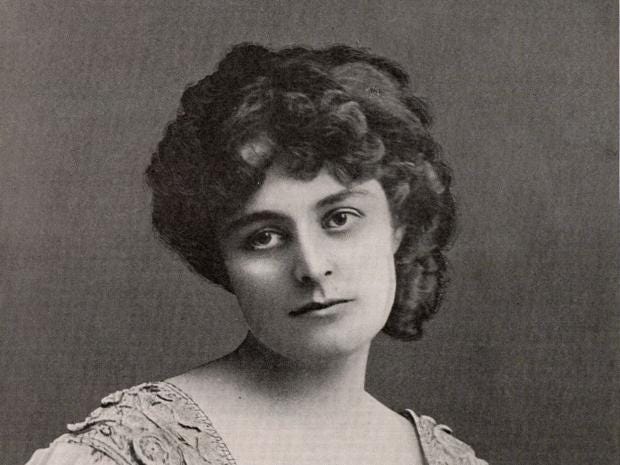
Maud’s primary reason for declining Yeats’ proposal was that he was unwilling to convert to Catholicism. But there was also the matter of his political sentiments. He was an Irish nationalist but he was not sufficiently radical for her taste.
Yeats said that from this time “the troubling of my life began.” In his letters he told Maud he couldn’t be happy without her.
This, Maud dismissed as ridiculous. “Oh yes, you are, because you make beautiful poetry out of what you call your unhappiness and are happy in that. Marriage would be such a dull affair. Poets should never marry. The world should thank me for not marrying you.”
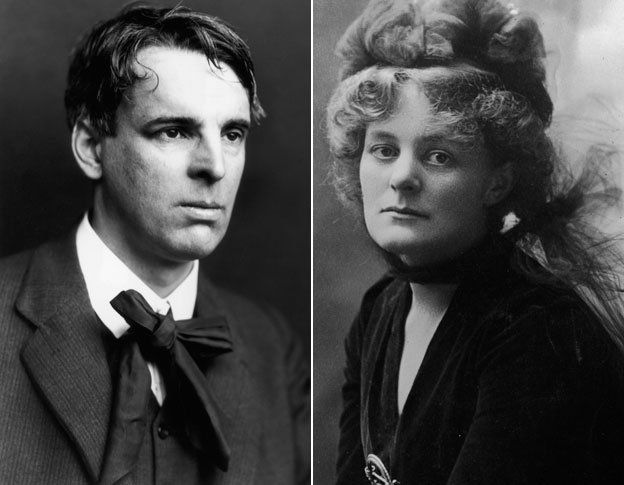
from BBC.com
But Yeats did not and could not forget Maud. In 1890, she had a son by the French politician Lucien Millevoye. Lucien was married but separated from his wife.
The child, Georges Silvère, survived only a year before succumbing to meningitis. Maud’s grief and devastation crushed her. She separated from Millevoye for three years, but eventually arranged to meet him at the mausoleum where their son’s body lay. She chose this location to conceive another baby with Lucien, in the hope that if she could make another baby with the same father, the soul of her dead son would transmigrate into a new body.

Lucien Millevoye, photographed in 1914 by Agence Rol – Bibliothèque nationale de France, Public Domain, Wikimedia Commons
Her plan was successful insofar that she had another child, but the little girl, Iseult, could never fill the hole in her mother’s heart. However, Maud remained with Millevoye until 1900. That summer, she packed up her daughter and their belongings and returned to Ireland.
Eventually the girl was bundled back to France to be educated at a convent there.

Maud, photographed by J.E. Purdy
Yeats, meanwhile, continued to long for his muse, regardless of what she had done or the life she was leading. He could no sooner cut Maud out of his life than he could cut his own heart out of his body and expect to go on living. He proposed to her again in 1899, in 1900, and in 1901. She refused him again and again. And again.

If you liked this post, please subscribe to Old Spirituals, like and share the post on your social media, and leave a comment! It really helps other people find the site. And if you’re so inclined, check out my books on Amazon or click the button to Buy Me a Coffee!

 old spirituals