This is Part 4. To begin at the beginning, go to Part 1.
In 1917, 52-year-old Yeats proposed for the fifth and final time to his muse.

from University of Cincinnati
Yeats’ biographer speculated this proposal was motivated by a sense of duty. Maud’s life had been a scandalous and troubled one. Her children with the married Millevoye, a drug addiction to chloroform, and the messy divorce proceedings with MacBride had tainted her reputation. Supposedly Yeats even imposed some conditions on his proposal and was unsurprised when she refused him again.
Far more shocking is the fact the poet immediately turned to Maud’s 23-year-old daughter Iseult and proposed to her. Iseult gave it serious consideration but ultimately turned him down. Yeats had always referred to the girl as his “darling child” and he was a paternal figure to her. Iseult also knew Yeats was not in love with her and believed that it would upset her mother too much if she married him.

Iseult Gonne. Public Domain. Wikimedia Commons
Iseult’s consideration for her mother was admirable, considering that Maud had never treated her as a mother should. She had been conceived as a means of reincarnating her brother. When she returned to Ireland from her schooling at the French convent, Iseult was introduced as Maud’s niece or her cousin, rather than her daughter.
But why did Yeats propose to Iseult? Certainly she was a beautiful girl. Yeats was determined to get married. But he could have asked anyone. Why Iseult? Was it a way to revenge his angry heart upon Maud? Or was it merely a sign that “the troubling of his life” was over?
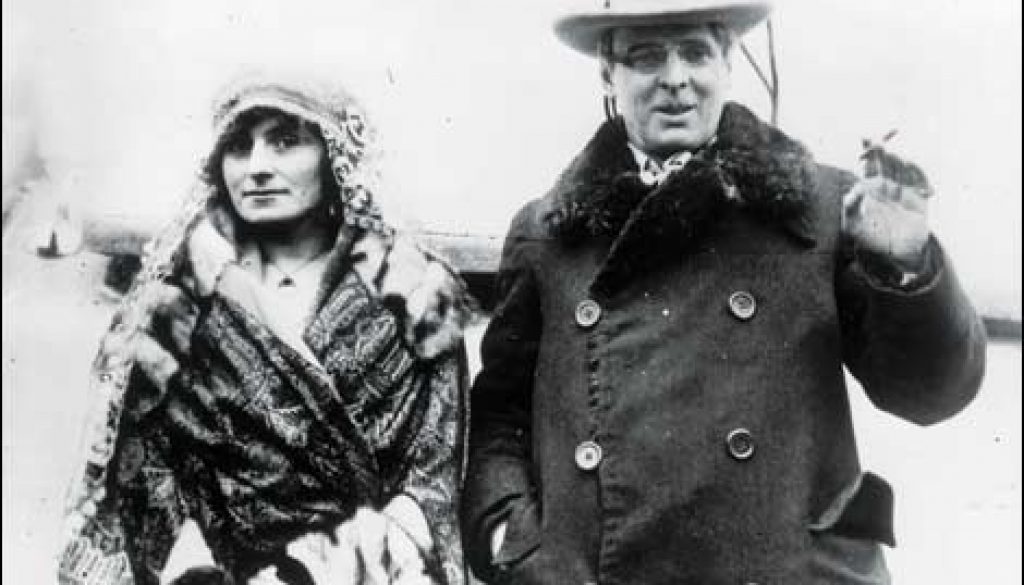
Georgie and Yeats, from Racontour.com
Regardless, the poet turned to another young woman, 25-year-old Georgie Hyde-Lees, and married her after a 3-week courtship. Georgie appeared to have been a reserved and infinitely tolerant woman who believed in her husband’s genius and shared his interest in spiritualism. The couple apparently had a good marriage, despite their 27-year age difference and numerous infidelities on Yeats’ part. They had a son and a daughter together. According to reports, Maud Gonne was sincerely happy for Yeats when he married.

Yeats photographed in 1933 by Pirie MacDonald
W.B. Yeats died in Menton, France January 28, 1939, at the age of 73. There are many things about the last phase of Yeats’ life that are unknown. Did he ever recapture that transcendental feeling he once had for Maud? Or had he ever let go of her at all?
Maud lived another 14 years. She passed away in Clonskeagh in1953 at the age of 86.
When she died, her daughter Iseult was not acknowledged in her will. This was rumored to have been due to the machinations of her half-brother Seán MacBride, who didn’t want his mother’s relationship with Millevoye to become public property. Iseult had little time to feel hurt. She died from heart disease less than a year after Maud passed away.

Maud had always maintained to Yeats that his beautiful poetry was a result of the deep pain he felt, and marrying her would destroy that. Many people believe that the greatest art is born out of pain that has no other outlet.
I want there to be something more about Maud, in relation to W.B. Yeats. Maybe the muse of the great poet could have regretted him or devoutly wished she had the years back to live over with him. But I can’t find anything like that.
Perhaps her 1908 letter to him, when she talked of praying for “bodily desire” to be taken from both of them, was really the end of the matter for her. She wrote, “I have not made these prayers without a terrible struggle a struggle that shook my life though I do not speak much of it & generally manage to laugh. That struggle is over & I have found peace. I think today I could let you marry another without losing it – for I know the spiritual union between us will outlive this life, even if we never see each other in this world again.”

If you liked this post, please subscribe to Old Spirituals, like and share the post on your social media, and leave a comment! It really helps other people find the site. And if you’re so inclined, check out my books on Amazon or click the button to Buy Me a Coffee!

 old spirituals