When I first came across this short January 1901 article, I was indignant.
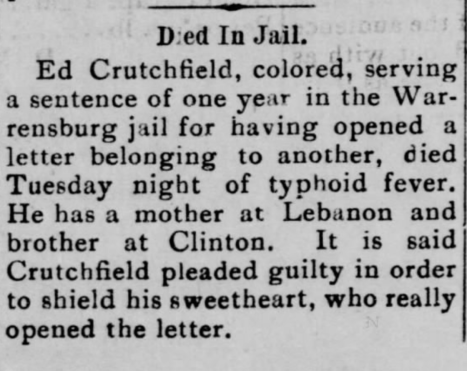
Original article
The term “colored” was widely used in 1901 and was not considered derogatory. But the sentence—a year in jail for opening a letter!—that was no more normal in 1901 than it is in 2021. And he didn’t even open it, his girlfriend did! To add insult to injury, this poor guy died in jail.
I found a second article that was written two weeks before Crutchfield’s death that said his illness was sudden. By then, he had been in jail for months. As soon as his condition was known to be hopeless, an appeal was made to Judge Phillips in Kansas City, who had sentenced Crutchfield. The judge refused to approve an early release, saying that Crutchfield would stay put, unless the president issued him a pardon.
But Crutchfield was dying. What possible reason would there be for keeping him in jail? Did the judge imagine his unauthorized letter-opening spree would continue, placing the public at risk, or what? But it was Judge Phillips comment about the U.S. President—an evidently serious comment—that caught my attention. I dug in to find out more about Ed Crutchfield’s story.

Photograph by Jimmy Chan
The first article I found was titled “The Deacon Fell From Grace” in the Darlington Record, in February 1900. “Ed Crutchfield, a deacon in the Negro Baptist Church at Clinton, is in the toils for appropriating $5…and spending the same for liquor in a very secular manner.”
This put a different spin on things. This guy didn’t just open or read someone’s mail. There was money involved for one thing, and $5 in 1901 would be worth about $160 in 2021. Also, if Ed Crutchfield was a deacon, spending all that money on booze wasn’t exactly becoming. I was still confused about why the judge mentioned the president.
I found the answer in an article in the Henry County Democrat, titled “Got her 15 plunks,” that revealed Ed was in jail because an elderly “sable” woman named Vina Lawson pressed charges against him. (Quick detour: The word sable has many meanings, one of which is black. I’d never heard the term applied to race before but a quick search showed it was used in this way by the poet Phyllis Wheatley, who was brought to colonial America as a slave around 1760. “Some view our sable race with scornful eye…”)

Clinton, Henry County, Missouri
Like Ed Crutchfield, Mrs. Lawson lived in Clinton, Missouri. Mr. Lawson, however, was working in Springfield, a town some 90 miles south of Clinton, and sending his wife his earnings regularly. In January 1900, the post office notified Mrs. Lawson that another package had come in for her.
But Mrs. Lawson did not appear to get the package. Instead Ed Crutchfield showed up with an order, allegedly from Mrs. Lawson, to give the package to him. As soon as he turned the corner from the post office, Ed ripped open the package and found three $5 gold pieces (approximately $480 in 2021).
“For a few days, Ed rolled so high that he only hit the earth once in a while,” the story went on. Every cent of the $15 was spent on gambling, booze, and women. Ed heard that Vina was worrying about the missing money her husband sent, so he dropped in to visit with her from time to time.

$5 gold piece
The article continued, “He told her he had put it in her trunk, had deposited in the bank to her credit, and made other little ‘con’ talks which only staved the trouble off until Sunday when Vina wouldn’t listen to his lies any longer and he felt the heavy hand of Sheriff Callaway on his shoulder.”
Ed maintained that Vina authorized him to open the letter, a suggestion the lady vehemently rejected. Mrs. Lawson was very angry and pressed charges. In early May, Ed was convicted. People expected he would be sent to the penitentiary, but he was ordered to serve one year in the Johnson County Jail. It seemed that part of the reason for Ed’s harsh sentence was that Mr. Lawson sent the money to his wife via registered letter, which made stealing it a federal crime.
Obviously, things look different when you know Ed Crutchfield didn’t just mistakenly open someone’s mail, that he stole money from an elderly couple, and blew it on booze and women. You have to wonder if the reporter knew that and omitted it to make a better story, or if he didn’t know many of these facts. I guess It goes to show, then and now, it’s just as well to do your own research.
In my opinion, it was still too harsh a sentence and it’s horrible that he died there. I have to admit, though, I’m a little in awe of Vina. No way was she going to let Ed Crutchfield steal her money and lie about it. She didn’t care if he was a deacon; she took him to court and she made sure he went to jail. She must’ve been a force to be reckoned with.

