Musical accompaniment: Adagio un poco moto – III. Rondo. Allegro (excerpt) from Piano Concerto No. 5 in E-flat composed by Ludwig van Beethoven
Today I want to profile the beautiful old Public Library of Cincinnati. It was completed in 1874 and drew people from around the world to marvel at it.
From the outside, it’s a nice building but the exterior gives you no sense of how magnificent the interior was, with its spiral staircases, marble floors, immense skylights, and treasure troves of important books.

Part of the reason the library was so spectacular was that the building was originally intended to be an opera house. The owner died while it was under construction and the city purchased the lot and the building. They hired a new architect, James W. McLaughlin, to turn it into a city library.

wikimedia

wikimedia

wikimedia
I love these checkerboard marble floors!

wikimedia
If I were a ghost, it is just the sort of place I’d like to haunt.

The building was opened to the public in 1870 and officially completed in 1874. At that time, Harper’s Weekly profiled the building:
The whole interior construction of this hall is of iron, with the exception of the book-shelves, which are of ash. The light, graceful columns which support the roof are of wrought iron. Sixteen feet above the main ceiling is a lantern of iron and glass, covering the entire space. There are 32,000 glass prisms in the lantern, set in cast iron after the HYATT pattern, which is used in sidewalk pavements to light basements.
The roof and all the floors are laid on iron girders, spanned by corrugated boiler plates, which are filled with cement and covered with iron. In the eastern corners are two square stacks of brick, one for an elevator and the other for ventilation.
Through the centre of the latter passes the iron chimney of the steam-boilers in the basement. Four dumb-waiters extend from the lower floor to the upper alcoves, which, with the elevator, are worked by hydraulic power.
The building was more than a beautiful place. It met very specific needs, like this reading room for the blind.

wikimedia
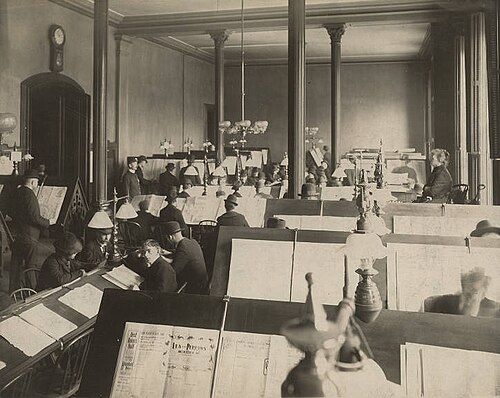
The newspaper archive room:
wikimedia
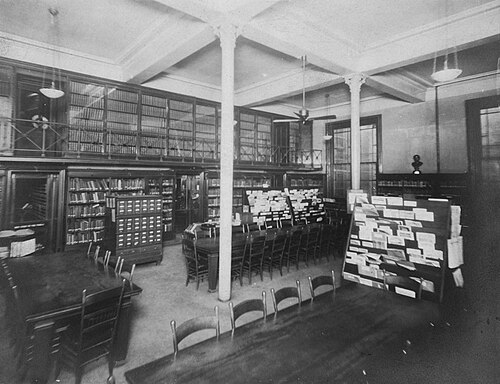
The useful arts room housed many rare and valuable manuscripts.
wikimedia
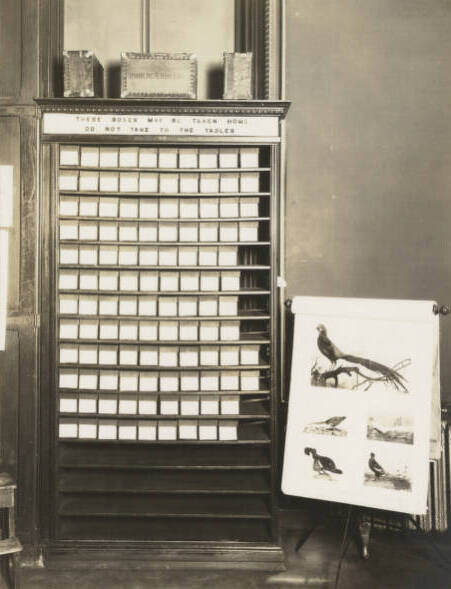
Audubon room. My friend Alexandra tells me these were first editions!

wikimedia
wikimedia
The catalogue department. One of my dreams is to own a library card catalogue. I know they’re expensive and heavy and difficult to come by but I really, really want one.

wikimedia
The Training room:

wikimedia
I’ll grudgingly admit the building had challenges. The basement was prone to flooding, the natural light was lacking, and there was no air conditioning. People had legitimate worries about a fire. Fire destroyed many beautiful buildings in that era, leading to horrible tragedies with high death tolls. Also, the library was created to hold 300,000 books and by the time it closed there were 1.5 million books!
Nevertheless, it’s a sin to destroy something so beautiful. Cincinnati’s lovely opera house library was demolished in 1955 when a newer, modern library was built nearby. Even its demolition was interesting. The vice president of the Cleveland Wrecking Company, which was hired to carry out this wicked deed, said the old library would “die hard.” He meant that it was built so well and so sturdily, it would be difficult to take down. And it was! It took three months to demolish it and required a large crew of approximately 60 men, in addition to the heavy wrecking equipment.
In its place today is an office and a parking garage. It’s hard to believe such a wonderful place was deliberately destroyed. It’s a theme I harp on too often but I really believe that people behave better and live better lives in beautiful surroundings.
This library card reminded me of another Ohio case–that of disgraced professor Orville Marsh, whose criminal career was exclusively related to library books!

wikimedia
 old spirituals