Today, Old Spirituals readers, I’ve got a terrific case for you! It’s got poison pen letters, scheming females, an unhinged millionaire’s daughter, a popular doctor, a former First Lady, and a twist ending. Hold on to your hats!
Shall we begin at the beginning? In 1906, Canton, Ohio was at its wits’ end. For years, stretching as far back as 1903, high society in this northern Ohio city had been tormented by scandal. Prominent members of society, including Mrs. Ida McKinley, widow of President McKinley, received letters that oozed scandal.
These missives betrayed an intense, obsessive interest in Dr. W. A. McConkey, a married physician “of considerable popularity,” seems to dominate the unprintable correspondence. In fact, McConkey’s name was signed to around 100 of the letters.
Many of the letters targeted Mrs. Maud Payler, age 26, as well. Mrs. Payler was the daughter of millionaire John Gibbs and the wife of a traveling auditor. I think it would be fair to call her a rather intense person, but read on and let me know if you agree with this characterization. “[Mrs. Payler]… goes armed with a revolver half-cocked in a holster,” the Evansville Press revealed.
Maud Payler was no shrinking violet. She spoke boldly to the press, saying, “I have been getting threatening and indecent letters for nearly four years. My name has been signed to letters sent to married women. Women have been called to the ‘phone and addressed like this, ‘My name is Miss Gibbs. Your husband tried to flirt with me!”
Mrs. Payler described a particularly strange incident that began with a letter instructing her to go out on a specific night, taking $50 with her. She was to go to a specific location and place the money on the sidewalk at the appointed time. At that point, a woman dressed in men’s clothing would appear and tell her who had been persecuting her.
All of this may sound as quaint to us today as a Werther’s Originals ad but Mrs. Payler was really angry. As I mentioned, she was a rather intense and seemingly fearless woman, and she determined she would follow the directions in the letter—at least to a point. On the night in question, she went out alone and appeared at the designated place, but without the money. (Presumably the half-cocked revolver was in her holster.)
Mrs. Payler did spot a slight figure hovering nearby wearing men’s clothes and, as you might guess, immediately charged at her. The figure fled and, luckily soon outpaced Mrs. Payler. But the millionaire’s daughter did not leave empty-handed. She triumphantly told the police and the press that the mysterious figure left behind dainty footprints, proving it was a woman in men’s clothing.
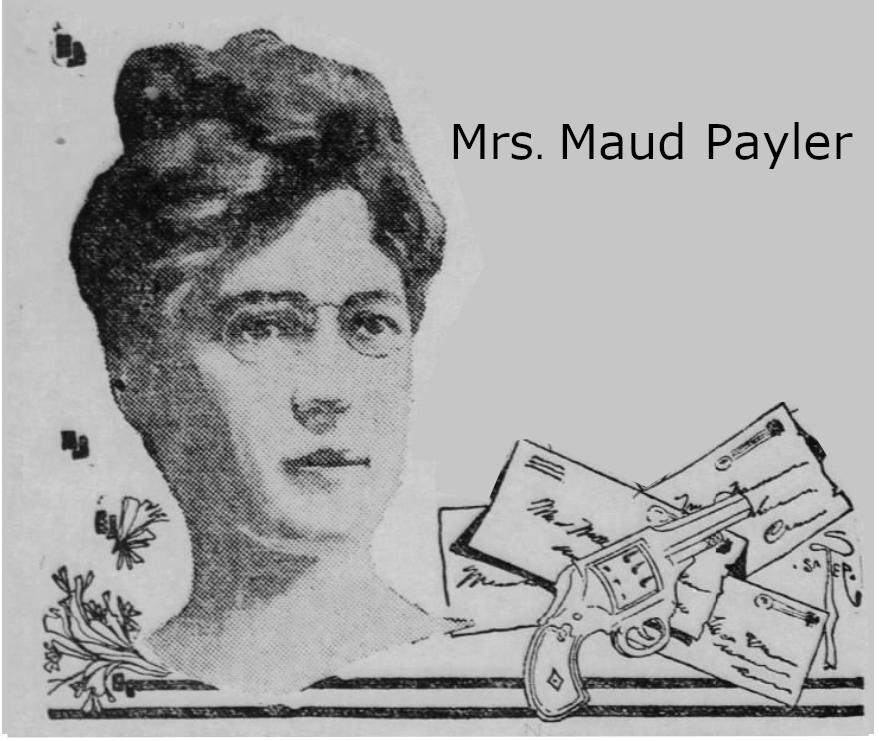
On still another occasion, a stranger calling himself a private detective came to her home and tried to seduce her. If you guessed that she responded by hitting this man in the face with a fire shovel before seizing a pistol and chasing him off her property, well…you would be correct. This sinister visit yielded another layer of intrigue. After running the private detective off, Maud discovered her trunk had been tampered with—smeared with soap, in fact. Mrs. Payler suspected an attempt had been made to get an impression of the lock.
Dr. McConkey, though the primary target of the letter-writer, was quieter. “I do not know who wrote the letters, but the evident intention was to bring me into unpleasant notoriety,” was his only comment.
But who was doing all of this? And why?
The case was finally broken in June 1906, with the arrest of Mrs. Mary Feicht, the wife of a newspaper man. She was indicted in September, posted a $1,000 bond, and was released. She was indicted a second time in February 1907, though the reason for this was murky. If she was indeed the letter-writer, she was not scared off. Since September, the offensive missives had continued.
Mrs. Feicht had been swept up in law enforcement’s net with the purchase of marked stamps. (We’ve seen this ploy before, haven’t we? That was Harriet Jones, the prolific poison pen writer from Pennsylvania.) The one and two-cent stamps featured George Washington, and tiny, almost imperceptible red lines had been drawn on his neck. Mrs. Feicht admitted she purchased the stamps and they were found in her house. However, she insisted she had not used any of the marked stamps.
J. W. Albaugh, one of Mrs. Feicht’s attorneys, declared his client was the victim of a conspiracy, but he was sure he would be able to place the blame where it belonged. Based on what the newspapers printed, the case against Mrs. Feicht looked pretty thin though.
Go to Part 2.
 old spirituals