Cassie had started out the 1880s as a clairvoyant with a clear record, except for the minor record in Canada. By 1889, she had been married three times, divorced twice, widowed once, had a child, adopted a few aliases, was a well-known con artist, and she was under federal investigation for forgery. After the death of her third husband, C.F. Hoover, she returned to her earlier alias Madame Lydia Devere.

In January 1890, a case involving Cassie and a man named Joseph Lamb exploded in the papers. The two were arrested for forging the name of C.F. Brown, a wealthy iron manufacturer from Toledo, which is about 115 miles west of Cleveland.
Youngstown is only about 15 miles south of Trumbull County where Cassie had lived with her second husband, John Scott. This suggests she may have met Joseph Lamb, the man who would be an accomplice to her, around the time she was living on the farm. Later, people speculated that Lamb was the real father of Cassie’s child.
Lamb was released on his own recognizance, but Cassie was far too slippery a character to be given the benefit of the doubt. She remained in jail while the grand jury considered the case. While in jail Cassie had many visitors and society ladies in Toledo sent her gorgeous bouquets. When she heard Lamb intended to make a public statement to exonerate himself, she was angry and said, “Lamb shall not escape and I go up.”
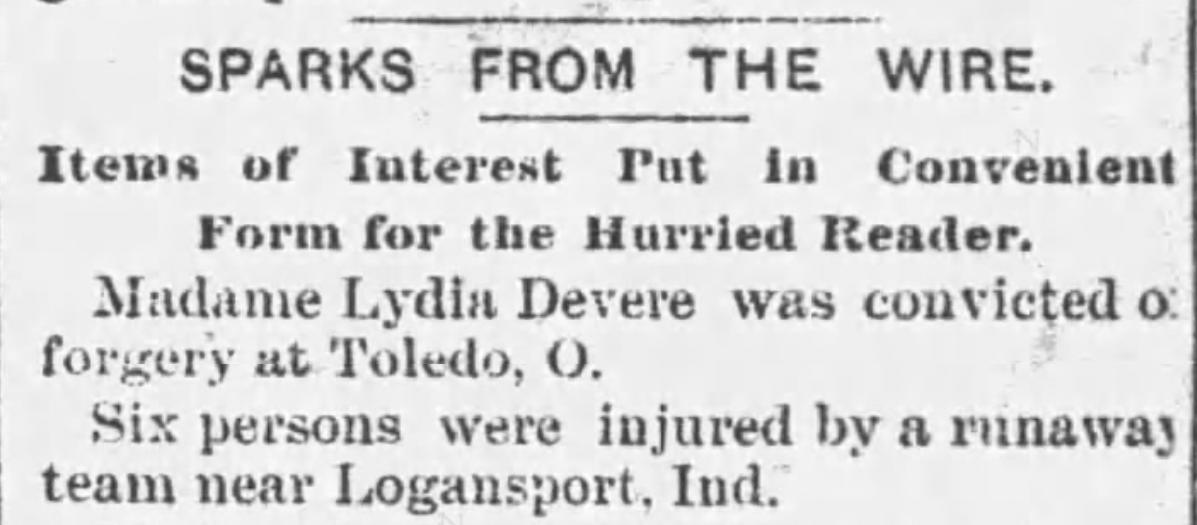
The Piqua Daily Call May 03 1890
Lamb was rearrested when the indicted came down but he posted bond and Cassie was either not given the opportunity or was unable to pay it.
Cassie was convicted of fraud and sentenced to nine-and-a-half years in a penitentiary in Toledo for forgery.

Lamb, however, managed to escape prison. When he died of heart disease ten years later, the Marion Star revealed how he was able to evade conviction, in an article entitled “The Original Hypnotic Victim.” Though his attorney admitted his involvement in the Brown forgery and acknowledged the charges against him were true, he pleaded that Lamb had acted under Cassie’s hypnotic influence. It was the first time this defense was ever made in an American court and it was successful. Lamb was declared not guilty and allowed to go free. He did, however, lose his job.
Cassie was paroled after serving just two years of her sentence. She returned to Cleveland in 1893, determined to regroup. In terms of actual assets, she didn’t appear to have any. But she had something else. As the Philadelphia Inquirer memorably (but not very kindly) put it: “It does not appear that this woman with more names than a Morman (sic) has wives was beautiful even as a girl. Certainly she is not handsome now and shows no traces of beauty, but she had fascination then as now and managed to get men under her spell.”
But Cassie’s biggest frauds, the unbelievable ones that made her famous, were just beginning to unfold.
 old spirituals