If you haven’t read the earlier installments of this series, go to The Mad Love of Mrs. Mort, Part 1

Part 11: Dorothy Clears Claude’s Name
On April 18, 1921 Dorothy Mort was sent to Long Bay Gaol. Soon afterward, the Sunday Times laid out their view on the whole scandal, writing:
“When Dr. Tozer first kissed Dorothy Mort he put the first stitch in his shroud, and plainly he suspected as much. The rest was merely incidental…
“Let us be reasonably honest with this dead man. He was a fool. He was a fool, in circumstances that find few men wise. He was doubly a fool because he was a doctor intriguing with his patient…But we reckon without the devil, just as Claude Tozer and Dorothy Mort did.
“Claude Tozer agreed with himself that this thing was to be stopped—agreed with himself the moment he began to be tired of the thing he was doing. And then he had to reckon with the lacerated nerves of the little average foolish suburban woman. To her, the thought she was going to lose the thing she loved and that another woman was going to enjoy it, was hateful, intolerable. Dr. Tozer made moral speeches. Dorothy Mort went out and bought a revolver.
“There for practical purposes, the story ends…Because we sympathize with Dorothy Mort, there is no reason why we should draw aside our unsullied robes from Claude Tozer, who is likely to care very little what we do. Sympathy with Dorothy Mort is easy enough. The little veiled figure is tragic in its immobility, tragically lonely in a world of normal righteous people like you and the rest of us. Tragic, too, because the woman who yields in love to a man younger than herself is always tragic potentially.”
If we speculate based on this article and others like it, the press seemed disinclined to blame Dorothy much for murdering Claude Tozer. He was a doctor; no one knew better than he how clouded and irrational her mind was.
About three months after taking up residence at Long Bay Gaol, Dorothy wrote to Beatrice Tozer. She seemed to want to retain a connection to Claude through his mother.
July 12
Dear Mrs. Tozer,
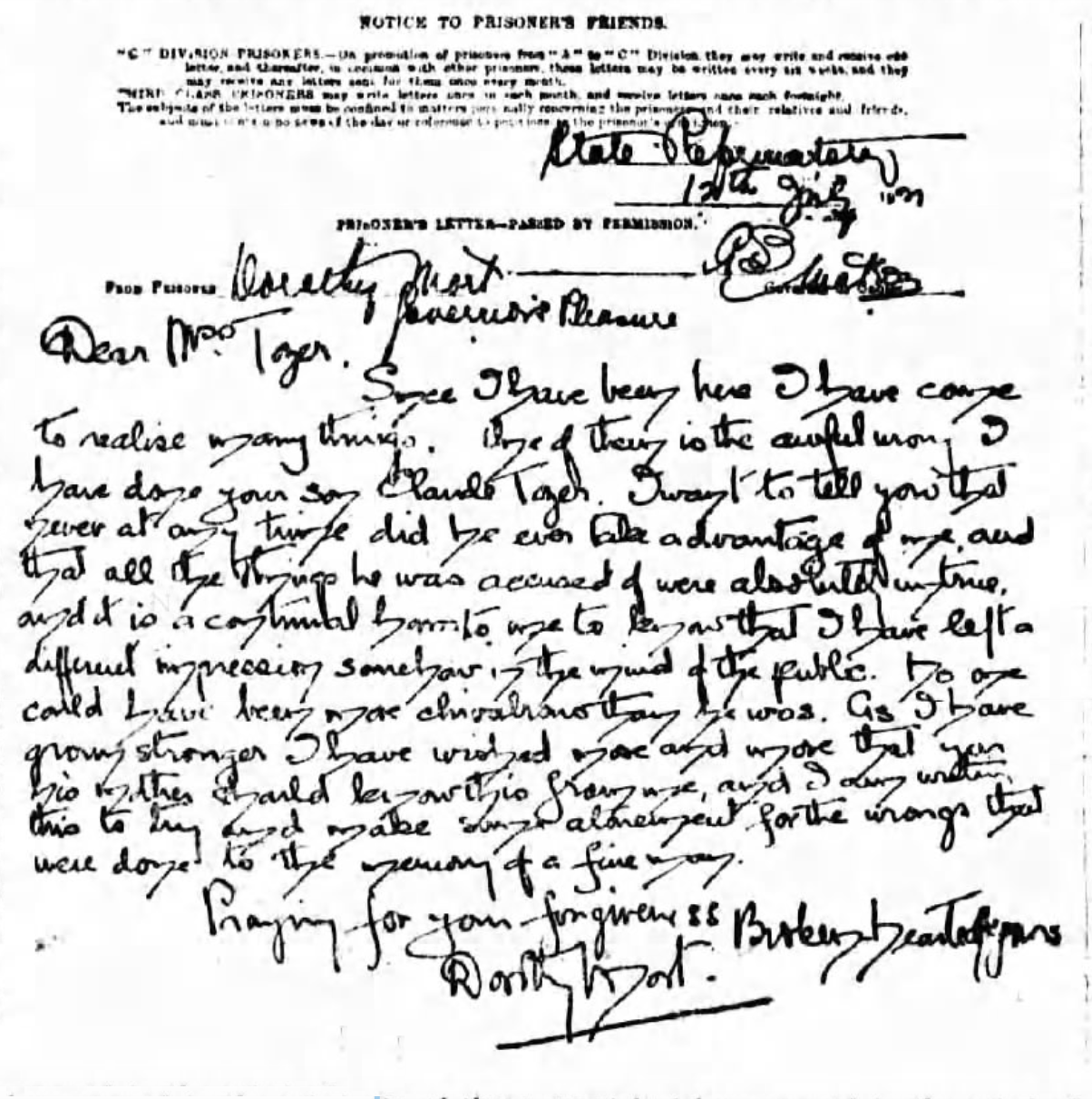
Since I have been here I have come to realize many things. One of them is the awful wrong I have done your son, Claude Tozer. I want to tell you that never at any time did he ever take advantage of me, and that all the things he was accused of were absolutely untrue and it is a continual horror to me to know that I have left a different impression somehow in the mind of the public. No one could have been more chivalrous than he was. As I have grown stronger I have wished more and more that you, his mother, should know this from me, and I am writing this to try and make some atonement for the wrongs that were done to the memory of a fine man.
Praying for your forgiveness. Brokenheartedly yours,
DOROTHY MORT.
Do you notice Dorothy’s odd phrasing? Her second sentence calls out “the awful wrong I have done” but there is no description of Dorothy’s wrongdoing. “The things he was accused of” is strangely passive. Accused of by whom? The same applies to “the wrongs that were done.” Wrongs that were done by whom? Strangest of all is the line that laments she “left a different impression somehow in the mind of the public.”
She seems to imply the defense’s smearing of Dr. Tozer was wrong and based on falsehoods. She wrote as if she, the client, had no ability to stop it. Her next letter to Mrs. Tozer continued this theme.
July 19.
Dear Mrs. Tozer,
I received your letter today thanking me for my letter. You ask if I have any objection to my letter being made public in some way. No, I have none at all, if it is going to clear your son’s name, which would never have been besmirched if my health in that Court had been as it is today.
Sincerely yours,
DOROTHY MORT
Because Dorothy gave her permission to Mrs. Tozer to print the letter, we have a copy of her handwritten letter.
It’s difficult to analyze a picture of someone’s handwriting as opposed to the paper itself. Overall it gives the impression of confusion or tangling. Most people who are ill tend to have light pressure, but Dorothy’s writing looks heavy. When the letters Y and G are suddenly and habitually cut off, they’re called clubbed letters. It’s not a well understood trait but it has been associated with cruelty.
Note her signature. This time, she signed it Dorothy, not Diana. Most people tend to put their signatures closer to the right margin, Centering it on the page is associated with a desire for attention. When people put a pedestal under their own name or someone else’s, it’s associated with putting that person on a pedestal. She also puts a period after her name. In signatures, this is associated with self-centeredness.
Read the final installment: Part 12: Dorothy’s Fate!
If you liked this post, please subscribe to Old Spirituals, like and share the post on your social media, and leave a comment! It really helps other people find the site. And if you’re so inclined, check out my books on Amazon or click the button to Buy Me a Coffee!

 old spirituals