On January 2, 1903, a stockbroker named W.H. Scott who lived in Kansas received a letter in the mail. The envelope was plain and had a coarse texture. It was clearly addressed to him and bore no return address. Scott was just leaving the house on a business trip, but he paused when he saw the envelope.
He tore it open and removed the letter inside, which was written on plain white paper. Scott unfolded it and read the message. Then he read it again. And again. And again. The message itself was only one line but Scott stared at it, seemingly unable to comprehend its meaning.
The letter read: “We know of two men who are preparing to steal one of your boys for a ransom.”
It was signed A Friend.
Scott’s trip evidently couldn’t be postponed or canceled. So the stockbroker turned the letter over to a friend and asked him to notify the police.
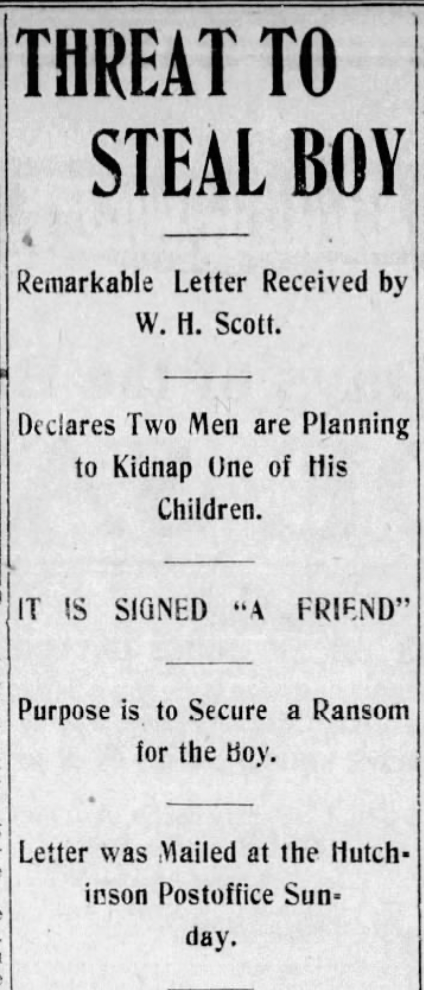
The authorities traced the letter to the Hutchinson postoffice where it had been mailed on Sunday and Mr. Scott got it Monday morning. They deduced that the letter was not written on ordinary paper but was likely the fly leaf of a book. There was no means to identify the writer. They theorized that the letter was genuine, and that someone in the confidence of the would-be kidnappers and knew of their plan had decided to foil the plot.
“Who the plotters are, of course, is not known, although the authorities will make every effort to locate them,” the local paper reported and speculated that the plotters were probably local men who thought kidnapping was a good way to make some easy money. “Since the plot has become public the would-be kidnapers will have no opportunity of carrying out their plans. The boys will be guarded by their parents and the police will keep a sharp lookout.”
The newspaper seemed to find the situation to be rather funny. “Not only could they not carry out their plot, but they could not even maintain the necessary secrecy until the time to carry out their plans arrived,” the article gloated. “It is likely that the police will be able to find out who the plotters are.”
But they didn’t. Or if they did, it was never written about in the paper again.
In my opinion, the anonymous letter Scott received sounds legitimate. It probably was a real warning about a plot that was in the works.
My first thought was that three people can keep a secret if two of them are dead.
My second thought was that it’s strange that the father received such a message and immediately left town anyway. (Though behaving a little coldly doesn’t make him guilty of anything.)
What do you think?
 old spirituals