We recently talked about San Francisco’s Bohemian Club. Its name comes from its original purpose of building a fraternity of artists and writers. As soon as membership was opened to the wealthy and powerful, they replaced most of the club’s original population. For convenience, to distinguish the two groups from one another in this post, we can call them the Elites and the Bohemians.
So many Elites wanted to join the Bohemian Club, membership had to be capped at 2700. The Bohemians themselves were almost extinct in their own club, until a bylaw was passed to ensure 10% of the club would always be made up of artists and writers. Even with 2,430 places reserved for Elites, some influential men have waited up to 15 years to get in to the club.
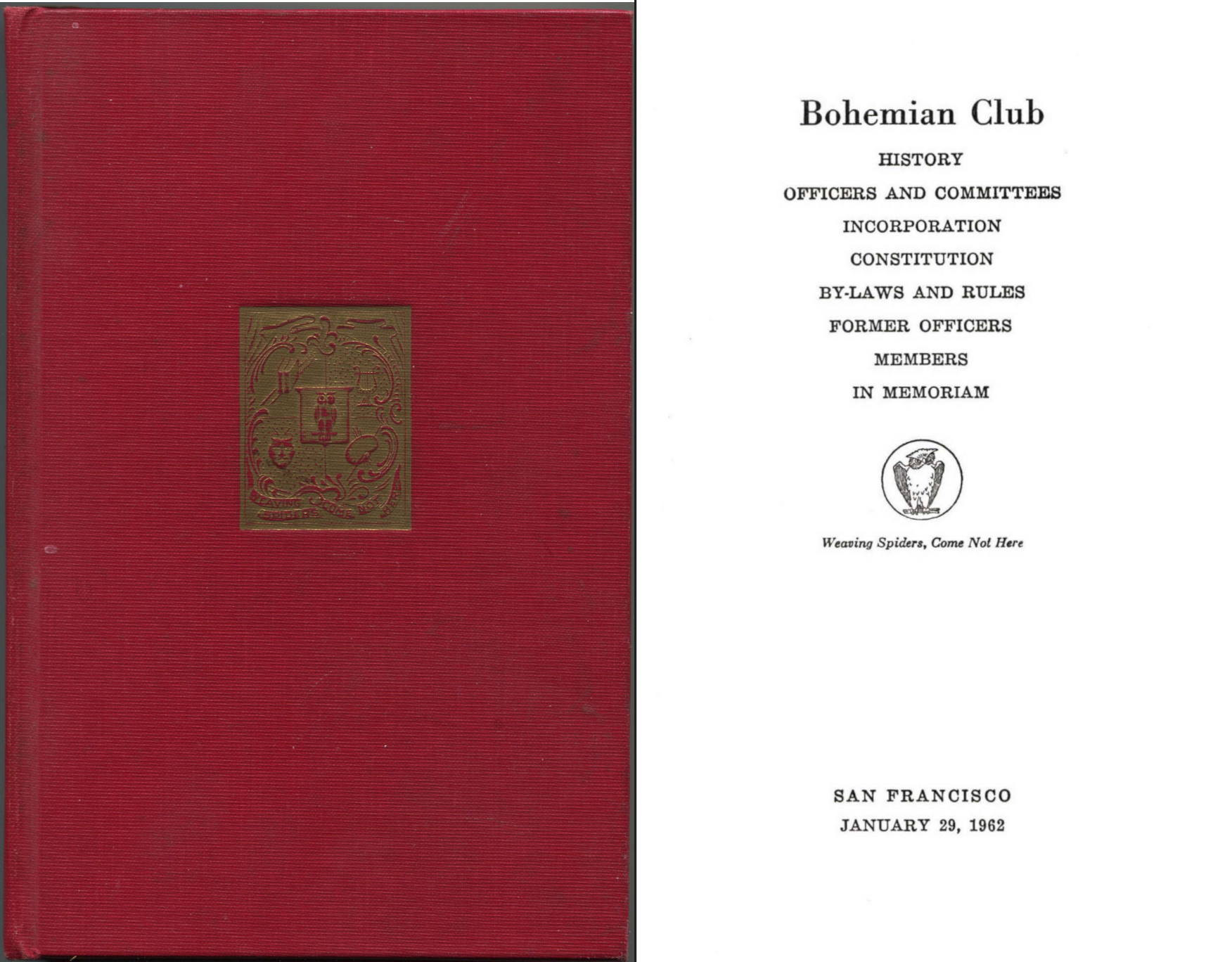
Bohemian Club membership book from the 1960s
The Elites and the Bohemians aren’t natural friends nor enemies. They are two separate species, populations that would never interact outside of the Bohemian Club. We can infer there have been tensions. At least some of the Bohemians saw the Elites as necessary evils to pay for the luxurious accommodations and provide access to restricted spaces. Whereas some of the Elites didn’t have much interest in art but thought it was prudent to retain a handful of the Bohemians to entertain the powerful at the group’s annual summer retreat. The relationship may not be warm but at least it’s mutually beneficial.

The Buffalo News, 1977
The Club’s most famous activity is their two-week summer retreat at their 2,700 acre Bohemian Grove property in Sonoma County. Each member who attends the retreat is associated with one of the 118 rustic accommodations that populate Bohemian Grove. These camps are where many of the political and corporate alliances are made that shape our world. Archive.org has an astounding infographic from 1991 showing the club membership and their various other affiliations. The graphic also shows the various camps members stayed in. In the Hillbillies camp, you could find Secretary of Defense Donald Rumsfeld, President George H. W. Bush, famed anchor Walter Cronkite, and Mickey Hart, the Grateful Dead drummer. Over in the Woof camp, you could find astronaut Pete Conrad, Secretary of State James A. Baker III, venture capitalist Steven L. Merrill, and John Brent Mills, the author and playwright.
A photograph of a camp in Bohemian Grove, by the great Arnold Genthe, made between 1896 – 1911:

LOC
Each year, on the first night of the retreat, an elaborate ritual is performed. The Cremation of Care is a symbolic ceremony performed annually on the first night of the two-week retreat in July. A hooded ferryman conveys an effigy representing Dull Care across the lake, places it on an altar before a 40-foot tall concrete Owl, and sets it on fire. This represents the banishment of worldly worries and the enjoyment of the sanctuary. Pyrotechnics are a regular part of the celebration which seems insane with all the beautiful redwoods there and the unfortunate threat of wildfires.
A 1907 photograph of the ritual:

Wikipedia
Bohemian Grove is not solely used for the summer retreat. Other significant gatherings have taken place there. In September 1942, the Grove was the site where a planning meeting took place for the Manhattan project, which led to the atomic bomb. The meeting was attended by two Nobel Prize winning physicists; the presidents of Harvard, Yale, and Princeton; military officials like Major Thomas T. Crenshaw and Colonel Kenneth Nichols; and Standard Oil and General Electric representatives. Do you suppose any Bohemians were present for that?
Throughout its 150-year history, the Bohemian Club and Bohemian Grove have played a unique role in American history. When it was founded, the Bohemian Club traded in art and literature. Today’s currency seems to be secrets.
I’m attracted by mysterious rituals and hidden knowledge. At the same time, I would regard many of these people in much the same way I would a benevolent rattlesnake.
What do you think of all of this? Does the Bohemian Club repulse you, or do you find it has a strange allure?
 old spirituals