The maid’s screams pierced the mid-morning quiet.
In the hallway, guests of Columbus, Ohio’s Deshler Hotel hurried into the hallway. What was it? What was the matter?
The maid pointed inside the open door of Room 305. Guests crowded in the doorway to gape at the body of a woman, lying on the floor in a pool of blood. The shock of the murder was closely followed by curiosity about the victim’s identity. She didn’t look like someone who would be staying at the upscale, 12-story Deshler Hotel.

The murder had been a brutal one. The victim, who was partially dressed, had been shot in the head and her throat was gashed. She was soon recognized and identified as Mona Simon. She was originally from Philippi, West Virginia but had been living in Ohio for six years.
Through their investigation, police found a monogrammed handkerchief with the initials W.H.W. A few people had observed the woman the night before in the hotel bar with a man who was considerably more refined than she. The room was registered to a man who gave the last name “Van Brunt.” Police suspected it was an alias.
Back in Barbour County, West Virginia, Mona Simon’s former friends and neighbors heard the news with a sigh. “Poor little weakling,” they said. Mona was a sweet little girl who grew up to be a charming young woman. She left Philippi six years earlier, and had only returned once, to care for her ailing father before his death. Her mother died when she was little and her siblings had lost track of her.
The January 13, 1917 edition of the Mansfield News reported: “She received her education in the public schools and after her graduation took a position in the Philippi telephone exchange. Her charm made her unquestionably the village belle. Six years ago she left Philippi to come to Columbus…She was in the flower of young womanhood and at the height of her popularity, a vivid contrast to the deserted, haggard, unkempt woman whose body lay in a pool of blood at the Deshler Friday.”
What had happened to Mona in Ohio? According to the papers, the belle of Philippi had become a slave to vice.
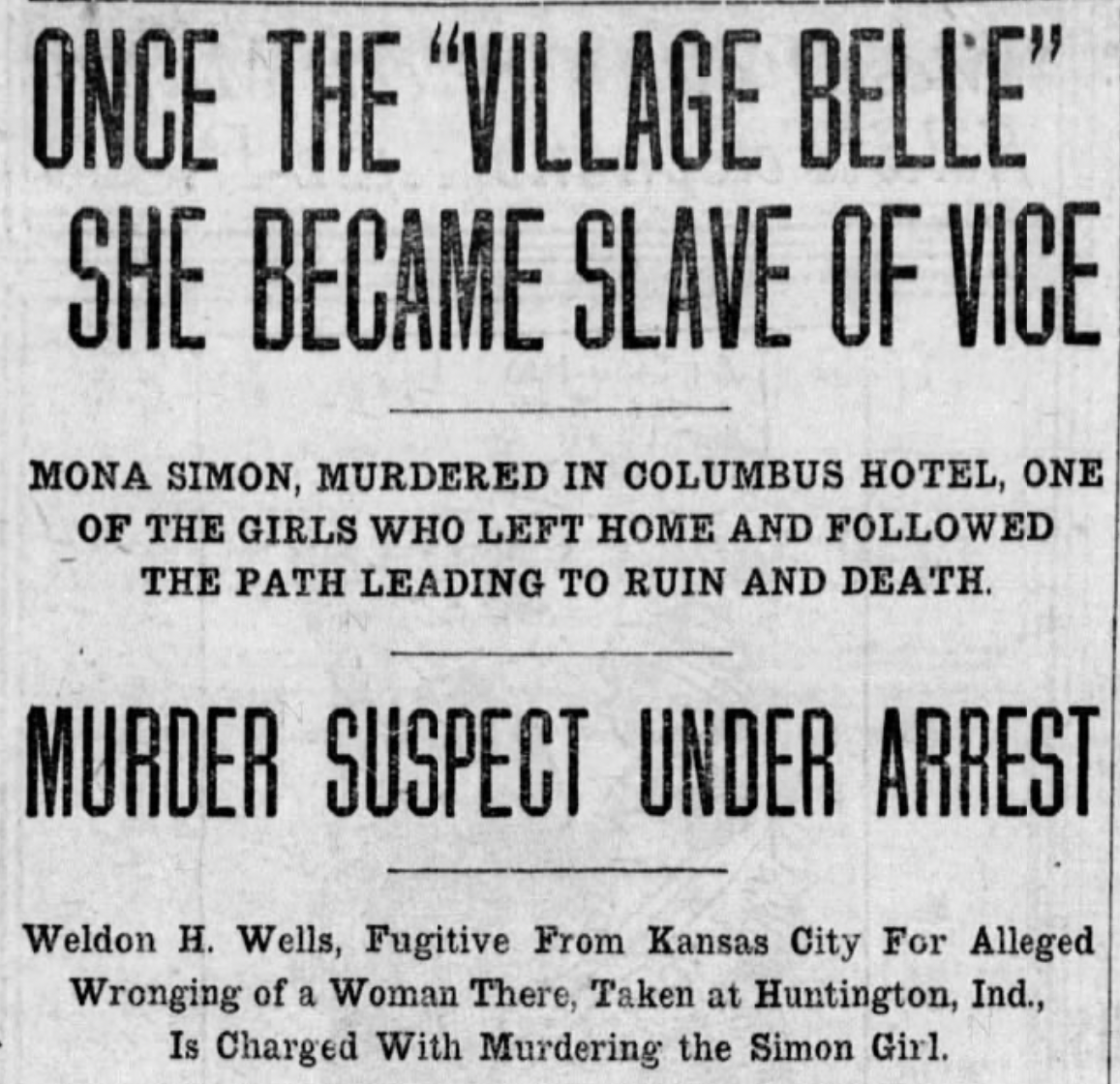
Mona’s downfall began with her marriage, which occurred around the time she left home. Her husband shot her during a quarrel, and consequently served a term in the West Virginia penitentiary. He had recently been released but police did not suspect him of the murder.
After her husband was sent to prison, Mona moved on, but her drinking caused her to lose one job after another. She moved from Cincinnati to Canton and finally landed in Columbus.
Those who knew her said Mona had a heart of gold. Whisky and men were the twin causes of her ruin. She was frequently arrested and served a term in the workhouse.
FindaGrave.com
The Mansfield News quoted Miss Charlotte Martin, of juvenile court, in her assessment of the victim. “With Mona, drink was a disease,” she declared. The troubled girl tried to live in places with fewer temptations but the glittering lights of Columbus beckoned to her irresistibly. “Every association worker who came in contact with her was her earnest friend,” Miss Martin went on. “She was so appreciative and well-read and evidently well-born that she stood head and shoulders above the class we dealt with. The one word–drink–sums up Mona Simon. Her end came just as we feared.”
She was forever turning over a new leaf only to turn to a new drink.
The suspect was identified two days after the murder. His name was Weldon H. Wells, from Huntington, Indiana. Wells was traced through his handkerchief and from information provided by a local who was a longtime acquaintance of the suspect. Wells was divorced and rumored to have a violent temper. When he was a boy, he had once attempted to kill a girl with a pitchfork.
Wells was apprehended at home in Huntington, Indiana. When he was arrested, he was wearing a stained undershirt that the police insisted was blood. Newspaper reporters were waiting at the police station when he was brought in for questioning. They showed him Mona’s picture. “I never saw the girl in my life,” Wells said flatly.

The police wore Wells down easily and he admitted he had killed Mona. He was in Columbus on January 11, not for work, but because he was on the run.
His former employer, Charles Ward, accused him of embezzlement, after Wells stole money and some blank checks. He sent Mr. Ward a letter that read, “There is little use for you to try to find me. By the time you get this letter I will be in Canada, a member of the Royal Guard.” Wells enclosed the checks but not the money.
Wells may be the most unimpressive criminal to ever disgrace the state of Indiana. He was like Bond villain, who confesses his crime in great detail, right before being caught. Wells also explained where he was going to evade justice and what he planned to do there. Perhaps as part of his route to Canada, Wells went to Columbus, a city where he was well known through his work.
He encountered Mona on the street a few blocks from the Deshler, where he had checked in earlier in the day. Mona suggested they have a drink at a dive, but Wells demurred. The Deshler had a bar, he said. Once they arrived there, Wells took another look at his companion. Her friendliness on the street had masked the tawdriness of her appearance, and he began to suspect she was a prostitute. He unsuccessfully tried to shake her in the bar and later in the lobby, but Mona insisted on going to his room.
From there, we must take Wells’ word for what happened, but he probably told the truth. According to Wells, they had been in his room for 25 minutes, when Mona suddenly began laughing and merrily confessed she was afflicted with a venereal disease.
It was men like Wells who had ruined her, she said accusingly. She told him she hated men and threatened to slash him with a razor. Whether the razor belonged to Wells or Mona was carrying it with her is unknown. They wrestled for it and her neck was gashed, but she still had the razor. Wells shot her and left in a hurry. His undershirt was stained with blood and “red lip paint.”
Wells was extradited to Ohio and received a life sentence. He served only six years before his sentence was commuted. He lived a few more years and died of tuberculosis in Kansas City.
Mona’s death became a cause célèbre, a golden-hearted girl who became a fallen woman, through the evils of alcohol.
 old spirituals