Once upon a time, everyone knew Storyville. The red light district in New Orleans was abuzz with dance halls, gambling joints, saloons, and brothels.
Storyville was named for Alderman Sidney Story, who wrote the legislation that enabled the district to operate. Ostensibly, the legislation forbade any and all prostitution in New Orleans in 1897–outside of one well-defined district. Prostitution wasn’t exactly legal but the wording of Story’s ordinance was such that it could be regulated.
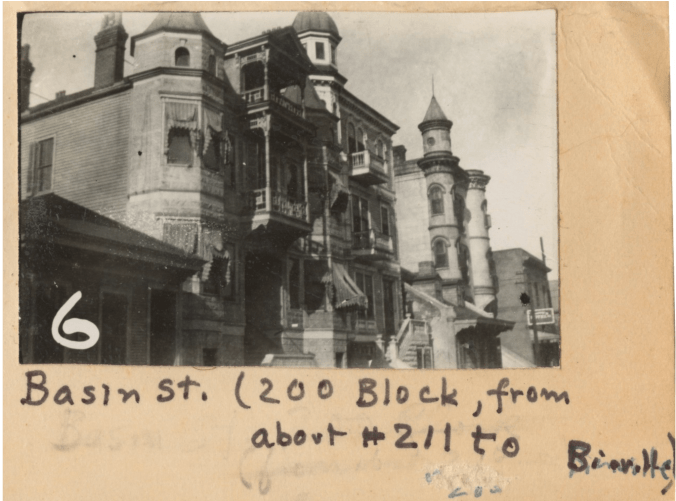
From hnoc.org A view of the 200 block of Basin Street, showing brothels
Photographer E.J. Bellocq photographed the girls and women of Storyville. Many of his famous photos are a bit racy for Old Spirituals, but he was a brilliant photographer. Here’s one of his more tame photos:
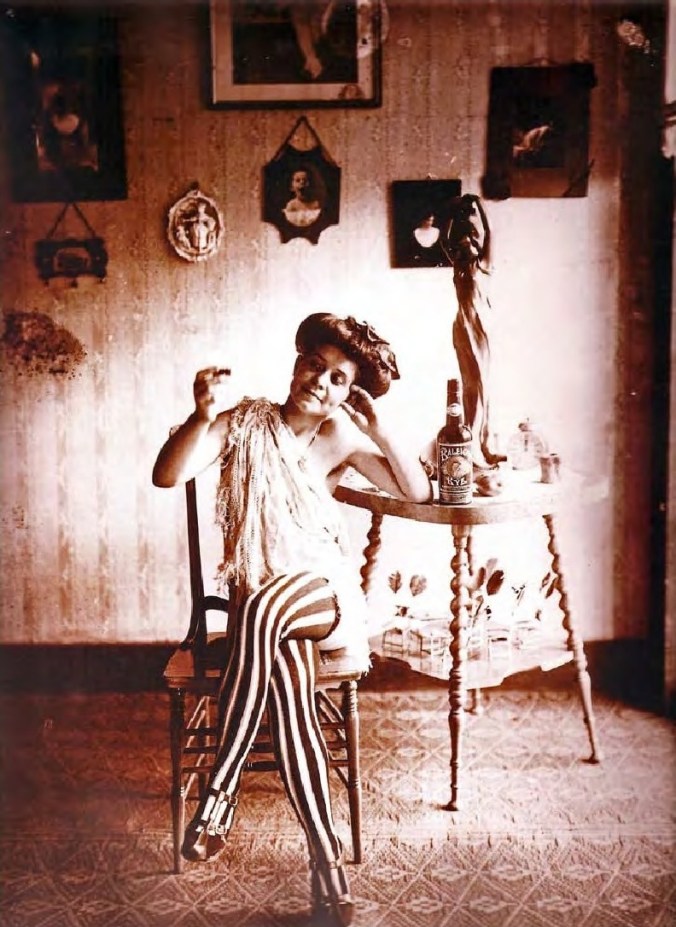
E. J. Bellocq, circa 1915
Storyville had many establishments and they were usually run by madams, who kept the houses and hired the girls who inhabited them.
Lulu White was one of the more infamous madams. Ms. White’s clients were some of the most consequential men in Louisiana and her establishment, Mahogany Hall, flourished in old Storyville. At one point, she had a staff of 40 women.
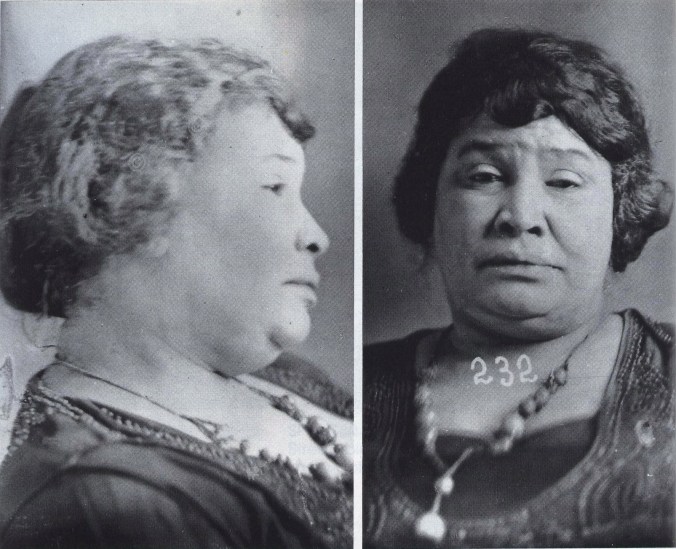
One of Lulu White’s mugshots. She got in trouble a lot.
People navigated the maze of streets and vice dens using Blue Books.

The 1901 Storyville Blue Book cover. From HNOC.org
Blue Books were practical directories of the demi-monde. A new book was published every year, listing the addresses of the various brothels, usually with information about the occupants, such as names, ages, and race.
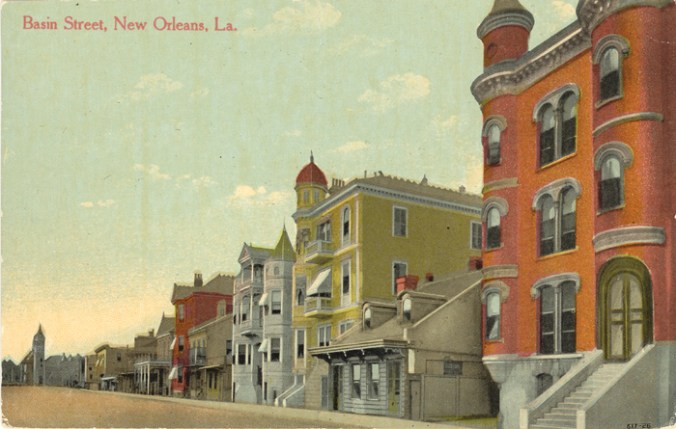
Basin Street was home to some of the more elaborate establishments

hnoc.org Corner of Perdido and Liberty Streets, Uptown Storyville
The establishments varied widely in terms of quality, discretion, and atmosphere. The Blue Books contained hints for the men who used them, such as describing an establishment as discreet or alluding to the beautiful furnishings. Others might refer to jolly girls and fun times. Take these two places for instance, which were side-by-side in one of the blue books:

Occasionally, you could find an ad for a saloon amongst the ads for the houses. There you might bump into Louis Armstrong or Jelly Roll Morton playing and entertaining the people. Lots of apothecaries dotted the streets as well, and they sold mixtures marketed as “sure cures” and “pleasure friends”–auxiliary products that sold well in Storyville!
Some of the ads would be enough to scare a more timid (or intelligent) soul straight out of this red-light district.


A page from Storyville’s 1900 edition
You can see the contents of some of these Blue Books online.
Storyville’s heyday was a casualty of the Great War. After four soldiers were killed in separate incidents in the district within just a few weeks of each other, the military demanded that Storyville be closed down.
The mayor of New Orleans, Martin Behrman, said, “You can make it illegal, but you can’t make it unpopular!” Nevertheless, he acquiesced and ordered Storyville prostitution come to an end at midnight of November 12, 1917.
The district continued to be the home of gambling halls and speakeasies but the Army and Navy had dealt Storyville a death blow. The place gradually faded away and in the 1930s, the site was used for public housing. By then, city officials were ready to put the district’s wild days behind it. Today, very little is left of this once-infamous neighborhood, minus three saloons that are still standing. Storyville is a place that can only be visited in pictures and imagination.
 old spirituals
This is the 500th post on Old Spirituals! ✨
LikeLike
Woohoo on 500 posts! 🥳🎉🎊
LikeLiked by 1 person
Thank you! 🙏🏼 🌸
LikeLike
love this! I’d like to know more about Lulu White 💍
LikeLiked by 1 person
Thank you! Lulu is definitely an interesting character!
LikeLike
Congratulations on 500 posts!!! I always enjoy the very interesting content.
LikeLiked by 1 person
Thank you, Judy! Your comments always make me smile!
LikeLike
Congratulations on the 500th landmark. The effort is appreciated and the post are enjoyed.
Anyone who has spent time in Louisiana, particularly New Orleans, should not be surprised by the history of Storyville. Just walk Bourbon Street in the French Quarter at night. The best time is during Mardi Gras.
Louisiana is the only State in the Union with laws NOT based on English Common Law. Private law in Louisiana, i.e. principally contracts and torts, has principles based on French and Spanish common law codes. Judges may use their own interpretation of the law; they do not have to rely on precedence.
LikeLiked by 1 person
Thank you, Jax! I really appreciate you and everyone who reads and comments on my stories!
I didn’t know any of this about Louisiana law but I’m not surprised exactly. Louisiana is a state that defies classification. It has a unique culture that sets it apart from the other southern states!
LikeLike
Pingback: Reminiscing about Storyville | old spirituals