This is the second and final part of the Canton Poison Pen writer story. See comments for a link to Part 1.
To the Evansville Press, Mrs. Feicht emphatically insisted on her innocence and her lawyer said he would prove the offense against someone else. “‘I am only too anxious for the trial to commence,’ says Mrs. Feicht. who is a blue-eyed, refined-looking woman of great attractiveness. ‘I am the victim of a plot.'”

Her case was scheduled to begin on March 11, 1907, at the U.S. District Court in Cleveland, Ohio. When the day arrived, the courtroom was a circus. Over 100 of the richest residents in Canton, mostly women draped in their best finery, traveled to Cleveland to watch the proceedings. As the trial commenced, with Judge Robert Tayler presiding, Mrs. Feicht rose royally from the defense table and denied all involvement. “It is a plot, a conspiracy,” she declared.
The accused woman took the stand. She admitted she had purchased 25 stamps but denied that she used any of them. Mrs. Feicht told of the cruel treatment she received at the hands of Post Office Inspector Owen and Postmaster Clark. When she denied the charge, she invited them into her home to see the unused stamps. Despite her graciousness, Owen and Clark had shoved her to one side and searched her sideboard until they found the stamps. She tried to telephone her husband, but Postmaster Clark knocked the receiver from her hand.
Then Mrs. Feicht accused the woman she suspected of being the real writer: Mrs. Maud Gibbs Payler. This testimony brought a shrill laugh from the gallery from Mrs. Payler herself.
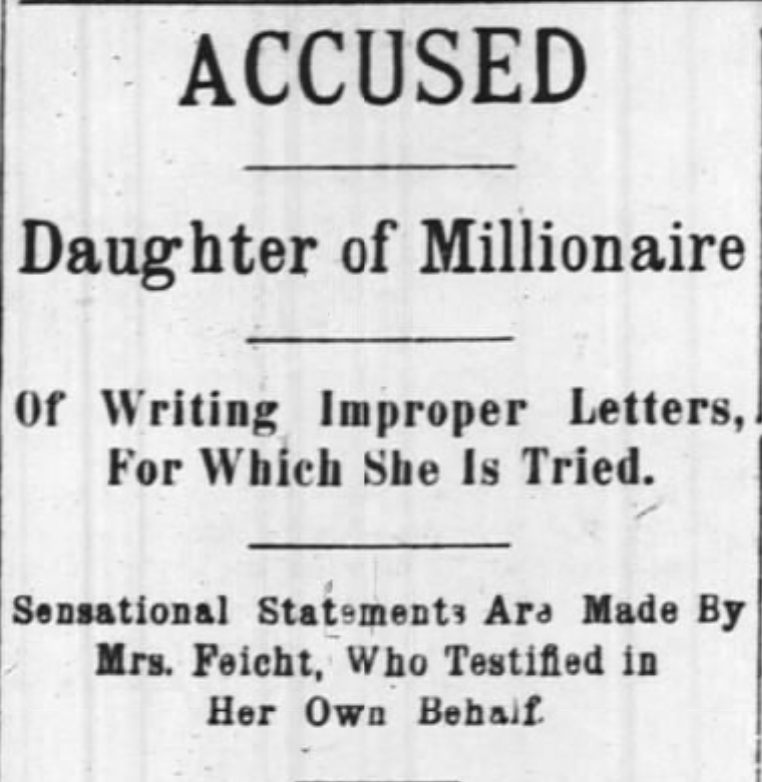
As you might guess, Owen and Clark told a slightly different version of events when they were on the stand. They described finding two of the marked stamps on obscene letters at the Canton post office. It’s not clear if they intercepted Mrs. Feicht after she dropped the letters off or if they merely confronted her there. In any event, the lady denied mailing the letters. She said all of the marked stamps were at home and invited the men to come and see for themselves. They agreed but when they arrived, Mrs. Feicht suddenly demanded to know if they had a warrant. She never did produce the stamps.
Dr. McConkey was put on the stand and asked if he had authored any of the obscene letters. The doctor said he neither wrote nor signed them. He was then asked how many times Mrs. Feicht had visited his office or he had called at her home. “She has called at my office a number of times for professional treatment,” said the doctor. “I have been in Canton practicing for six or seven years and she called a number of times. I do not remember ever having visited her at her home.”
Another of Mrs. Feicht’s attorneys, John C. Welty, cross-examined McConkey. Had Mrs. Payler visited his office or called at his home? The doctor said she had called at both places, professionally at the office and sometimes socially at the home. “But when she called socially at my home it was to see my wife,” he added.
“Did she got riding with you with your horse and buggy?” The doctor said Mrs. Payler had gone riding with his wife.
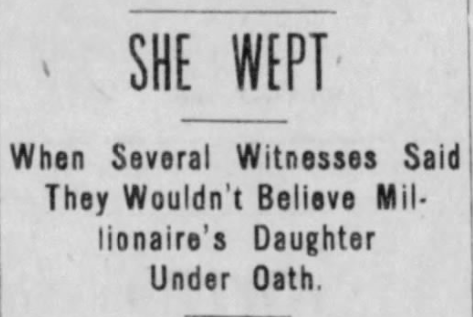
Mrs. Payler was put on the stand and denied she had written or mailed the letters. In response, the defense brought up eight of her neighbors, who agreed they wouldn’t believe anything Maud Payler said, even if she was speaking under oath. Several other witnesses testified to the defendant’s excellent character. Mrs. Payler was recalled. When confronted with her neighbors’ poor opinion of her veracity, she burst into tears.
It’s a good thing she didn’t have that revolver on her.
By the end of the day, the Cincinnati Enquirer had grown bored. “The trial has resolved itself into a battle of gowns, with Mrs. Feicht and Mrs. Payler in the heavy roles,” the paper yawned. “All of the Canton women in attendance appeared in the latest creations, Mrs. Feicht and Mrs. Payler being especially well garbed.”

At 11 a.m. on March 14, the courtroom was called to order and the jury silently filed in. The verdict was Not Guilty.
Mrs. Feicht was instantly surrounded by a group of friends. She laughed and then she cried. “I knew I would be vindicated,” she sobbed. “I am innocent and the persons to blame for charging me falsely will someday pay the penalty! This has been the most wicked piece of malice that ever was perpetrated.”
Not everyone was so pleased. The Akron Beacon Journal reported that Judge Robert Tayler severely censured the jury that had freed Mrs. Feicht. Such a finding, he told the jurors bluntly, was not reconcilable to the evidence. It was a miscarriage of justice.

Just three months later the anonymous letters made a final appearance.
“The discovery yesterday that two obscene letters had been written and delivered through the mails to Thomas L. White, of Dayton… and Fred Hoerter, of Louisville, Ky,…caused a sensation,” the Lima Times-Democrat announced. “The letters revive the mysterious letter case in which Mrs. George Feicht, of this county, was tried and acquitted in Cleveland recently. Many Cantonians received the unprintable epistles at the time. They bore the signature of Dr. McConkey, of this city. The letters received by White and Hoerter contained the same signature and are similar in contents.”
It’s likely these letters were written by the same author, but who was it? An unrepentant Mary Feicht? A malevolent Maud Payler? Or was it really Dr. McConkey, or someone else altogether? But these letters were seemingly the last. No more stories were written about Canton’s anonymous letters case again.
Now, what happened in this case? I await your clever deductions!
 old spirituals
See Part 1 of this story.
And, as mentioned in this post, here’s a link to another poison pen writer we’ve examined. The Wickedness Harriet Wrought
LikeLike
During the few years I lived in the Canton, OH, area, I do not recall being told this local history about “Poison Pen Letters.” People must have decided to let the story fade into the annals of history. I much prefers the history surrounding the founding of what we know today as the National Football League and Jim Thorpe, the Leagues first President.
LikeLiked by 1 person
I guess that’s slightly more inspiring than a poison pen writer! I’m not surprised this person didn’t make it into the local history books. But what do you say? Did Mrs. Feicht write the letters?
LikeLike
I investigated the Gibbs family after I read the patriarch was from New Jersey, Pennsylvania area and a Quaker who moved to Canton to grow his business. Suspect he is a distant relative.
https://www.hobbydb.com/marketplaces/hobbydb/catalog_items/gibbs-new-wooden-toys
http://vintagemachinery.org/mfgindex/detail.aspx?id=12030
https://www.worthpoint.com/dictionary/p/toys-dolls-games-puzzles/toys-manufacturer/gibbs-mfg-co-toys
LikeLiked by 1 person
That’s so interesting! Just reading a little about the Gibbs family in the course of writing this, they were a very prominent family in the Canton area.
LikeLike
I don’t know about this one. The Harriet Jones case was more clear cut to me. What was Mrs. Feicht’s motive? It’s too bad that we don’t know more about her relationship with Mrs Payler. I could understand the obsession with a good looking doctor but why Mrs. Payler? Could it have been one of those cases where someone is targeted in a mysterious and cruel way and it turns out to be self inflicted? In short, was it done for attention? Mrs. Payler’s neighbors didn’t think much of her. Did she ever give proof of this story about the detective? The doctor’s testimony too, seemed to suggest Mrs Payler was finding reasons to see him. Could she not have written the letters with the intention of getting closer to the doctor? I don’t know, she seemed like the better suspect to me.
LikeLiked by 1 person
You know, that’s a pretty good theory, Ruby. I took it for granted that the press had somehow verified all of Mrs. Payler’s stories but I reread it and you are right! It was all “Mrs. Payler says this or that….” When you put it in that light, everything looks a bit different. It seems more significant that her neighbors actually testified that they didn’t believe her, even if she was under oath. Why would they be motivated to do that? It’s quite likely the doctor wouldn’t realize what was happening if Mrs. Paylor was turning up at his home and office for less-than-honorable reasons. It’s not clear that they proved in court that a marked stamp Mrs F purchased was on an obscene letter. If so, her guilt would be inescapable.
LikeLiked by 1 person