We left Pasquale Marchesi in the most dire of predicaments. After catching his wife Roxsaria with his cousin, he grabbed a hand-ax and murdered them both. Then Pasquale dropped his children off at his brother’s house, wandered around until he wound up in his church’s basement, and lay on the floor having visual and audio hallucinations. He rushed upstairs and confessed to the priest about the murders.
(Did I mention Pasquale’s cousin was his namesake? That’s really adding some insult to injury.)
November 27, 1911 proved to be a sad day for Pasquale. A coroner’s jury held a formal inquest and returned a verdict charging Pasquale with murder. “Marchesi himself seemed to be the least interested person present at the inquest,” the Inter Ocean reported. “His attorneys had told the coroner that they would not permit him to go on the stand. but they insisted that he be present at the inquest. He paid little attention to the evidence and most of his time was spent watching the crowd. He has indicated that his defense will be the unwritten law while his attorneys declare that it will be an easy matter to prove the man insane.”
The same day, the funeral was held for Roxsaria Marchesi and her lover Pasquale Marchesi (not to be confused with her husband Pasquale Marchesi). “In rough boxes the bodies of both the victims were loaded in a “black wagon” without a sign of a hymn or prayer and taken to the cemetery. Not a person save the undertaker and his assistants were gathered about the two open graves and the Dust to Dust, Ashes to Ashes was even forgotten as the bodies were lowered into the ground,” the Kenosha News reported. “Not one of the relatives of the two people seemed to take any interest in the burial and the undertaker was even forced to go out to the house where the crime was committed and hunt up clothing with which to clothe the people in order to give them the semblance of decent burial.”

Associated Charities took in the Marchesis’ two small children, noting they were poorly clothed and poorly nourished.
Pasquale Marchesi entered a plea of Not Guilty to the charges and was remanded to the county jail pending a hearing on Dec. 11th. “The alleged murdered with new suit and his face closely shaved appeared like a different man from the one attending the coroner’s inquest on Monday afternoon. He had his old smile back again and when he came into the court room with Sheriff Stabl he bowed to the men in the crowd that he knew and smiled at some of his Italian friends who occupied chairs usually reserved for the jury.”
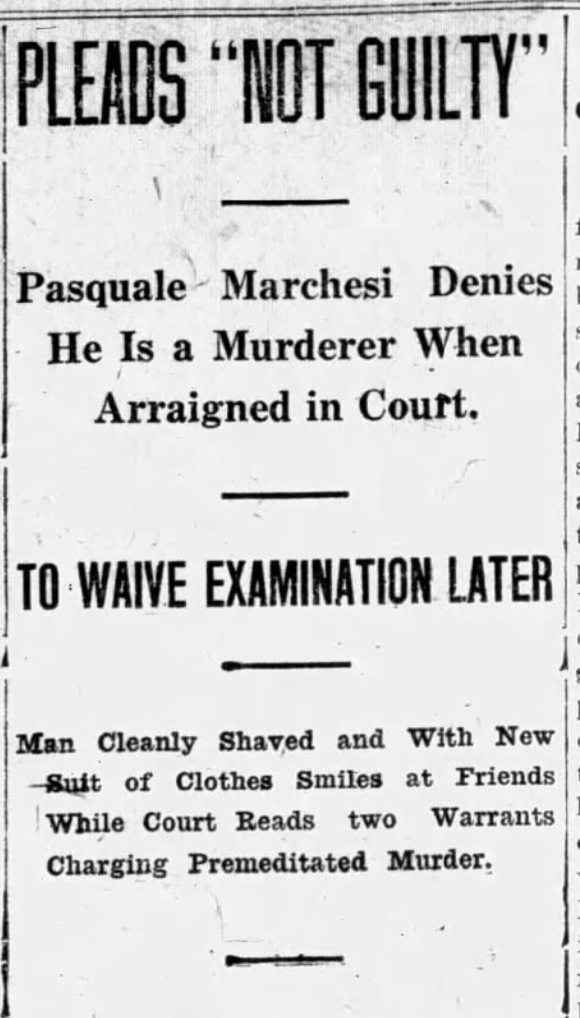
“It is declared that he suffered from a fall years ago and that since that time there has been reason to believe that he was not mentally sound. Italians in the city seem to be taking a great interest in the defense of Marchesi and it is declared that societies to which he belonged will arrange for a proper defense fund.”
The hearing on December 11 either didn’t happen or wasn’t covered. I’m guessing it was the former since this case was of such great interest in Kenosha.
By January 9, the papers were writing that Marchesi would be more likely to wind up in the asylum than a prison.

In May of 1912, Pasquale Marchesi was found guilty of manslaughter in the third degree, or as the Green Bay Semi-Weekly Gazette put it, he was “partly justified.” His attorneys tried to present his case that he was insane, either from the prior injury or the discovery of his wife’s infidelity. In the end, the jury determined he was sane but that the conditions under which the crime was committed would not warrant a heavier verdict.
That meant Marchesi would go to prison for two to four years. The funny thing was, almost everyone was happy about the verdict. The District Attorney secretly thought Marchesi was insane and was sure he would be acquitted. The defendant’s attorneys didn’t expect the outcome to be that great for Marchesi. The defendant’s Italian friends thought it was a victory for Marchesi.
Only Marchesi was distressed by the verdict and protested after he heard the finding of the jury that he expected to be released. Of course, he was the only one who was going to prison.
 old spirituals
Apparently, Marchesi was judged by a jury of his peers.
LikeLiked by 1 person
That’s true! They were pretty merciful by giving him 2-4 years for decapitating two people. I bet if that happened today, he would’ve gotten about the same sentence—heat of passion or similar?
LikeLike
I guess these days he would have been convicted of 2nd degree murder; a sort or catch-all for an unplanned but supposedly provoked reaction to someone. Really, for the brutality of the murders, he did pretty well. I wonder what happened to his kids and if they ever saw him again.
LikeLiked by 1 person
one article mentioned that Associated Charities took the children. I wasn’t able to verify it but I saw a guy named Pasquale Marchesi emigrated to Australia in the 1920s and was applying to become a citizen there and to change his name to Percy Marchesi. But I don’t know if it was the same man…
LikeLike