In mid-May 1905, the Evening World ran an amazing article announcing the death of the Veiled Murderess, a mad woman who had died after 50 years in prison.

To begin at the beginning, Henrietta Woods was born in Canada in 1827. She was the daughter of William Woods, Quebec merchant. She had three sisters, all beautiful women, and a brother. She was sent to the United States to be educated and when she returned to Quebec, she was betrothed to a young Philadelphian. But he was not considered Henrietta’s social equal and his suit was violently opposed by the girl’s parents. They had someone else in mind for her. An Englishman, Lord William Elliott, an officer in the British army, fell in love with the beautiful Miss Woods. She rejected him but the Woods family suggested a forced marriage. How they managed it was not recorded in the article, but somehow it was done.
Henrietta was miserable in England and she soon deserted her husband. She returned to the United States, and settled in Troy, New York. There, under the name of Henrietta Robinson, she began the life which ended in the madhouse. “She realized her position too keenly to try and force herself on those she had known in her schoolgirl days,” the Evening World reported. She had few friends. One of the only people in her world was a grocer named Timothy Lanigan. But they quarreled—and Henrietta spiked his beer with arsenic, killing him. She was arrested.
Her defense attorney, Martin Townsend, was unable to persuade the girl to tell him her real name. Nevertheless, he was confident he could free her. The defendant was so beautiful that he was certain the jury would acquit her. But Henrietta appeared in court wearing a heavy veil and nothing could persuade her to lift it, even a direct order from the judge. The girl resisted so fiercely that the court rescinded the order and she remained in court, present but invisible in her way.
The jury sentenced Henrietta to hang but her sentence was commuted to life in prison. She was sent to prison in Auburn, where she was known as Henrietta Robinson. Even behind bars, Henrietta refused to be seen without her veil. The rumor began to spread that the “Veiled Murderess,” as she was known, was Lady Elliot. The rumor gained traction and the Woods family was determined to stop it. Mr. Woods decided to host a large banquet in Troy. “Mrs. William Woods and Lady William Elliott were announced. The guests saw the beautiful smiling woman on Mr. Woods’ arm. There was no mistaking her: it was indeed Lady Elliott. She was the belle that evening and the next day she had disappeared again. How she got out of prison on that occasion has never been told. But gossip was laid to rest and Lady Elliott was back in prison known as the Veiled Murderess.”
Another woman, Mrs. Charlotte Norris of Chicago, had known Henrietta when they were young. She heard her old friend was in prison and decided to go to Auburn to see her. When the warden went to fetch Henrietta, he insisted she appear without her veil. The prisoner complied and was horrified to come face to face with Mrs. Norris. She cried out, “For heaven sake, don’t mention my name!”
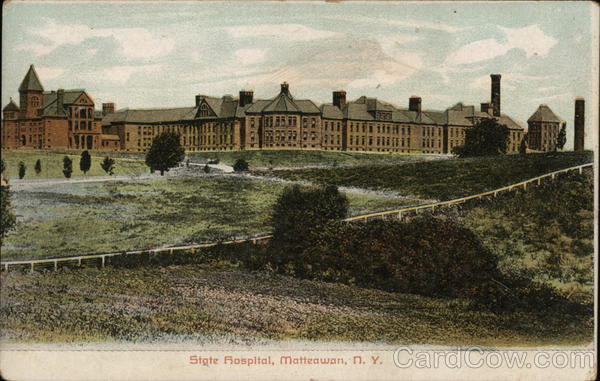
Matteawan Asylum
In 1900, five years before her death, the Veiled Murderess became “hopelessly insane” and she was removed to Matteawan asylum. Until she died, her lips were sealed regarding her identity. “For 50 years, she had been known as the Veiled Murderess,” the Evening World reported. “Today she is spoken of as Lady Elliott. Her body lies in the dead house at Matteawan Asylum for the Criminal Insane and none has come to claim it. It is said that the old woman has handled her estate so successfully that $250,000 awaits her heirs, if heirs she has.”
After Henrietta passed away, a locket was found around her neck containing this verse:
When first I saw this world of joy and pain assailed by doubts that ever will remain.
I wondered what it meant to live—to die. The question off I pondered but in vain.
Have you seen the 1929 silent film Pandora’s Box, starring Louise Brooks? The plot is suggestive of this story in so many ways, I wondered if it is based on this story!
 old spirituals
In Greek mythology, Pandora opened a box left in her care by her husband and decided to open it, unknowingly releasing death, illness and other evils into the world. However, she closed the box leaving one thing behind, “Hope.”
In the case of Henrietta Woods, she released death onto Timothy Lanigan. One can opine that Henrietta was placed in a box and never released.
Scholars say the translation from the Greek was incorrect. The word was not “box” but rather “jar.”
LikeLiked by 2 people
Do you know, I never realized that Pandora didn’t realize what she was doing! I always thought she released the evils upon the world on purpose because she was a wicked woman!
I love your thought about Henrietta being put in a box and never released. That’s exactly what happened to her.
LikeLike
Henrietta was supposed to have gone mad in 1900? She probably went mad in the 1850s when she was forced to become Lady Elliot!
LikeLiked by 2 people
Possibly! Her story reminded me a little of Mata Hari as well. She left her husband and also led a “loose life” in Paris before turning to dancing and spying!
LikeLike