This post includes a contest to win a free book! Just share your thoughts about the question posed at the end and you are entered in the contest.
Read on and enjoy a little musical accompaniment, if you like.
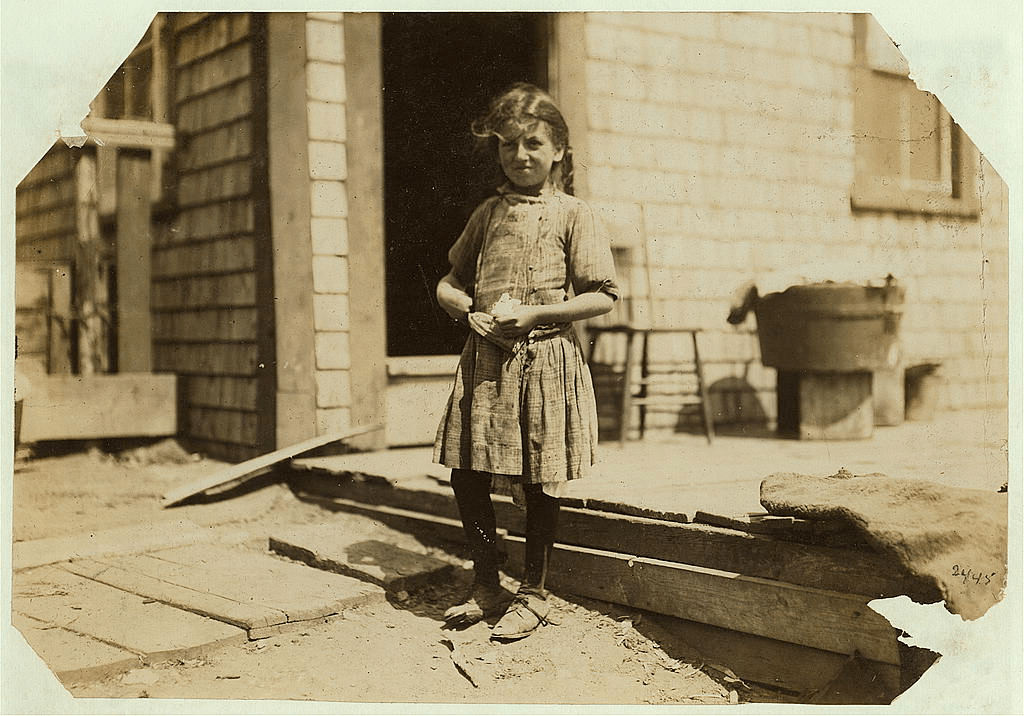
In August 1911, photographer Lewis Wickes Hines was indignantly photographing children who worked with dangerous equipment. One day, he was at a canning factory in Eastport, Maine when an 8-year-old Syrian girl named Phoebe Thomas began to scream. The end of her thumb was nearly severed by her machine.
Wickes Hine witnessed the difficult efforts to stem the blood flow. When at last it was under control, Phoebe was sent home for the rest of the day. Her mother worked at the factory too but she could not be spared. The girl walked home alone despite losing an alarming amount of blood.
Dumbfounded, the photographer captured the child’s image as she hurried home with blood running down her arm and hand.

Wickes Hine took another photograph of Phoebe, a little while after the accident. She is wearing a clean dress.
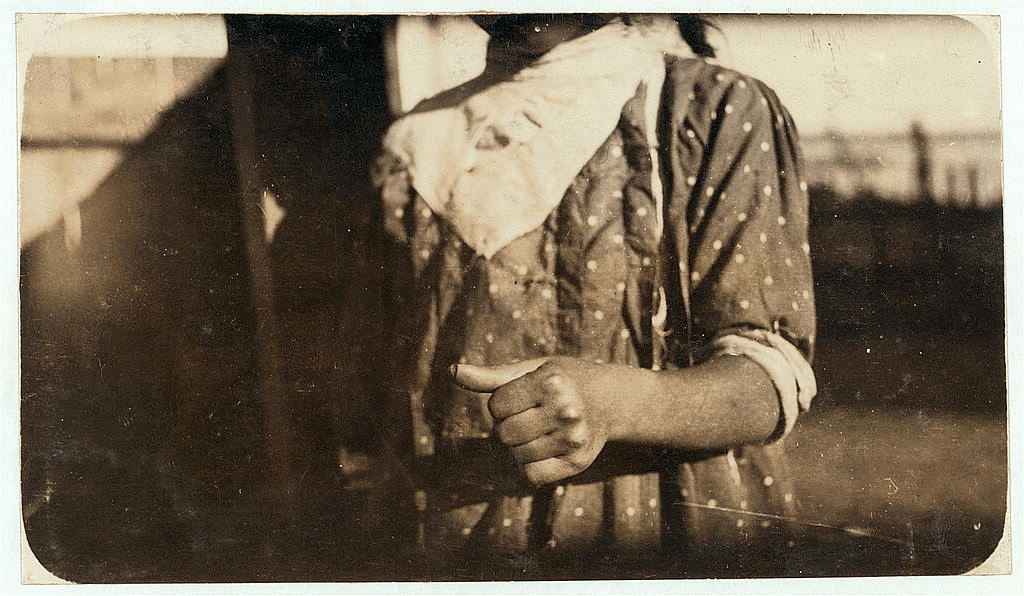
Phoebe’s thumb, pictures a week after the accident. She was back at the factory that day, using the same big knife.
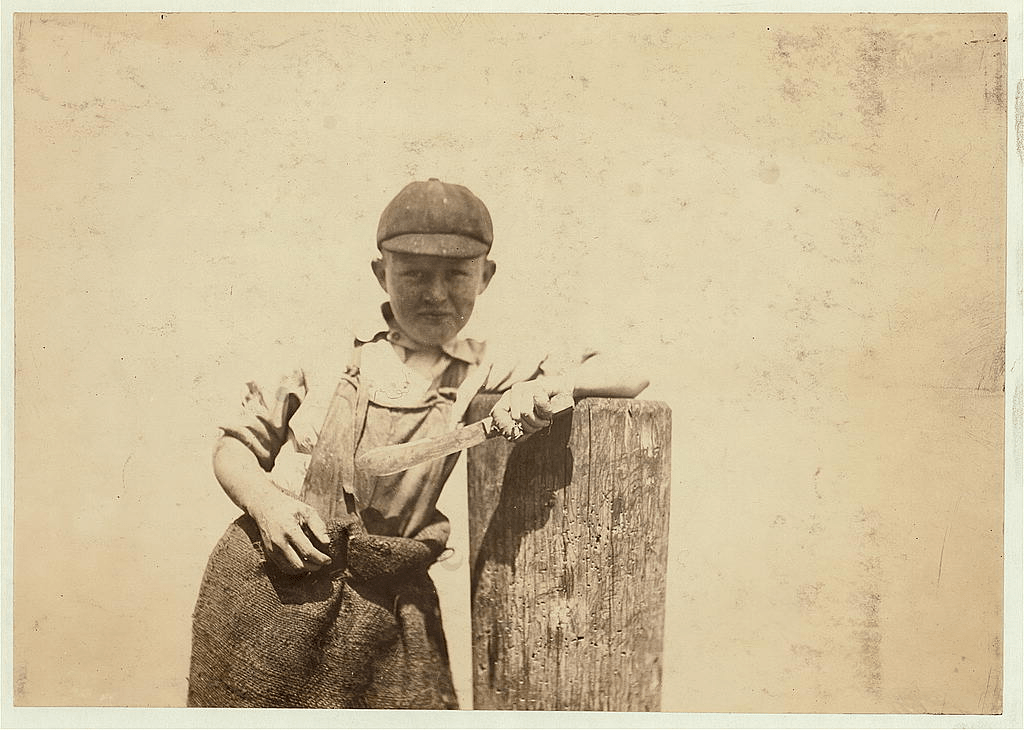
The photographer found that such wounds were common. Shortly after Phoebe’s accident, he talked to 8-year-old Ralph, another cutter in the canning factory.
He photographed the boy holding a butcher knife and modeling a badly cut finger, and noted, “Several children working with him had cut fingers, and even the adults said they could not help cutting themselves. August 1911.”
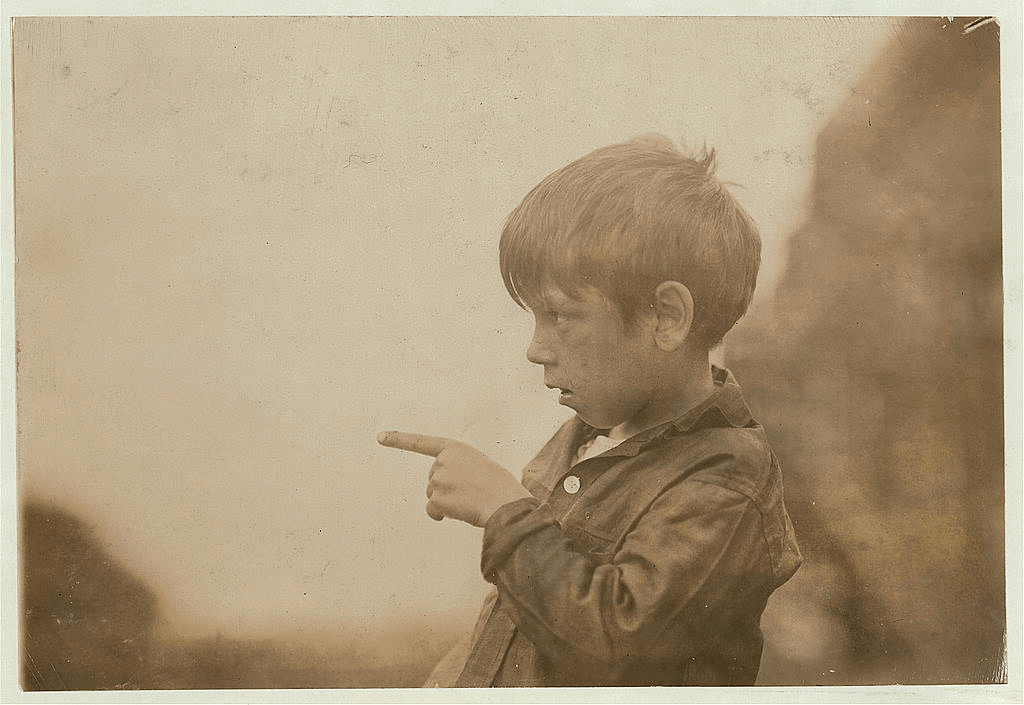
He photographed Richard Mills, 8 years old, displaying a severely cut finger here.

7-year-old Byron told Wickes Hines matter-of-factly, “I cut my finger off, cutting sardines the other day.”
Most people here are familiar with Lewis Wickes Hines but if you’ve never seen his pictures of the tenements and terrible living conditions from the turn of the century, check them out. Wickes Hines was a social reformer and he was infuriated by what he saw. In addition to the pain of seeing a hurt child, he raged that society considered it normal for a family to depend on the wages of an 8-year-old child working with dangerous equipment to keep starvation at bay. That is certainly where Wickes Hines wanted the focus to be.
I have a different question for you. When a child was unexpectedly hurt in these situations—even grievously injured—they returned to work as soon as possible. Even when faced with the tragedy of the death of a loved one, children were soon found toiling away.
There was no therapist, no grief counselor, no medicines, and no time to reflect on the terrific blow that had befallen them. It wasn’t acceptable to dwell on it. Children and adults had to carry on. Amazingly, there are few (if any) accounts from this time of emotional pain disfiguring a child’s soul, of people becoming twisted and bitter, and developing neuroses about traumatic experiences. Possibly they forgot it.
They had to carry on so they did.
This isn’t a plea to send 8 years olds back to work in canneries, of course. I’m considering how children handle an unexpected physical or emotional blow, versus older people. You could look at it a thousand different ways: How the poor go on versus the rich. Introverts vs extroverts. There is a vast spectrum of how people absorb and process pain, some healthier than others.
I have some reservations. I don’t know if it’s possible to overcome your nature. Some people are resilient, some are not. Some people may be unable to accept good, rational guidance. Nevertheless, let’s have a look.
What is the best way for a person to deal with a sudden emotional or physical catastrophe?
Write your answer in the comments. Let’s make it interesting and have a contest! The winning comment will be determined on Friday afternoon by the number of likes from the group. The prize is a free book.
– If you’re in the US, you can choose a paperback of the expanded Cold Heart or a Grievous Deeds audiobook
– If you’re bit in the US, you can have the Grievous Deeds audiobook from the UK or the US Audible store.
I’m interested to hear your thoughts! I’m behind on responding to comments since I haven’t been on my computer but thank you for leaving them and I will respond soon!
I’m traveling this week but will post when possible!
 old spirituals
Large families were the norm in the 19th and early 20th Century. Educational institutions were either not available for children or too expensive. Children were valued as a means of generating needed family income. Ergo, children were expected to work regardless of the hazards of the job.
Lewis Wickes Hine decided to photograph children working in a cannery. What about the children who worked on farms? They, too, were exposed to dangerous equipment, but it seems that farming was viewed differently than factory work.
LikeLiked by 1 person
Those poor people. Most parents probably would have preferred to send their children to school but I don’t think they saw a lack of education as a threat to the child’s prospects in life. At least not to the degree a parent would have 20 or 30 years later. I think you are right that factory work was considered more dangerous than farm jobs. But Lewis Wickes Hine did photograph them. We profiled a few pictures of children working on farms on Old Spirituals.I remember one little girl in a cotton field who only had one shoe.
LikeLike
It isn’t possible to compare one generation to another when it comes to catastrophes, emotional or physical. The children at the turn of the century, especially our legal immigrants, had to work so very hard to help the family just put food on the table and a roof over their heads. We would need to know what life was like in the country they came from. What had they escaped from to have freedom in America? Freedom is never free and our own pioneers toiled night and day. My heart breaks when I see pictures such as these. Children, such as my dad, lost fathers at a young age and had overwhelming hardships. I do not agree with child labor, but we must face facts, this was how it was at that time, unfortunately. I’m so glad child labor laws came into being.
Just about all of our people that came here wanted freedom of religion and I believe most at that time turned to their faith in times of calamity. I believe our trials can make or break us. We make that choice.
Too many of our young people “crater” over the outcome of an election and need a “safe space” because someone said something they didn’t like or offended them. What would they do if they time traveled back to the last World Wars or even Vietnam? What would they do if we had an invading army? I think the more people go through in life, the stronger they become emotionally. (I’m not including people that have real emotional problems and those that are mentally ill.)
We’ve also seen many of our military lose limbs from war. I know one personally and the one thing that helped him through recovery of loss of both legs at the knees and fingers on his left hand was to see his wife walk into his hospital room at Walter Reed and let him know she loves him no matter what. They’re doing great and have a lovely family.
My husband and I got through Vietnam, my parents through WW 2, my uncle through WW1, my grandparents through the 1918 flu …..
LikeLiked by 2 people
I so agree with you about the brittle nature of young people today. There’s a stereotype about them that they can’t bear to be around someone who disagrees with one of their views. It’s bizarre to watch them melt down after learning that someone somewhere disagrees with them on any hot button issues.
Controversial opinion of the day:People shouldn’t discuss their trauma, feelings, and political views quite so much.
LikeLike
I quite agree, Kimberly. The way to have and keep friends is to like them and care about them as a person. It’s a matter of respecting another point of view if a controversial subject is brought up, but best to not bring it up!
LikeLiked by 1 person
I concur with both you and Kimberly. When the youth of today complain about having to make payments for their student loans I think of the WWII veterans who returned and went to college under the Federal “GI Bill” programs. These are the same young adults who charged Omaha Beach under saturating machine gun fire and scaled the rocky cliffs at Pointe Du Hoc under enemy fire. Their student loans were earned in advance. Those who serve in the military today reap a form of those original “GI Bill” benefits.
LikeLiked by 2 people
No doubt it, Jax! Might be a great thing if we required people to work a year before going to college. If they work for the country, they’ll love the country!
LikeLike
We accept that each child develops differently, e.g. speaking, walking, learning, etc., yet we expect that every teenager at age 18 should go to college. The “men” I knew in college that had been or were in the military approached school and lite in a very mature manner and were better students.
LikeLiked by 1 person
A little life experience goes a long way
LikeLike
I don’t like shouting and fighting so I tend to avoid bringing things up too But I don’t mind discussing controversial issues if people can do it calmly and rationally
LikeLike
The picture of that poor little girl walking home alone injured and bleeding was way too much for my very empathic soul. It will take hours for me to forget her traumatized little face! This topic and its up close and personal photos of children hurt is not necessary and the only one I’m disappointed in.
Sorry, not to offend but just speaking as a great Fan of oldspirituals.com !
Thank you
LikeLiked by 1 person
That’s okay, Nancy! I appreciate you reading OldSpirituals and commenting. Totally valid point of view. I’m glad you’re here.
Thanks, Kimberly
LikeLike
Looks like we have TWO winners! Jax and Judy win copies of the updated Cold Heart!
Look for an email from me 😊
LikeLike