I usually don’t write about well-known stories, but every once in a while it’s good to do something different. Note that some details vary according to the sources.
The Flannan Isles are a group of seven uninhabited islands in the Outer Hebrides of Scotland. They are named for Flannán mac Toirrdelbaig, an Irish saint, who took his sheep there to graze in the 7th century. He built a small chapel on Eilean Mòr, the main isle and the chapel ruins are still there. According to legend, Flannán never stayed overnight on the island, fearful of the spirits said to inhabit the place. St. Flannán wasn’t the only person to be afraid. Many sources cite the spookiness of the place.
In the 1890s, the Northern Lighthouse Board deemed a lighthouse necessary to help ships navigate the treacherous waters around the Flannan Isles. They selected Eilean Mòr as the logical place to build the new lighthouse. At 37 acres, it was the largest of the islands. Accordingly, construction began in 1895 on what would become the 75-foot Flannan Isles Lighthouse. Building the lighthouse was no easy task. There was no sheltered landing place on the island, and workers had to hand-carve steps to the top of the steep cliffs. All of the construction materials for the building then had to be brought over by sea and hauled up the steps and assembled there.

The rough steps on Eilean Mór, Wikimedia Commons
The lighthouse was first lit on December 7, 1899. Just over a year later, our story commences.
On December 15, 1900, the steamer Archtor recorded in its log that the light was not working. Due to stormy weather, the ship was delayed three days. When the Archtor docked, however, they reported that the Flannan Isles Lighthouse was dark.
The Northern Lighthouse Board noted Eilean Mòr was due for a visit to restock their supplies on December 20. James Harvie, captain of the SS Hesperus lighthouse relief vessel, was ordered to investigate and identify the problem with the lighthouse. Due to stormy weather, the Hesperus was delayed until December 26.
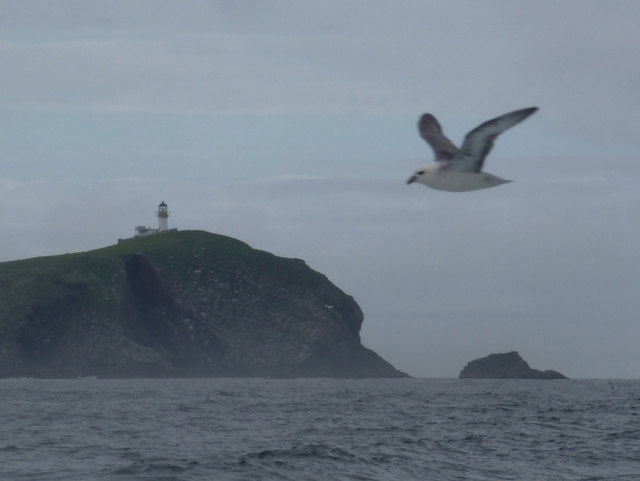
From historic-uk.com
Before the Hesperus even reached the island, there were clues something was amiss on Eilean Mòr. James Ducat, the 44-year-old principal keeper, was not there to greet them. Nor did they see Thomas Marshall, the 29-year-old assistant keeper, or Donald MacArthur, the 40-year-old occasional, trained in lighthouse duties. MacArthur was a tailor and had joined the lighthouse keepers earlier that year.
The provision boxes should have been waiting on the landing stage to be filled by the crew of the Hesperus but they were nowhere to be found. The flag was not flying. Nervously, Captain Harvie blew the ship’s whistle. When there was no reaction, he fired a flare. But all was still.
Joseph Moore, the relief keeper, was dispatched to investigate and rowed ashore to the east landing. He climbed the steep steps with growing trepidation. The door to the courtyard closed. He opened it and saw nothing unusual inside. The door to the lighthouse was also closed but it too opened easily.

Arial view of the courtyard and lighthouse at Eilean Mòr. Image from Strange Outdoors
Moore stepped inside the entrance hall. A quick look around the lighthouse satisfied him that none of the keepers were present. He noticed the kitchen clock had run down.
When the relief keeper returned to the dock, he told the others no one was in the lighthouse. Two men returned to the lighthouse with Moore to make a more thorough search of the place. Apart from discovering the missing keepers’ beds to be unmade, nothing appeared to be strange or out of place.
However, the men were chilled by the sight of oilskins that belonged to one of the keepers. They could think of no reason why a keeper would leave the lighthouse in the stormy December weather without his oilskins. The oilskins belonging to the other men were missing.

An ad for oilskins
Evidence that may explain the men’s disappearance was found on the west landing of the island, which had sustained considerable damage–presumably from the same storm that delayed the Hesperus. At the top of the cliff, they discovered turf had been torn from the ground 33 feet from the cliff’s edge and a rock weighing more than a ton had been displaced. Iron railings had been bent and remnants of a smashed box of equipment and its contents were strewn around the bottom of the cliffs.
Leaving Joseph Moore and three other members of the crew on Eilean Mòr, Captain Harvie returned to shore and immediately sent this telegram to the Northern Lighthouse Board:
A dreadful accident has happened at Flannans. The three Keepers, Ducat, Marshall and the occasional have disappeared from the island. On our arrival there this afternoon no sign of life was to be seen on the Island.
Fired a rocket but, as no response was made, managed to land Moore, who went up to the Station but found no Keepers there. The clocks were stopped and other signs indicated that the accident must have happened about a week ago.
Poor fellows they must been blown over the cliffs or drowned trying to secure a crane or something like that. Night coming on, we could not wait to make something as to their fate.
 old spirituals
Pingback: The Disappearance of the Lighthouse Keepers at Eilean Mòr – Part 2 | old spirituals
Pingback: The Disappearance of the Lighthouse Keepers at Eilean Mòr – Part 3 | old spirituals