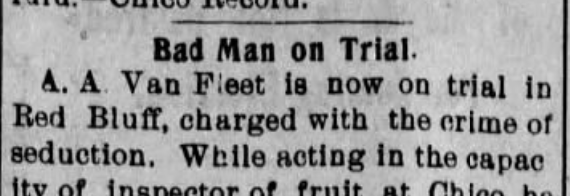
“Rev. and Mrs. George Davis testified to having said, in the presence of Josie Allen, that Van Fleet was a married man.” So reported the Red Bluff News on the trial of A.A. Fleet, who was charged with the seduction of Josie Allen, under the promise of marriage.
The defendant, Van Fleet, was a 34-year-old fruit inspector. He had a wife and two children in San Jose, about 250 miles southwest of Tehama County, where he frequently traveled for work. When he was in Tehama County, he boarded at the Davis residence. Josie Allen worked for the Davises and also boarded at their Red Bluff home. She was from Chico, about 40 miles south.
Miss Allen was 18 years old in June 1901. She said Van Fleet arrived on June 1 of that year and he escorted her to church, prayer meetings, and parties, “and conducted himself as a perfect gentleman.” Miss Allen was told Van Fleet was married but she was under the impression he hadn’t told people he was divorced.
Their summer romance culminated in him begging her to be his wife, and she accepting him. Van Fleet wanted to get married in Oregon. He hadn’t yet been divorced a year, and he didn’t want people to know he was already remarrying. Josie agreed to that too.
On August 17, the couple traveled to Vina, some 20 miles south of Red Bluff, with their friend Tom Center and his sister Maggie. Van Fleet and Josie were going to take a train from Vina to Oregon to get married. Once they stopped at Vina, Van Fleet said he needed to make business telephone calls before they went to Oregon. The day slipped away, and Van Fleet told Josie they would stay in the Vina hotel that night and travel to Oregon in the morning. They would only get one room at the hotel because they needed to save money, he explained. It didn’t make a difference as they would soon be married anyway. Josie allowed herself to be convinced. “Up until the time of reaching Vina, I was chaste and virtuous,” she testified.
The following day she and Van Fleet boarded the train and went as far as Tehama where Van Fleet apparently had business. Not long after they got off the train, a Chico police officer spotted Van Fleet and arrested him on another charge. Her suspicious were finally raised and Miss Allen soon realized Van Fleet had lied about being divorced.
Miss Maggie Center testified that the couple discussed getting married in Oregon as they traveled together. Maggie asked them to send Oregon newspaper clippings about their marriage to her, and Van Fleet promised he would. She did receive a letter from him later, but it merely contained a request for a loan of $15.
Van Fleet did not deny his relations with Miss Allen, but he declared he never asked her to marry him. Further, the defendant stated that Miss Allen had made every improper advance. According to Van Fleet, both of their bedroom windows opened onto a “porch roof.” Late one night, Miss Allen entered his room though the outside window. “She came to the side of my bed, put her hand on my face, and said, ‘Silence!’ Then she got into bed with me.” According to the defendant, this occurred four or five times in June. For her part, Miss Allen declared that she had no idea Van Fleet was married, and insisted he had asked her to marry him.
After all the trial evidence was in, the attorneys made their closing statements. The prosecutor denounced Van Fleet severely, and pleaded with the jury to convict him. The defense attorney—whose name was Matlock!—pointed out the defense produced many witnesses who recalled mentioning that Van Fleet was a married man in Miss Allen’s presence.
The jury had some trouble coming to a decision. The first ballot was nine for conviction, two for acquittal, and one undecided. But after more discussion, the jurors voted unanimously to convict A.A. Van Fleet of seduction.
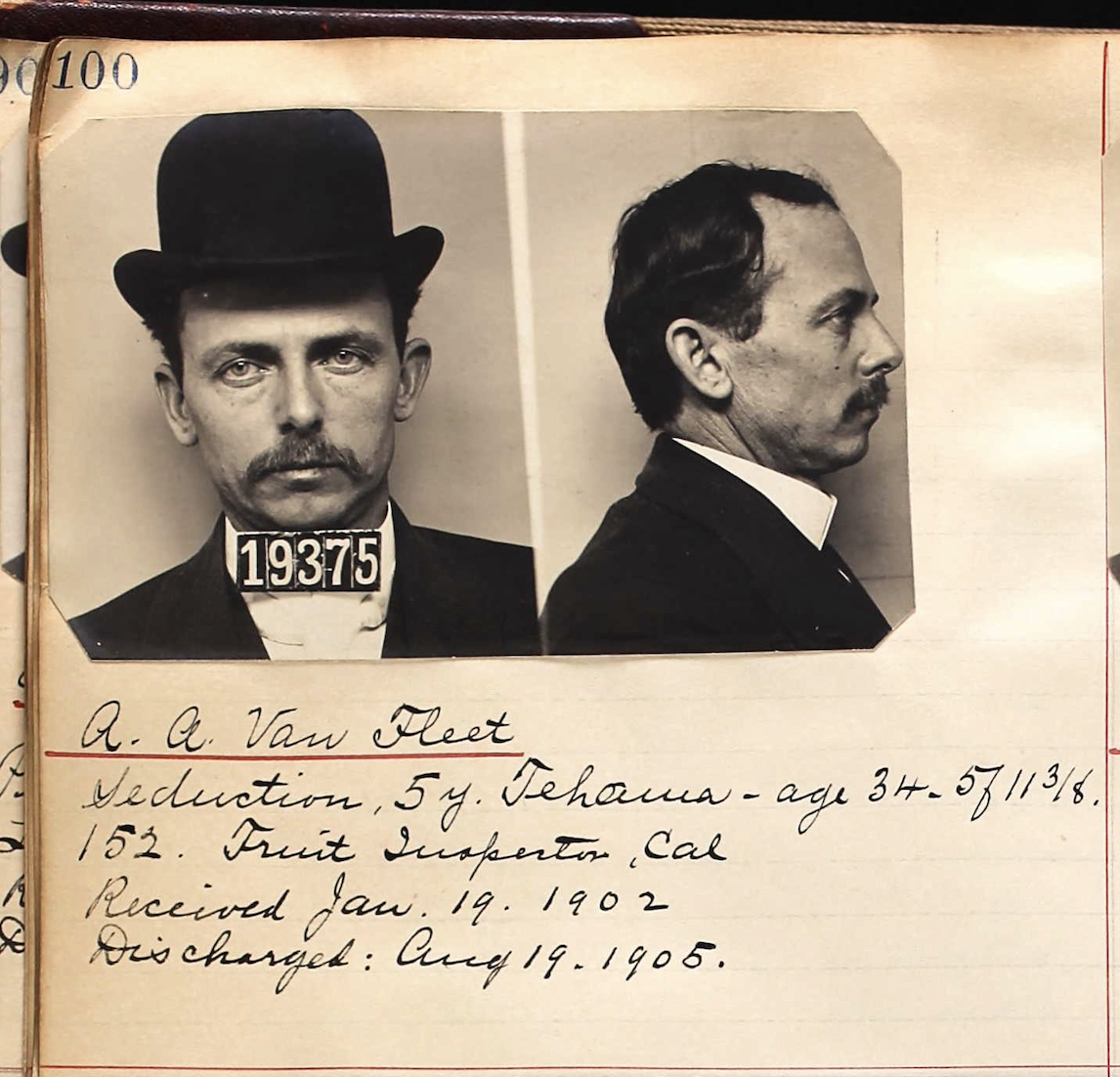
Judge Ellison handed down the harshest possible sentence: Van Fleet would spend the next five years in San Quentin. “There is no evidence in your favor; there are no mitigating circumstances,” he said.
Van Fleet served 3.5 years of his sentence and he does sound like a snake. We could take it for granted that the jury got it right but we have to rely on Josie’s honesty and I don’t entirely trust her. She had reasons to lie too!
 old spirituals
There are usually three stories told in court. The accuser’s (the Paintiff), the accused’s (the Defense) and the “Truth.” I believe the “Truth” is woven in both Josie Allen’s testimony and A. A. Fleet’s representation of what happened. The testimony of Rev. & Mrs. Davis supports Fleet’s claim that Josie knew he was married, but, then, the testimony of Maggie Center supports the credibility to Josie’s story. Given what we know here, Fleet was likely guilty of seduction.
An interesting aspect of this story is that there was a criminal code against “Seduction” in 1901. From 1848 to 1935, a movement in the United States started that was one of the most intrusive and expansive judicial changes in history: an effort to regulate seduction by legal decree. It began in Michigan circa 1840s and quickly spread across America. The Courts combined legal and moral principles in an attempt to define “Seduction.” A Civil Suit could be filed against a man by a woman (or vice versa) on her/his own initiative. The woman plaintiff, or victim, had to prove she was moved “by some promise or artifice . . . . by his flattery or deception.” The man’s defense was usually presented as the woman failed to resist or she had prostituted herself to other men. It appears that all men were seducers but only certain types of women could be seduced.
LikeLiked by 3 people
You have a way of distilling these matters into a very clear point 😂 one of the last people to get charged with seduction had one of the most famous mugshots of all time: none other than Mr. Frank Sinatra
https://www.google.com/search?sca_esv=224aa860ab5f4b24&rlz=1CDGOYI_enUS1021US1022&hl=en-US&q=frank+sinatra+mugshot+seduction&udm=2&fbs=ABzOT_DnPN66xNYYiVBYF80MNa9-mD9FW2KvyJ7Ee6i9AfRy7R1eW7fYkhs9lmIjuzf1c814hZBiGsd-xVdQMnO74TAYG6xVs_Jf6ReezTSHZRPh3_w0bBX_usS_cVABLSvTy-g77wOYE-5sKMlfUjz3Mk7J5Fr2nqIQ4BWuiLyEXvoAN6tdsycHJirhswScO9r04-_3-2MUmM90hmBthfldSs7utGETf-pH_XTDKnIXUvaypO6NDVg&sa=X&ved=2ahUKEwiX6cvh5fGLAxW5CTQIHRCcKkcQtKgLegQIDhAB&biw=393&bih=657&dpr=3#vhid=0eCzM1VldTxDiM&vssid=mosaic
LikeLiked by 1 person
I knew Sinatra had a mugshot but wasn’t aware it was for Seduction.
And thank for the compliment. Usually my distilling is of the consumption type.
LikeLiked by 1 person
Distillation in either context is nice! 😉
LikeLike
Van Fleet’s story about Josie seducing him sounds absurd! But I agree with Jax, I think they were both somewhat guilty.
LikeLiked by 2 people
If she really climbed in his window in the middle of the night and put her hand on his face, that’s restraining order territory! 😂
LikeLiked by 1 person