There are a handful of professions that still inspire trust and respect. Most professions tell us very little. If you’re introduced to a geologist or a warehouse manager, you don’t have any preconceived ideas about what kind of person they are. If you’re introduced to someone who is a major in the Army, you may automatically credit that person with being exceptionally skilled, resourceful, and brave.
What about someone in a highly respected profession who violates the trust people have in them? Think of a corrupt police officer or a soldier who deserts his unit. These individuals raise our ire far more than the common criminal because we placed a tremendous amount of trust in them–and they betrayed it.
Can this sentiment ever go too far? Let’s examine the case of 29-year-old First Lieutenant of the 12th cavalry, George A.F. Trumbo. In the summer of 1907, Trumbo found that Earl Sims, a 21-year-old soldier in his platoon, had deserted. A soldier who abandons his duty without permission and with no intention of returning is guilty of the crime of desertion. The penalties are severe. If a soldier is serving in a war and deserts, it’s a very serious offense that jeopardizes the lives of others. A wartime deserter can expect public humiliation, imprisonment, or the death penalty.
This picture shows French soldiers escorting a deserter to his execution during World War 1:
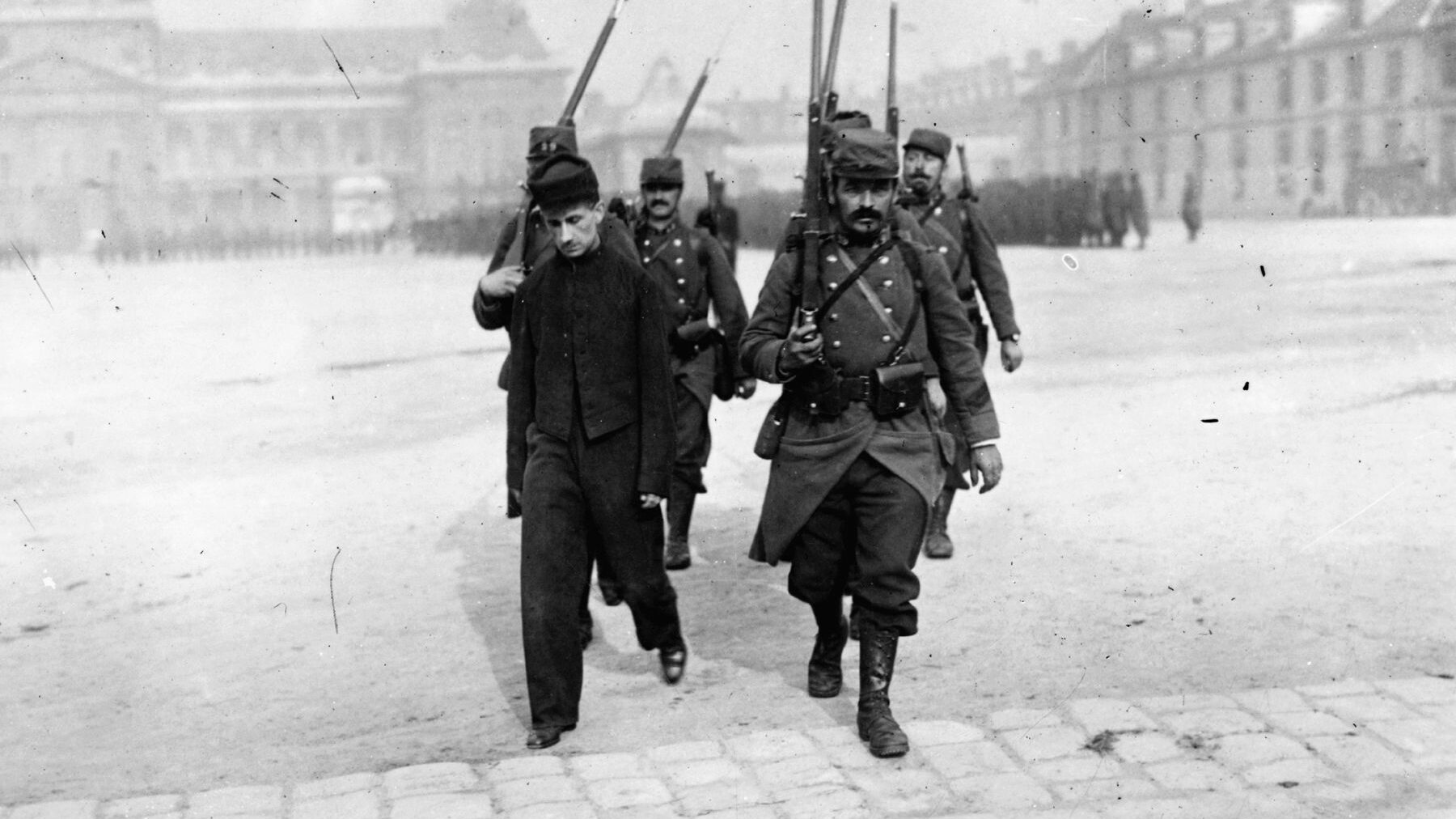
Credit: warfarehistorynetwork.com
Earl Sims deserted during peacetime but, even so, the military would likely dishonorably discharge him or confine him to a military prison if he could be found. We can imagine that Lieutenant Trumbo had a few things he’d like to say to Sims as well.
This is where the story takes a turn. Trumbo couldn’t find Sims and he was determined to vent his anger. So he wrote a letter to Sims’ mother.
Mrs. Sims, Clarksburg, W. Va.
Dear Madam:
It gives me great pleasure to inform you that your son, Earl Sims, who is about the most worthless scoundrel I ever saw, is a deserter from the United States army.
I sincerely hope to see him behind the bars for at least two years. Hoping this will be a source of condolence to you, I am,
Very respectfully,
GEO. A. F. TRUMBO,
First Lieutenant 12th Cavalry, Commanding Troop E
The War Department, upon learning of Trumbo’s missive to a soldier’s mother, was infuriated and ordered the first lieutenant to be court-martialed. He was convicted at Fort Monroe. The court sentenced him to be reprimanded and confined to his post for two months.

Brigadier General Frederic Dent Grant, the oldest son of President Ulysses S. Grant, considered Trumbo’s sentence to be inadequate. He reproved the court for its inappropriate leniency with the lieutenant but eventually, Grant approved the sentence.
I was a little surprised by the Fairmont West Virginian’s take on Trumbo’s sentence: “It seems to us he ought to have been suspended at least long enough for young Sims or someone else to give him a sound thrashing. That is what he needs.” I would have thought Sims’ desertion would outweigh the rude letter Trumbo wrote to his mother!
I was curious what happened to Trumbo and Sims.
Trumbo stayed in the Army until he achieved the rank of Colonel. He served honorably in four wars, including the Great War, and retired from the service in 1921. Once he became a civilian, Trumbo served as a Chief of Police in or near Chicago. He married Olive Wilson at the age of 58 and died three years later. He’s buried in Arlington Cemetery.
I could not find what punishment, if any, Earl Sims incurred for his desertion. His life seems to have gone back to normal after he deserted. He got married, had five sons, and lived out his days in West Virginia until he passed away at age 84.


The letter to the deserter’s mother was horribly cruel. His desertion would have been hard enough on the poor woman with the shame and not knowing his fate. Sims must have served his time and received a dishonorable discharge. Trumbo seemed to be quite an angry man and possibly caused his early death.
LikeLiked by 2 people
I had a similar thought about his anger causing an early death. But you know he did redeem himself . Maybe the letter was just a blotch on an otherwise excellent record
LikeLiked by 1 person
That’s true! Maybe getting caught and publicly embarrassed made him rethink his ways.
LikeLike
There is irony in shooting an army deserter who feared dying in battle.
A poem written by Winifred Mary Letts, The Deserter, perfectly fits in with this topic:
There was a man, — don’t mind his name,
Whom fear has dogged by night and day.
He could not face the German guns
And so he turned and ran away.
Just that-he turned and ran away,
But who can judge him, you or I?
God makes a man of flesh and blood
Who yearns to live and not to die.
And this man when he feared to die.
Was scared as any frightened child,
His knees were shaking under him,
His breath came fast, his eyes were wild.
I’ve seen a hare with eyes as wild,
With throbbing heart and sobbing breath.
But oh! it shames one’s soul to see
A man in abject fear of death.
But fear had gripped him, so had death;
His number had gone up that day,
They might not heed his frightened eyes,
They shot him when the dawn was grey
Blindfolded, when the dawn was grey,
He stood there in a place apart,
The shots rang out and down he fell,
An English bullet in his heart.
An English bullet in his heart!
But here’s the irony of life,-
His mother thinks he fought and fell
A hero, foremost in the strife.
So she goes proudly; to the strife
Her best, her hero son she gave.
O well for her she does not know
He lies in a deserter’s grave.
LikeLiked by 1 person
What a sad, sad poem! When I was reading about deserters, there were several stories of men who ran away but when they were caught and executed, they showed courage. For instance, they didn’t take the drinks they were offered to ease their fear. I think being ashamed would be harder than dying.
LikeLike
Shame lives forever. Consider Benedict Arnold who was wounded multiple times during the American Revolutionary War, notably at the Battle of Quebec in 1775 and again at the Battle of Saratoga in 1777, where he suffered a severe leg injury that required amputation. His bravery in these battles contributed significantly to his reputation as a skilled military leader before his later defection to the British. He was a hero one instant, which is never talked about today; however, his act of treason has lived for hundreds of years.
LikeLiked by 1 person
True! His very name is synonymous with “rotten traitor”
LikeLike