The Bohemian Club of San Francisco was founded in April 1872. It’s an exclusive men’s social club that promotes a fraternal connection among men who enjoyed the arts. They adopted an owl as their mascot.
Bohemian usually refers to someone who is unconventional, artistic, fun, and cares about beauty–and often without a silver dime to their name. The club’s first home was a room on Sacramento street below Kearny. Early members of the club include luminaries like Ambrose Bierce, Arnold Genthe, and Jack London.
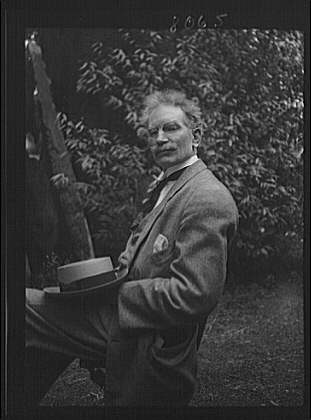
Ambrose Bierce photographed by Arnold Genthe LOC
The membership was initially limited to artists and writers, presumably until someone realized that artists and writers don’t have any money, and they were in San Francisco. So the members agreed to let in some wealthy, established, successful men who really appreciated the arts.
Turns out, a lot of men wanted to join. Businessmen. Industrialists. Railroad executives. Politicians. The wealthy and powerful soon gained control of the club. Today, the club’s bylaws require that 10% of the membership be reserved for accomplished artists and writers. The other 90% is composed of powerful men.
Today, membership is secret. But we know who many of the past members were. Men like Charles H. Crocker, the cofounder of the Central Pacific Railroad; Edgar Kaiser, the American industrialist; and Ernest Folger, the son of J. A. Folger who founded a little coffee company. Oscar Wilde once visited the club and remarked afterwards, “I never saw so many well-dressed, well-fed, business-looking Bohemians in my life.”
To divert momentarily, male-only clubs used to be popular in the nineteenth and early twentieth century. They seem to have been bullied into an endangered species by people who revile these types of clubs as archaic.
I’m all for men having their own social club if they want one. In the case of the Bohemian Club, I do feel a little queasy about it because of how much political power the members have. Looking at a list of past members, I counted four presidents, numerous governors, executives at the Federal Reserve, and a Deputy Director of the CIA.
There’s something distasteful about the idea of people with that much power being part of a secretive club and meeting up every year for important conversations in their secluded Bohemian Grove retreat. The club’s motto is Weaving Spiders Come Not Here, a line from Shakespeare’s A Midsummer Night’s Dream. It means that outside concerns and business deals are to be left outside.
This picture is from the Bohemian Club’s Summer 1967 meeting at Owls Nest Camp in Bohemian Grove. From left to right: Preston Hotchkis, Ronald Reagan, Harvey Hancock, Richard Nixon, Glenn T. Seaborg, Jack Sparks, Kevin Winter, unidentified individual, Edwin W. Pauley.

Roy Kaltschmidt/Lawrence Berkeley National Laboratory
Returning to the club’s early years… At some point, the members realized the group was no longer Bohemian in any real sense.
That point may have come when they decided to extend an honorary membership to the enormously powerful publisher, congressman, and tycoon William Randolph Hearst. It isn’t as if Hearst was thought of as a creative free spirit by his contemporaries.
One of the most famous stories about him was when he sent his illustrator, Frederic Remington, to cover the Cuban War of Independence. When Remington cabled Hearst that nothing was happening and Hearst replied: “Please remain. You furnish the pictures and I’ll furnish the war.”
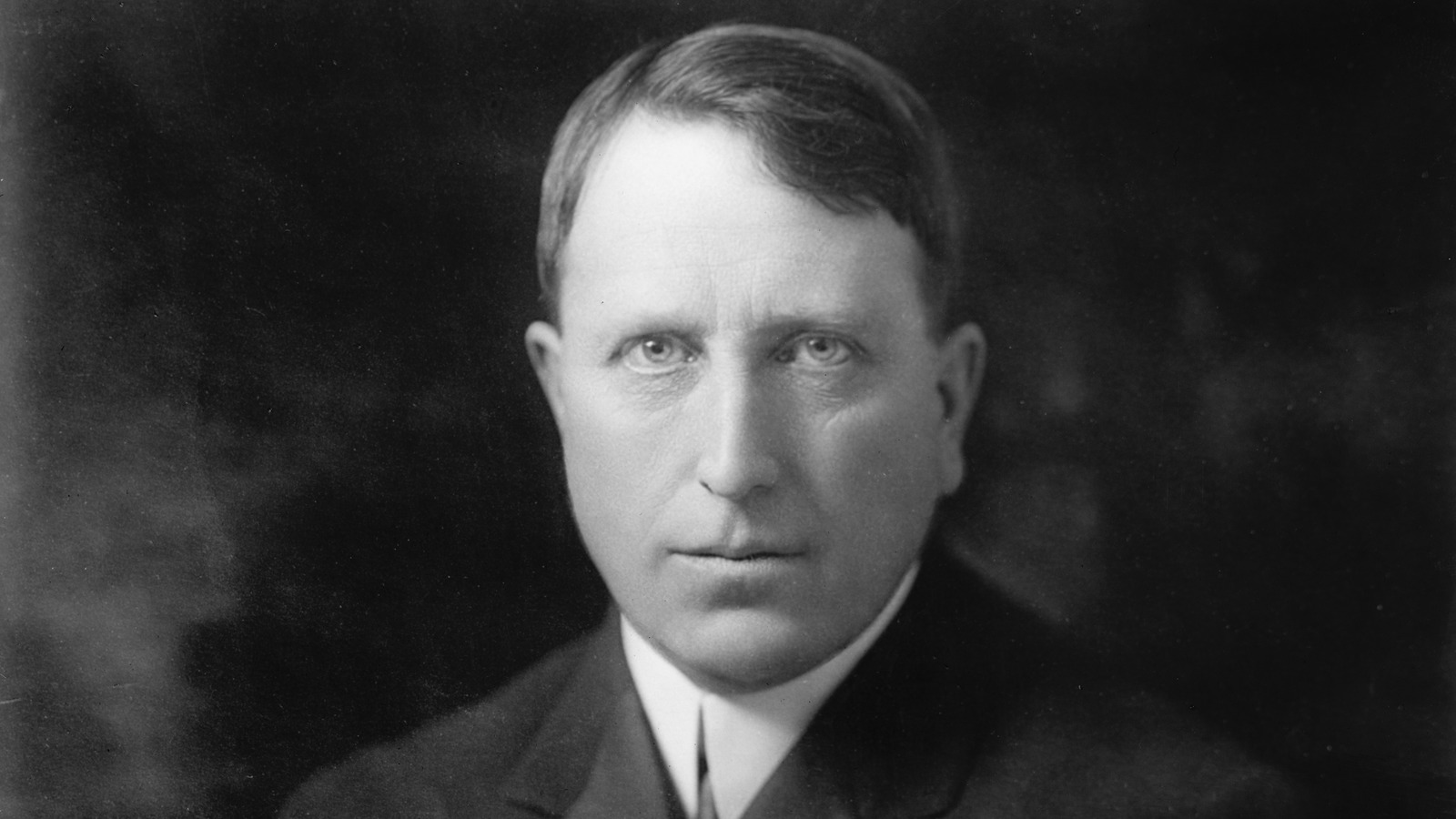
William Randolph Hearst
Faced with the possibility of renaming the club, the members instead chose to redefine “bohemian” to mean someone who lives for pleasure and enjoys the finer things in life.
I don’t think I would be happy with some of the finer things in life. This menu for a Bohemian Club dinner in May of 1900 does not sound appetizing to me:

New York Public Library
At first, some of the artists and writers who founded the Bohemian Club affected some scorn for the wealthy men.
The poet George Sterling said, “There are two elements, at least, that are essential to Bohemianism. The first is devotion or addiction to one or more of the Seven Arts; the other is poverty…I like to think of my Bohemians as young, as radical in their outlook on art and life; as unconventional, and, though this is debatable, as dwellers in a city large enough to have the somewhat cruel atmosphere of all great cities.”
Then again, Sterling and the others were happy to migrate away from the original room on Sacramento Street to hobnob with the powerful men of the day at the palatial city clubhouse in San Francisco and the Bohemian Grove retreat in Sonoma County.

Wikimedia
Another time, we may talk about the Bohemian Club again.
 old spirituals
Artists cannot sustain their existence without benefactors and customers to purchase their work. Even Renaissance Masters had benefactors who financially supported their artistic talent. It was common to commission works of art, particularly portraits. The walls of galleries around the world are covered with portraits commissioned by wealthy clients. Some artists were prolific in self-portraits painters. Rembrandt so admired himself he produced more than 40 self-portraits. Renoir painted self-portraits at various stages of his life.
LikeLiked by 2 people
That is very true! Most famous artists and writers I know of were born poor or middle class. They have to find some way to live and if they are good enough to make a living with their art or books, that’s the best anyone could ask for. You wonder about the effect of money on their work. Ernest Hemingway said he wrote differently when he was hungry and couldn’t afford to eat. It would be difficult to isolate any one factor, like money, because at the same time they were becoming famous and financially secure, they were also gaining more experience, growing older, and refining their techniques. An interesting thought!
LikeLike
forty self portraits is a lot
LikeLiked by 1 person
Ruby – I picked that up watching a British series on Prime. There are several by Waldemar Januszczak, a Polish-British art critic and a documentary producer and presenter of the series, who is entertaining and very educational. If the history of art is an interest I recommend his series called “Renaissance Uncharted.” Here are a few of Rembrandt’s self-portraits:
LikeLiked by 2 people
wow the self portraits over time are very interesting. he always wore a hat. was that typical?
LikeLiked by 1 person
He is hatless in his early self-portraits. As I recall, several versions of this first one in this group have been discovered. It is believed her was experimenting with “lighting.” The last in this series is a sketch, likely done to explore ideas, proportions, etc. I’ve concluded that Rembrandt was a bit peculiar based on some of his paintings. He painted a portrait of his son, Titus, as a Franciscan monk. Can’t fathom why. Despite his success, he had financial problems due to his habit of living beyond his means.
LikeLiked by 1 person
Maybe the hats are a status symbol?
LikeLike
🦉📖🔎
LikeLiked by 3 people
I would love to have been a fly on the wall at these meetings! Money got in the way of the original purpose of this club.
LikeLiked by 3 people
Unlimited wealth & power meets talent & vision. It sounds like a promising mix. I bet if we ever did hear the conversations there, we would discover an infestation of weaving spiders. 🕸️ what a tangled web they weave!
LikeLiked by 1 person
Pingback: The Secrecy of Bohemian Grove | old spirituals
ugh that menu sounds awful! frogs? turtles?!
LikeLiked by 1 person
The menu looks great…. fancy cakes and crackers!
LikeLiked by 1 person
You have more sophisticated taste than I do! So do most 10 year olds 😂😂
LikeLike
I hear you. My food choices are boring and unsophisticated even by regular people standards 🍞🧈
LikeLike
Frog legs cooked with garlic are outstanding!
LikeLiked by 1 person
😂 I’m very unadventurous with food. Frog legs are beyond me!
LikeLike