This post is the inspiration of a great photo on the National Geographic website. It was taken during the early years of The Great Depression and captures a piece of Americana . . . children dreaming about the traveling circus. Today, the more common monicker for this manner of entertainment is the touring circus.

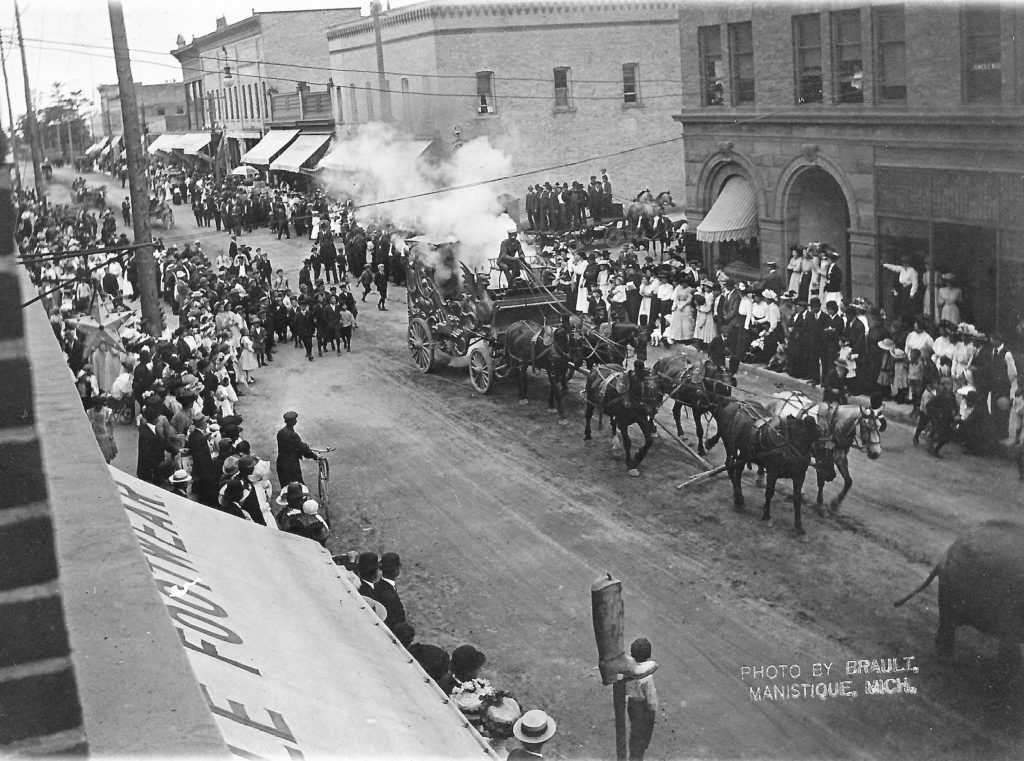
When the touring circus arrived in a Main Street American town it was the event of the season and the talk of the town. In the early days of the touring circus, after the support crew erected the “Big Top” tents in a nearby field, a short parade rolled down the “Main Street” to announce its arrival and tantalize the citizenry.
The second largest circus in America was the Campbell Bros. Consolidated Circus that began operations in 1883. It was the creation of brothers Virgil, Al, Charlie, and Ed Campbell. Initially starting with 30 horse-drawn wagons and over 100 personnel, it grew to become one of the largest circuses in the United States. The Cambell Circus wintered in Fairbury, Nebraska, reaching its pinnacle in 1910 when it toured the country with 42 double-length railroad cars. It featured 17 performing elephants and a troupe of 30 trapeze artists and other performers.
The Campbell Circus experienced a significant number of catastrophes that included a devastating train wreck in 1910, which resulted in the death of several animals and injuries to crew members. A main tent fire and an economic downturn added to its financial losses. Such events eventually led to the Campbell Circus bankruptcy. The once “second greatest show on earth” made its final performance on August 13, 1912, in Texas.

The recognizable “Circus Theme Song,” a.k.a. Entrance of the Gladiators, played by a “steam calliope” pulled by horses usually engulfed the parade as it rolled down the street. The “steam calliope” was replaced by the “band organ” to produce the circus music as the procession of elephants, performers and vehicles passed the spectator-lined street. Attendees at the circus grounds, while walking along the “midway,” were treated to the “calliope” or “band organ” playing Our Director March.
Click this link to enjoy the sound of a Wurlitzer “band organ.”
(A “band organ” is a type of mechanical musical instrument designed to play loud music, typically found at circuses, amusement parks and fairs, usually accompanying rides like carousels. It mimics the sound of a human band of pipes and percussion, and operates automatically without a human player. A Wurlitzer organ was a popular brand of “band organ,” made by The Rudolph Wurlitzer Company of Cincinnati, Ohio. The automatic playing feature was achieved by running long rolls of paper with blanks punched in it. The blanks in the paper triggered the instrumental sound played by the organ.)
The Beginning
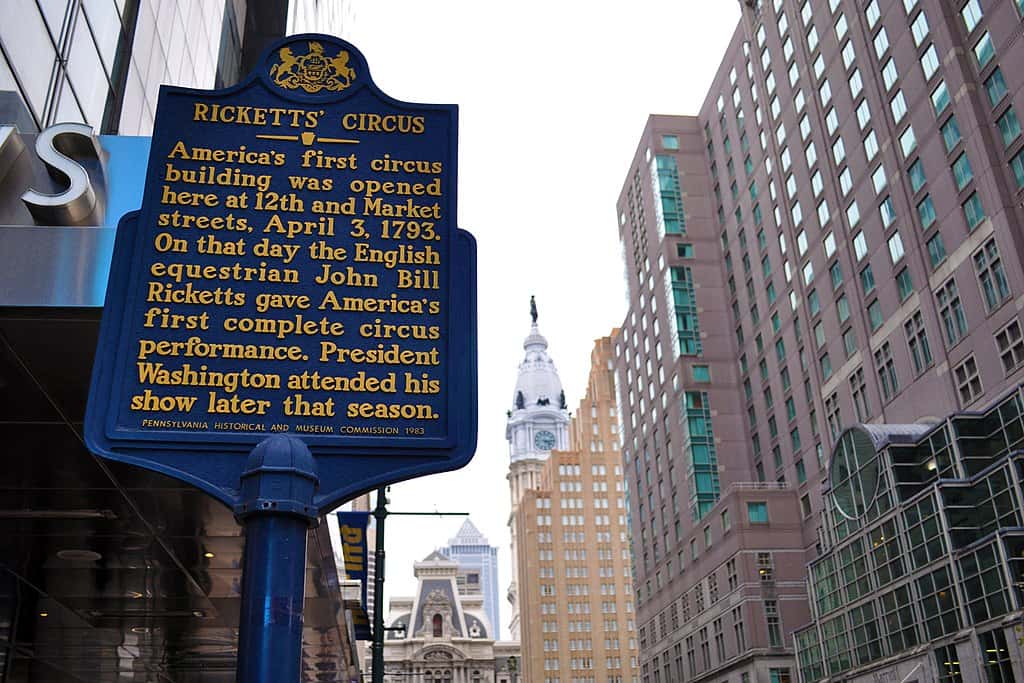
The first complete American circus performance was held 10 years after the end of the American Revolutionary War. It was the idea of John Bill Ricketts, a Scottish immigrant who had been a performer in The Royal Circus and Equestrian Philharmonic Academy in London. Ricketts established residence in Philadelphia 1792, immediately building an equestrian theater to train riders. The next year (1793) Ricketts opened the first complete circus to paid spectators. President George Washington even attended in the Fall of 1793.
In November 1807, the equestrian theater company Circus of Pepin and Breschard arrived in America from Spain. Pepin, an American, and Breschard, a Frenchman, built circus theaters in New York City; New Orleans, LA; Richmond and Alexandria, VA; Charleston, SC; Pittsburgh and Philadelphia, PA; their idea was to bring their circus to a wider American audience. Their circus survived until 1815.

Its Evolution
A co-operator of the Circus of Pepin and Breschard was Gaetano Mariotini, who is believed to have immigrated to Cuba from Italy and then to New York in 1809. Gaetano operated the Pepin-Breschard circus as well as performed as a clown, an acrobat and a horse rider. The circus traveled from its east coast touring and ventured west to Cincinnati, Ohio, returning to the east coast in 1814. That was when Gaetano Mariotini parted ways with Pepin and Breschard to open his own circus in western Ohio and Kentucky. Even more noteworthy, Mariotini is credited for being the first circus owner to include an elephant (named “Old Bet”) in his 1812 show. The Mariotini Circus worked its way south, following the Mississippi River, finally settling in New Orleans where Mariotini built two venues, one for the circus and next to it a theater. His time in New Orleans was short-lived because he contracted yellow fever and died in 1816.
(Victor Pepin and Gaetano Mariotini wrote to President James Madison in November 1813, during The War of 1812, requesting permission to travel by ship to Havanna (sic) with animals and materials to build a circus and perform shows.)
Over the coming decades, the circus became a major form of entertainment in America. The concept of a circus being inside a fixed structure limited its audience, so in 1825 an innovative man by the name of Joshua Purdy Brown, the first man to move his acts into a large outdoor tent, made his circus more itinerant, exposing it to a broader audience. As the popularity of the circus grew, the advancements in the transportation industry facilitated the owners ability to expand their market. Going from horse drawn wagons to rail cars provided a faster and easier mode of transporting equipment, animals and personnel required to present its show. As motor vehicles improved, the touring circus used large trucks and other vehicles to relocate its show.
In the early 20th Century, there were literally hundreds of touring circuses in America. Even during The Great Depression the touring circus traveled America, raising the spirit of the American people by providing an escape from the troubles of the time. Of course, a significant percentage of the population was unemployed or had little money for any thing other than basic necessities, so circus owners worked to lower operating costs and, thus, the cost of admission. That was usually done by reducing the number of acts in the show; the number of animals to transport and feed; and, in some cases, replacing the touring human talent with that available locally.
A Circus Man
The children in the National Geographic photo are studying a billboard advertising the Silvan-Drew Motorized Circus and all its attractions. The black-and-white photo below is of that circus set-up in a field in Mamarondeck, NY. Visible are the spires of the three-ring circus tent and, in the left background, the popular sideshow tent fronted by attraction imagery.

Everyone knows Ringling Bros. and Barnum & Bailey Circus. That circus toured the Country, and still does after a hiatus from 2017 to 2023. But the majority of Americans who experienced the touring circus more than likely were in the audience of a smaller, less known circus. That is because the smaller circuses were capable of traveling to small towns and cities. The small circuses could set-up quickly, have several shows per day for consecutive days, pack-up easily and move on to the next town or city. That business plan allowed small circuses to entertain a great breadth of the population with a lower overhead cost. For some of those living in small towns the circus was a way to see the country by joining the circus – to experience the circus life. It was particularly attractive during the Depression; it offered employment, a place to sleep and meals.
A boy born in 1873 by the name of Alson Wheeler was taken to one of those small circuses for the first time, the Amburg & Company Menagerie, at age 7 by his father. That experience ignited a love of the circus that motivated him to spend the majority of his adult life in the business.
Wheeler worked hard and over time developed a reputation for being able to cure the ills of a failing circus. He moved from circus to circus applying his expertise, leaving only after returning the debilitated circus to a sound financial footing. In 1928, Al Wheeler moved to the failing Silvan-Drew Motorized Circus and by 1930 returned it to financial viability. It was then Wheeler decided to purchase the Silvan-Drew Motorized Circus, renaming it the Al F. Wheeler Circus. Wheeler eventually merged his circus with other circuses, including one with a Wild West Show. During this time, Wheeler even owned a side-show that traveled with other circuses. Al Wheeler eventually retired from the circus business, taking up real estate sales full-time. Al Wheeler died on May 14, 1957 at the age of 84.
Epilogue
In my mind’s eye I can still see the small touring circus that arrived each summer in my small hometown. It is where I saw a live elephant and lion for the first time. All the town’s young boys found it enthralling to watch the circus crew erect the “Big Top” tent that housed the three-rings. It always set-up in the City’s large grounds next to the Little League field, a summer hangout for us young boys. It’s a wonderful memory.
The touring circus is something Americans can experience today in certain areas of the Country. However, the touring circus of decades ago is an outdated form of entertainment in modern America . . . especially with the advancement of the internet and cell phones.
Readers likely know the name Florida State University. They may not know of the Florida State University Flying Circus. Yes, that right, Florida State University has an extracurricular activity under the Division of Student Affairs that invites full-time students to audition and participate in the on-campus tented circus. The FSU Flying High Circus has existed since 1947 and is primarily an aerial and stage presentation with three rings of spellbinding entertainment for everyone. “Flying High” has no animal acts. Student performers rig all of their own equipment, sew their own costumes, produce lights and sound for performances, and set up the Big Top tent on campus.
 old spirituals
what a great post! I love the band sounds!
LikeLike
Pleased you enjoyed it.
LikeLike
What a fascinating post, Nicola! The circus was such a huge part of the culture in the US in the early twentieth century, it was something exotic and exciting that anyone could visit. I love this!
LikeLike
I am pleased you found the post interesting. The history of the American circus is a segment of history that, in a way, reflects The Progressive Era of the Country: immigration of the times; technological advancements; and, the “real people” who lived and accomplished their dream. Working on it also allowed me to reminisce of a time gone by.
LikeLiked by 1 person
Would like to extend an international thanks to Seb Stead in Worcester, England who liked this post.
LikeLike
Thank you, “harish.”
LikeLike
When I was about four years old, my dad took me to a Ringling Bros. Barnum and Bailey Circus in Los Angeles, CA. I still remember it and the elephants, my favorite! My youngest daughter has always had a fear of clowns. I never understood it, but needless to say we took her to her first and last circus when she was young. Great post, Jax! I really enjoyed the memories of childhood!
LikeLike
Thanks, Judy. I purposely omitted “clowns” from the circus history for the very reason you mention about your daughter’s feelings toward clowns.
LikeLike