This post concerns the early 20th Century, the era normally covered by Old Spirituals. However, it is not about an American – it is about a wonderful Finnish painter. Despite that fact, I believe you will find the post captivating.
The Impulse
While reading a Wall Street Journal digital newsletter recently, the page included a solicitation to subscribe to the publication, accompanied by a mesmerizing (in my opinion) digital painting by Elin Danielson-Gambogi, identified as “Sunset” (1915). I am not an art purveyor and did not know of the painter, but I do appreciate and value art that pleases my eye and other senses. (More often than not I prefer “realist” works.) The “Sunset” by Elin Danielson-Gambogi did exactly that – possibly more. I decided to see more of her work.

Who Was Elin Danielson-Gambogi?
Elin Danielson-Gambogi was born on September 3, 1861, the eldest of two daughters of a Finnish couple, Karl Danielson and Rosa Amalia Danielson. Elin spent her early years on a farm until the Finnish famine of 1866 caused the farm to fail, pushing her father into bankruptcy. After being forced to sell his farm, Karl Danielson was so depressed he committed suicide, leaving his wife alone with two, very young children.
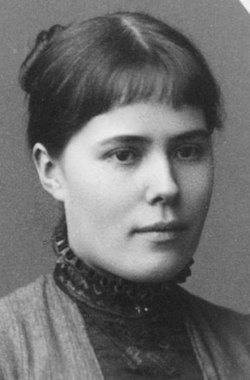
Determined to have her daughters obtain a sound education, Rosa moved to the village of Noormarkku. Because of the influence of the strong women that surrounded her, i.e. her mother, aunt and grandmother, the young Elin developed an attitude of independence. That determination motivated Elin greatly, so much so that at the age 15 she decided to pursue her desire of becoming an artist. Elin left the security of her mother and sister to enroll in the Academy of Fine Arts in Helsinki.
“Au revoir, Denmark“
Elin’s hard work and talent was admired by her teachers at the Academy, rewarding her with a grant to study and advance her painting talent in Paris. It appears that one of Elin’s teachers, Adolf von Becker, a German who had studied in Paris, played a impactful role in her grant. In Finnish art history, Becker is credited with teaching many of the artist of the Golden Age of Finnish Art. The era (1880 to 1910) is called the Golden Age of Finnish Art to identify Finnish realist and romantic nationalist painters of the late 19th and early 20th Century.

In France, Elin took lessons at the Academy Colarossi and also spent her summers painting in Brittany. After a few years in France she returned to Finland to live with her family.
In 1888, Elin’s love of painting motivated her to open an atelier (French for a private workshop or studio) in Finland where professional artists could work together. She also taught at multiple art schools around Finland, even attending an artist colony.

“Arrivederci, Finland“
Elin packed-up once again, this time to accept a scholarship in Florence, Italy. After a year in Florence she moved to a small village in Livorno. There Elin met another painter, Raffaelo Gambogi, who was thirteen years younger than she. The two worked together and then married in February 1898. Unfortunately, Raffaello was a philanderer which strained the marriage. Their marriage finally ended when Raffaello had an affair with Elin’s Finnish friend. That was, as the French might say, coupe de grade for Elin, so she moved back to Finland for a time. Eventually Elin returned to Italy. Unfortunately, due to World War 1, her connection to Finland was severed. By the time she died of pneumonia in Antignano, Italy, in 1919, she and her work were all but forgotten.
The model for this next painting was Elin’s younger sister. For me this painting is telling since Elin, as far as I can determine, never gave birth.

Italy was obviously a favorite place for Elin. She captured a street in the small town where she lived for a time. Sadly, two years after painting this street scene she died.

It is only fitting that this short biography end with a self-portrait of the artist.

Danielson-Gambogi is noteworthy because she was one of the of Finnish women artists who received a professional education in art, the so-called “painter sisters’ generation”. As one who just now stumbled onto her work I must say, “loistavaa työtä.” I believe that translates in Finnish to “splendid work.”
How do you interpret Elin’s facial expression in her self-portrait?
 old spirituals
she looks like a keen observer. having faced starvation and sorrow, she was still lovely but iI would guess a real introvert
LikeLike
Gosh, never gave thought to her being an introvert. For sure she was self-confident. Would a self-confident individual be an introvert? My supposition is that she was more an extrovert. Based on the photo of her with multiple friends, she was likely a congenial person. Whatever her personality, the woman could paint!
LikeLike
I see accomplishment and satisfaction.
LikeLike
Judy, that is for sure . . . . she must have felt accomplished. After she divorced her philandering husband, she probably did feel “satisfaction.”
As a woman who left her family home at 15 to pursue her artistic ambition, returning home only after significant advancements in her career or a personal disappointments, my guess is she found her family to be a place to go to be energized. I have empathy for Elin not being able to return home because of the War in Europe and, I gather, never seeing her family again before she died.
LikeLike
Thank you, Ruwaida.
LikeLike
I appreciate the “Liked” from Martha.
LikeLike
Thanks to Elena for the positive feedback.
LikeLike
Glad you enjoyed the Post, phylbert.
LikeLike