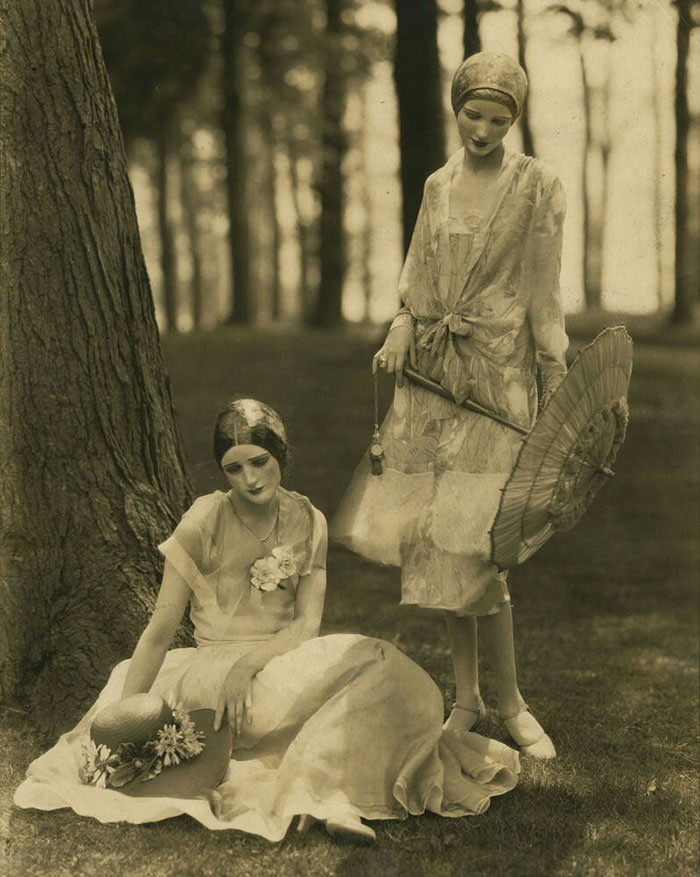
I was intrigued by this 1926 photograph by Edward Steichen.
Bygonely
Steichen photographed two American women. Marion Morehouse is the model sitting on the ground, wearing a bouffant dress. Actress Helen Lyons is standing, wearing a long sleeve dress by Kargère. Both women are wearing masks created by the illustrator W.T. Benda. I haven’t read an explanation of the photo, but it makes you think.
Ms. Morehouse and Ms. Lyons were both beautiful women–not the kind of women who would ever want or need a mask. It makes you think, we all wear masks. Not just one but many. You have friends that see you one way, coworkers that see you another, family that sees you another. If you’re lucky you have people in your life that can see behind parts of the mask. But even there, they only see one side of us.
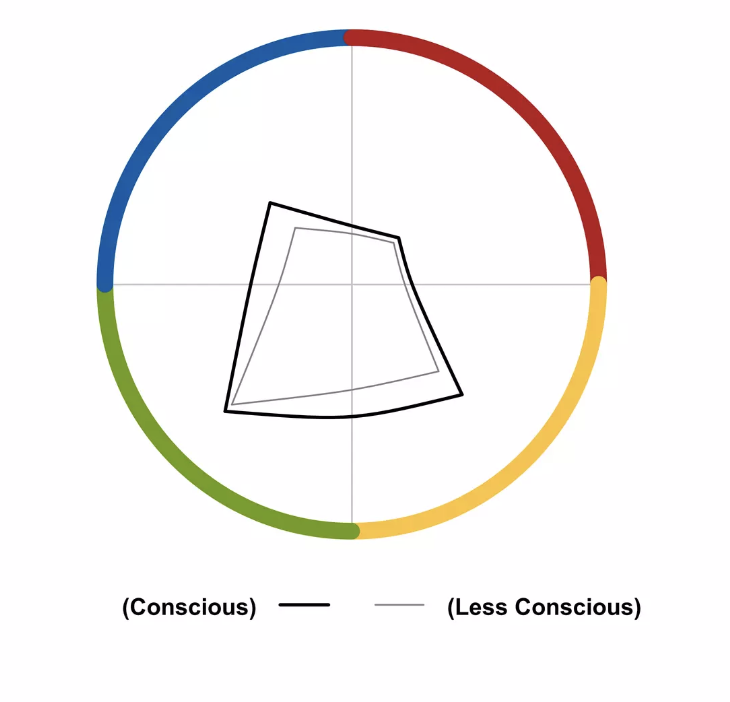
I used to lead a lot of Insights training workshops. The methodology is based on Carl Jung’s theories. Participants completed an extensive psychological profile, and one output is a picture that overlays two graphs, depicting your conscious and less conscious selves. In other words, they showed how different the image and personality your consciously project into the world was from what your natural inclinations were. For instance, did you have to force yourself to be more outgoing than you really felt? How much of your energy did you have to dial up or dial down at work to preserve your image–or your mask? The more of your real self you had to suppress and the more you had to project a personality that wasn’t really yours, the more stressful your job probably was.
In this graph, the person’s less conscious self, or natural way of being, is represented by the lighter line. It looks like they are a little more reserved than their conscious projected image but it’s very well aligned. Their mask might just be an airbrushed version of their real self.
By contrast, you see graphs that have very little crossover between who they really are and what they project to the world. Those masks may be disguising people you’ve known for years without really knowing them at all.
 old spirituals
Everyone has a public life, a private life and a secret life. The photo is really interesting and reminds me of Japanese geisha faces. The umbrella also reflects a Japanese atmosphere.
LikeLiked by 2 people
You’re right! I didn’t think of the geishas but they always have to wear a mask of sorts. You don’t have the privilege of having a bad day if you are a geisha… or any number of other professions.
LikeLiked by 1 person
“Preference falsification theory, developed by Timur Kuran, explains how individuals misrepresent their true preferences due to social pressures, leading to a discrepancy between public and private opinions. This phenomenon can distort social knowledge, create collective illusions, and impact political stability.”
LikeLiked by 2 people
That is so true! People say what they think is acceptable rather than what they really think and the circle of conformity deepens!
LikeLike