Musical accompaniment: Depende by Jarabe de Palo.
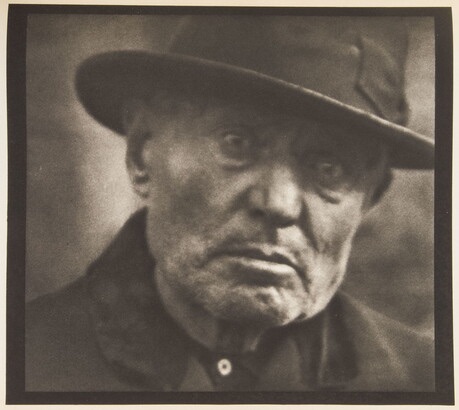
This unnamed picture was taken by our old friend, Paul Strand, in 1916.
Amon Carter Museum
I look at this picture and I wonder why Strand saved it. Initially I only think the subject looks very tired.
But Paul Strand saw something else .What did he see in this face?
I could come up with various stories about who he is. I would guess his age is important. A younger man could not make that expression if he tried. It’s not fatigue. It’s fear, shock, or loss. Perhaps he pinched and saved and worked every waking moment to be successful (however he defined success), only to learn his family had abandoned him because he spent no time with them. Maybe he was a greedy man and fell for a scheme that robbed him of his life savings .
Or is it the look of a man stripped of a lifelong illusion? Maybe he was in love with one woman his whole life, He finally married her, only to realize when he could no longer get away, that he really didn’t like her. He had just been caught up in pursuing his fantasy of being with her. Maybe his expression is that of a man who suddenly understands the old adage: Be careful what you pray for. You just might get it.
What do you say, friends? Why did this fellow look like that?
 old spirituals
maybe he’s frustrated by someone taking his picture? I like his hat though.
LikeLiked by 1 person
ha! Maybe. I don’t like people taking my picture either, I would sympathize with him!
LikeLike
I think it is more doesn’t want he photo take for identification reasons.
LikeLike
His hat caught my attention, too. Perhaps he is a capo (a.k.a. a caporegime) in the Mafia who doesn’t want his photo taken.
LikeLiked by 1 person
With those blue eyes, I doubt he’s a capo. You can’t be a made man unless you’re from the old country, right? At least that’s what Goodfellas led me to believe! 😂
LikeLike
No, you don’t have to be from “The Old Country,” but you have to be of Italian descent.
LikeLiked by 1 person
This may explains the uniqueness of the Strand photograph. According to Wikipedia:
“. . . Strand’s works reflect his interest in using the camera as a tool for social reform. When taking portraits, he would often mount a false brass lens to the side of his camera while photographing using a second working lens hidden under his arm. This meant that Strand’s subjects likely had no idea he was taking their picture. It was a move some criticized.”
LikeLiked by 1 person
wow! really! I’m outraged for those people. I don’t think anyone should be able to take pictures or video of you without permission.
I am a little conflicted. I have to admire his sly trick with the camera. How deviously clever!
LikeLike
i missed a couple of your posts somehow. this man looks shell shocked to me like he just got bad news
LikeLiked by 1 person
Shell shock is an interesting idea. Did you ever happen to see the George Carlin bit on how Americans love euphemisms to soften painful thoughts? He used the example of shell shock. Certainly there are many changes that are deliberate attempts to obscure ugly truths, which is one of many reasons I prefer to stick to turn of the century topics! https://www.youtube.com/watch?v=hSp8IyaKCs0
LikeLike
yeah he cared about language. i know you find it significant. i don’t think of it like you but you do make me think !
LikeLiked by 1 person
How did I miss this? What a chance to get on my soap box! 😂 Here’s an example that may be more relatable: what if the term “privacy” didn’t exist, and there was no equivalent? Privacy is an umbrella term with a lot of smaller issues beneath it. Your opinion on any new issue under the umbrella is somewhat pre-determined by how you already feel about privacy. Your thinking about privacy colors how you think about Google selling your information to marketers, and Target data breaches, and websites that publish your home address.
Terminology that predisposes you to connect different issues together, and the use of softened language and euphemism to change your thinking are two ways out of millions that language impacts you every day.
LikeLiked by 1 person
i’ll take your word for it!
LikeLike