It is time to shift genres from crime and criminals to the Arts.
Far from being a criminal, Mary Cassatt was born in Allegheny, Pennsylvania to an upper-middle-class family in 1844. Her father was a successful land speculator as well as a stockbroker and her mother the daughter of a prominent banker. Her ancestral lines went back to 1662 when the French Huguenot, Jacques Cassatt, arrived in the Dutch settlement at the southern end of Manhattan, then called New Amsterdam.
Eduction was important to Mary’s parents, particularly her mother, herself a well educated and well-read woman; and, she wanted the same for her daughter. The family moved in progressive steps eastward, eventually landing in Philadelphia where Mary was enrolled in school at age 6.
Besides education, travel was believed to be an important part of a well-rounded education, so Mary spent five years living in Europe’s major capitals of Paris, Berlin and London. Much to the chagrin of her parents, Mary decided she wanted to be a professional artist, enrolling in the Pennsylvania Academy of Fine Arts at age 15. To make the situation even more untenable, Mary lived the Bohemian Lifestyle of many her artist friends, yet another reason why her parents frowned upon her career choice. Furthermore, the group of artist were advocates of equal rights for the sexes, an ideology contrary to the prevailing culture of the 19th century.
Mary favored a less scholastic approach to becoming an artist and in 1866 moved to Europe to study under established and successful French painters. Her decision was proved to be the right one when in 1872 she had her first of several major Paris Salon showings of her work.
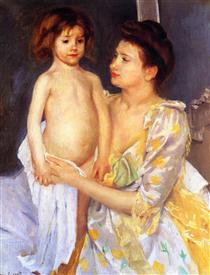
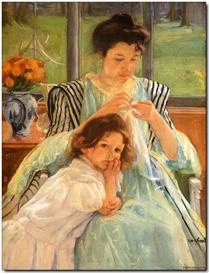
Achieving success in Paris inspired Cassett to establish permanency in the city and she opened her own studio there. The painting genre at the time was Impressionism, a movement that Cassatt joined and used in her work. At first she was experimental, then deciding to use bright colors to her art. After witnessing work by Edgar Degas and Japanese printmakers, Cassett shifted her focus to intimate depictions of woman’s lives, particularly mothers with children.
As an American painter and printmaker within the Impressionist group in Paris, her work consistently captured the intimate lives of contemporary women, particularly their roles as caretakers of children. Her work gained recognition and she continued to exhibit with Impressionists painters. Success provided the means for Mary to acquire a château about 40 miles north of Paris, and she began to split her time between her two residences.
With Mother’s Day quickly approaching, the perfect time is now to experience Mary Cassett’s depictions of mothers with their children. Mary Cassett was the only American to exhibit with the French Impressionist of the later part of the 19th Century, so she hold a seat of honor and respect in the American art history.
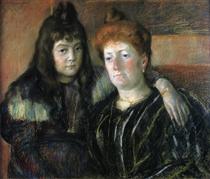
Mary Cassatt sketched and/or painted literally hundreds pictures (over 600 as far as I can determine), the majority of which are of a woman or a mother with her child. Only a tiny sample of Mary Cassatt’s work is included in this post. Of those in this sample, my favorite is Breakfast in Bed. Which one catches your eye? One, I believe, exemplifies the Japanese influence in Mary’s work. Comment if you can identify the painting I believe reflects that style.




Thank you, Margaret T.
LikeLike