My goal was to write an independence themed post today and I went looking in the Library of Congress for content.
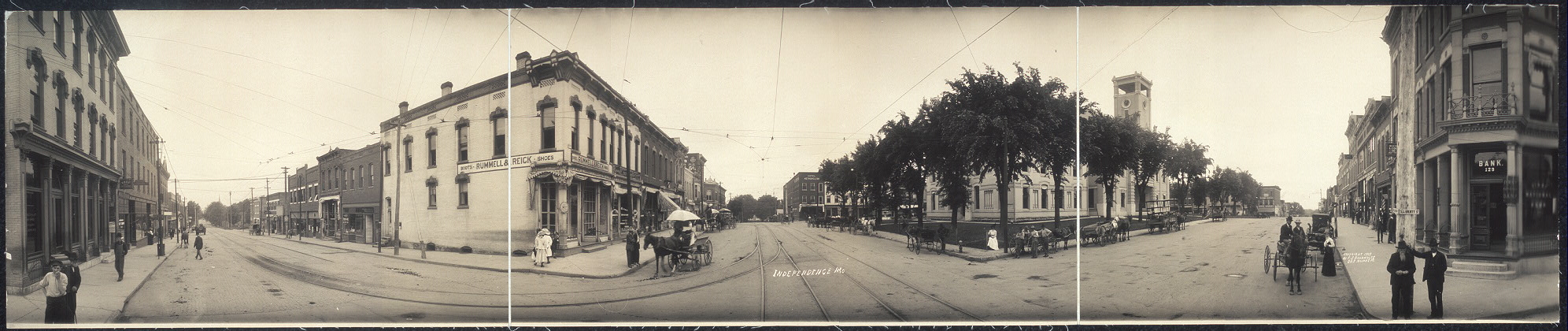
This is Independence, Missouri in 1909. It’s as turn of the century as you can get! You see tracks for a trolley, horses and buggies, and people chatting on the street on this beautiful day, some 117 years ago. The streets are broad and the sidewalks are spotless. At the time it was photographed by Frederick J. Bandholtz, the population was about 9,800.
LOC
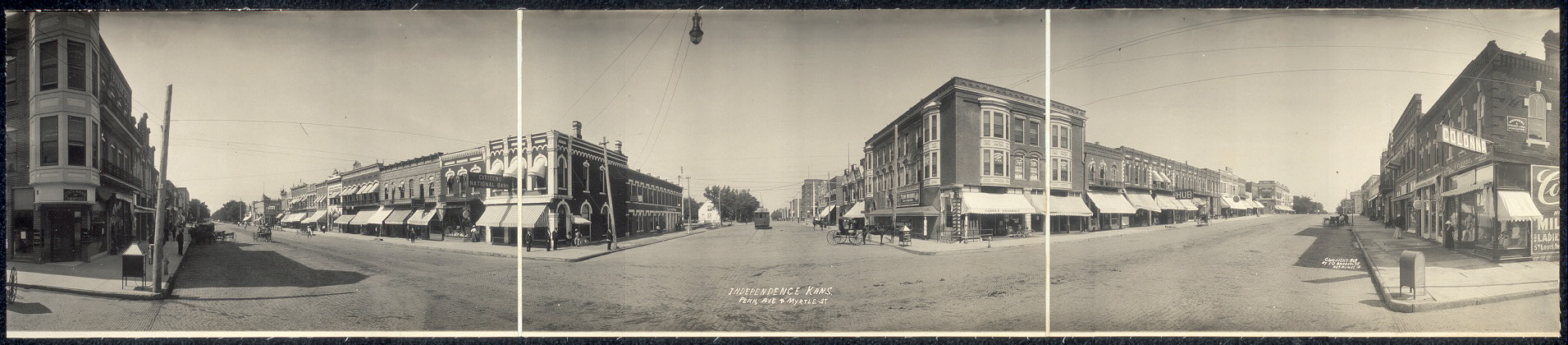
What should I find but another picture from Independence in 1909, taken by Frederick J. Bandholtz… but it was a different Independence. This is Independence Kansas, population 10,400. It doesn’t look quite as pleasant as Missouri, possibly because the glare of the sun makes it appear hotter.
LOC
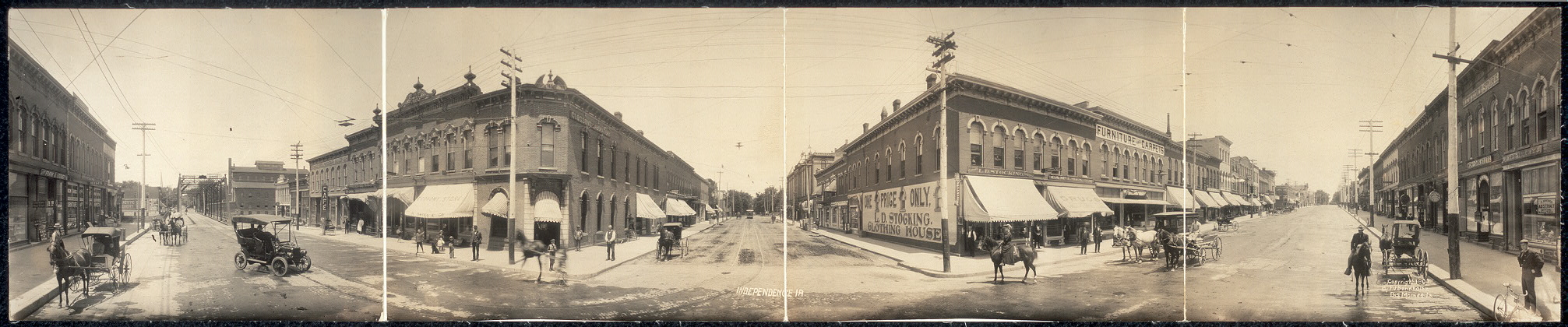
Frederick J. Bandholtz must have been on a quest. The third photograph is from Independence, Iowa in 1909. At just 3,500 people, the population of this little town was significantly smaller than the others but it looks more active. Notice the people on the street, looking curiously in the photographer’s direction.
LOC
Today, Independence still exists in all three states but the little towns, which look almost identical in these little snapshots have had very different fates. Independence in Missouri is about 12 times larger than it was, with most of the growth coming directly after World War II. In Kansas, the town of Independence has shrunk by about 20%, with people beginning to leave during the Great Depression. And in Iowa, Independence has grown slowly and steadily and the population has nearly doubled.
But what of the photographer, Frederick J. Bandholtz? Who was this fellow who left us these glimpses into history? And what inspired his quest to find Independence all across the Great Plains? I could find very little about him. His friends and family called him Fred, and he was 32 years old when he went on this quest, married to a woman named Mary Ellen (Steele), and a father of four–though only two were living. The year after these pictures were taken , his fifth and last child was born, a son named Leonard.
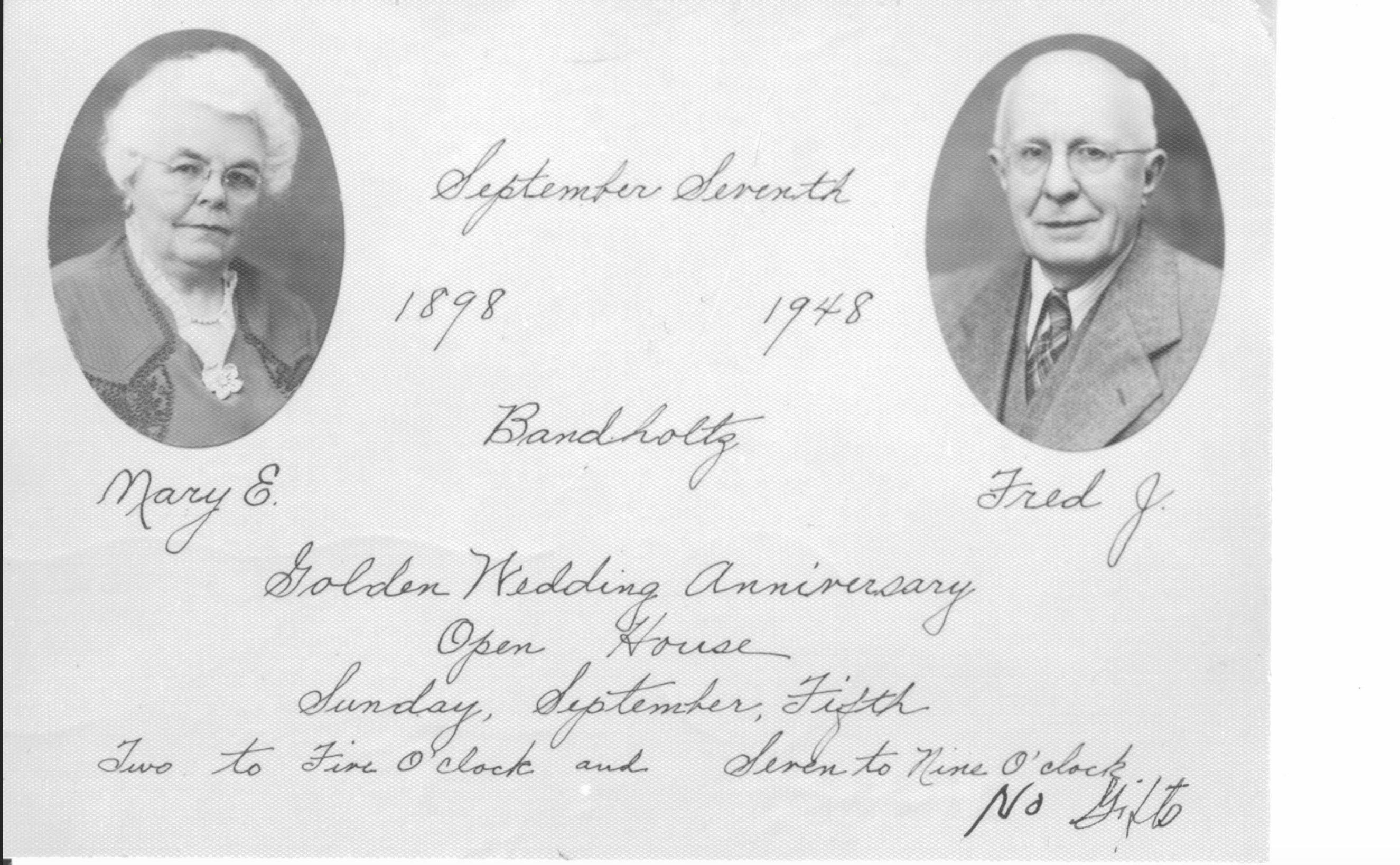
I found this picture from years later on Ancestry–an invitation to an open house to celebrate Frederick and Mary’s Golden Anniversary. Can you deduce anything about them from their faces? My guess is Mary wrote the invitation. The words “No Gifts” were added later, almost certainly by another person.
Ancestry
 old spirituals
fred is hard to read. he might be a pretty hard man or he may have a sense of humor. mary looks sharp. not much got past her
LikeLiked by 1 person
Neither Mary nor Fred appear to be the life of a party. Do you think they “danced the night away.”
LikeLiked by 1 person
At most, one good polka!
LikeLiked by 1 person
Well I might have agreed but I read Judy’s take and I think she nailed it!
LikeLiked by 1 person
me too
LikeLike
Cursive penmanship on the invitation is to be admired.
An Open House for a Golden Wedding Anniversary today would be continuous hours, not broken by a period of non-celebration. Wonder if that was customary practice? Perhaps Mary and Fred lacked the stamina to entertain for 5 continuous hours. Or, that it was a Sunday may be a factor.
LikeLiked by 1 person
Hm. I would imagine they would both be exhausted by 5 straight hours of socializing. Mary’s handwriting is very pretty! II wish mine were better. It’s legible if I slow down!
LikeLike
I went to a school where penmanship was an integral part of the grade you received. If it can’t be read it can’t be evaluated to be correct.
LikeLiked by 1 person
i went to a similar school
LikeLike
I like Mary and Fred. Good old Midwest people. Mary’s handwritten invitations are lovely and I’m sure Fred’s arm was twisted by Mary just to have this celebration. I think Fred was more of a private person and definitely added the “no gifts” on the invitation. I love the way Mary wrote the number nine. Artistic.
Fred’s photography is a time capsule of each city. Iowa really looks to have unpaved streets and Kansas is very flat and lacks the beauty of Missouri. I lived near in the Kansas/Missouri areas from 1953 to 1962. Missouri is lush with greenery and rolling hills. You’ll see the trees in the top picture. I have very fond memories of going for walks in the woods with my friends. The movie, Picnic, reminds me of Olathe, Kansas in the 1950’s.
LikeLiked by 2 people
I am going to ask you if I ever really need a good analysis of a picture. I think you got it right. I studied graphology when I was younger and I noticed Mary’s capital letters and her Zs. IThat style of capital Es is called a Greek E and it’s often used by artistic people. I would like to visit Missouri someday. Everyone I’ve met from that state has been genuine and wonderful.
LikeLike
My hometown was settled in 1705. It was a stopping point during the U.S. Colonial period for travelers going between New York and Philadelphia; a ferry transported them across the Delaware River. Some of Washington’s troops were hidden the town just before the historic Battle of Trenton. Its only hotel dates back to 1812 and has hosted many historical figures.
Such small towns have evolved over the decades, attracting new residents who decided to escape large cities. Sadly, they have no family history in the town. Ancestors of the town’s founders and early settlers were individuals I personally knew.
The business district that one time sustained the owners’ families and met the needs of residents have been transformed. Businesses such as a men’s clothing retailer; a 5¢ and 10¢ store; a children’s clothing shop; two pharmacies; two large and two small food markets; a two-story family department store; a family shoe store; a cobbler; a small sporting goods retailer; and, a hardware store, all within a two block radius are all gone now.
They have been replaced by store fronts hiding behind the same facades but selling items to attract tourists . . . . primarily unconscionably priced antiques and tchotchkes. Added to that change is the influx of many different peoples and their cultures that do not have a steeped family history in America. What once was “Main Street America” has dissolved and formed a different landscape. Whether it is for the better is yet to be determined.
LikeLike