The Discovery
Two men walking along Oak Hill Road (a.k.a. Blue Grass Road) between 8:00 and 9:00 a.m. on Wednesday, May 23, 1900, crossed the bridge over Pigeon Creek known by locals of Evansville and Elberfeld, Indiana, as Stephens’ Bridge. They were walking at a leisurely gait, after all it was a beautiful morning to walk to the country to buy some cattle. They glanced into the waters of Pigeon Creek as they walked across the bridge when something caught their eye floating along the south bank of the creek. It must be a “dummy” they first decided.
The men were Eb Cross, Sr. and Louis Hegel. Cross and Hegel stood looking from a distance and convinced themselves – “it looks like a ‘dummy’.” Charles B. Herrman, who lived nearby, was contacted and asked for his opinion. Now there were three men standing on the bridge trying to discern what they were seeing in the water. Herrman noticed flies buzzing around the object, the telltale sign that it was not a dummy. The trio descended the bank of the creek for a closer look.
The object was mid-stream, about 40 or 50 feet past the bridge, making a very close look impossible. Nonetheless, the men were certain it was a human body. What little they could see appeared to be a body with “The head and upper part of the body . . . submerged, while the rest floated” on the surface.
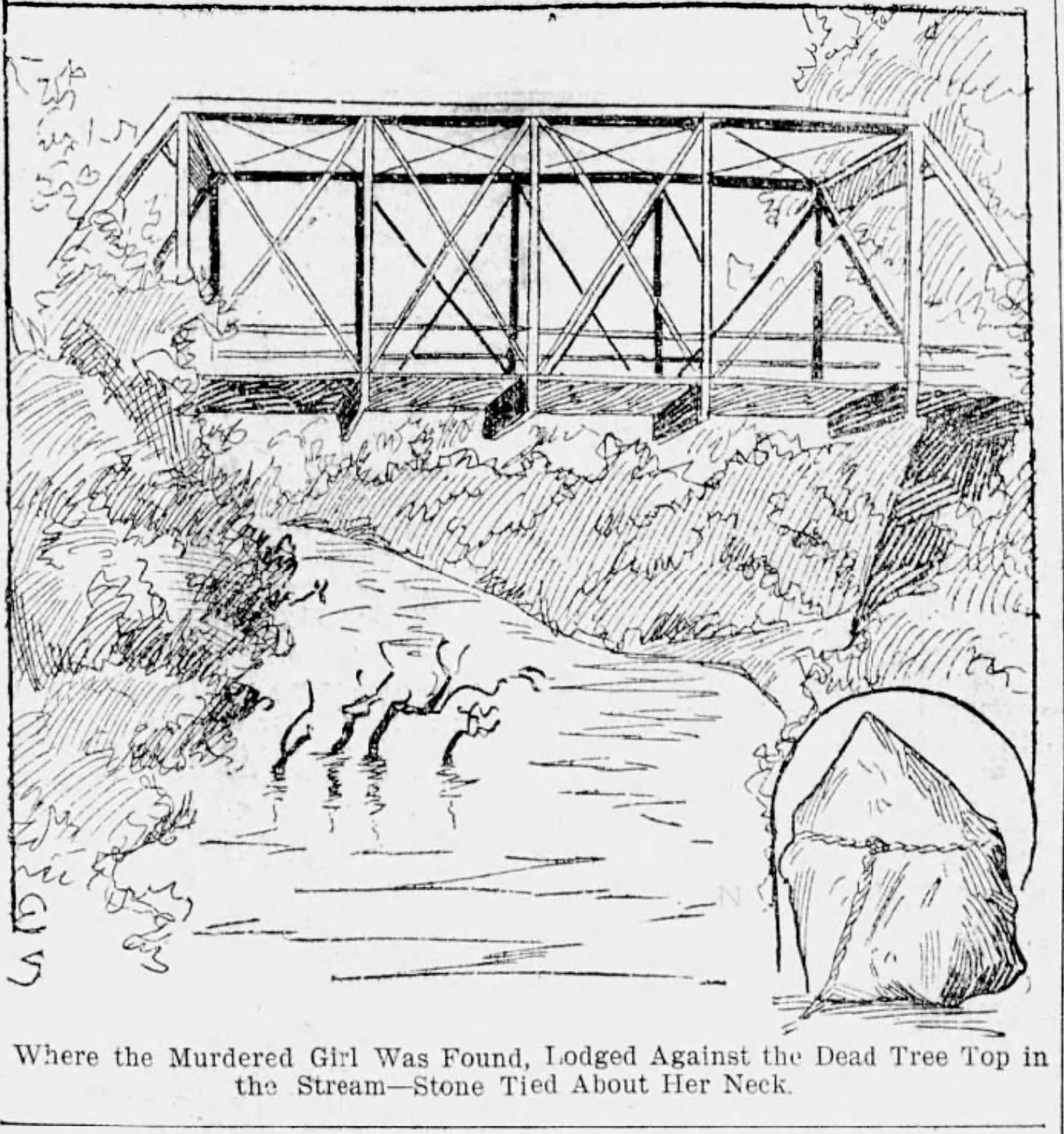
The coroner was called and accompanying him was Deputy Matt Perrin who, along with Charles Herrman, used a skiff to retrieve the body – a feat more difficult than expected. From the clothing it was determined to be a woman, but her head was submerged, tethered to a 13 to 15 pound stone by a rope around her neck. The creek depth was about 3 or 4 feet at that location and the stone was tied to the body with a piece of sisal rope (made from the Agave plant) that was only 2 feet long. The feet of the woman were snagged on the branches of a tree lodged in the creek, otherwise the body would have floated down stream. A search of the area suggested to the police the stone came from an outcropping under the bridge on the south bank of the creek.
Most of the face was badly mutilated and decomposed, making identification nearly impossible. One clue was a white silk veiling that had, apparently, slipped down from her face that was being held by the noose around her neck. Thirty or forty feet from the body, on the bank, the searchers found a storm apron that officials assumed was used to wrap the body for transport to the creek.
Sidebar: A storm apron is a protective covering made of waterproof material, used in buggies to shield passengers from rain, snow, or dust while riding. It typically attaches to the dashboard and extends over the front and sides of the buggy, slanting upward to attaching about chest height of the driver and any passenger.
A coroner’s examination of the body determined the head and face had be crushed with a blunt instrument – the exact object undetermined at that time. The corner also opined the body had been in the water decomposing for several days. The condition of the face made it impossible to identify except that it was that of a young woman. At that point, no woman from Evansville or its surrounding areas had been reported missing, so the police had to work every clue that it had available.
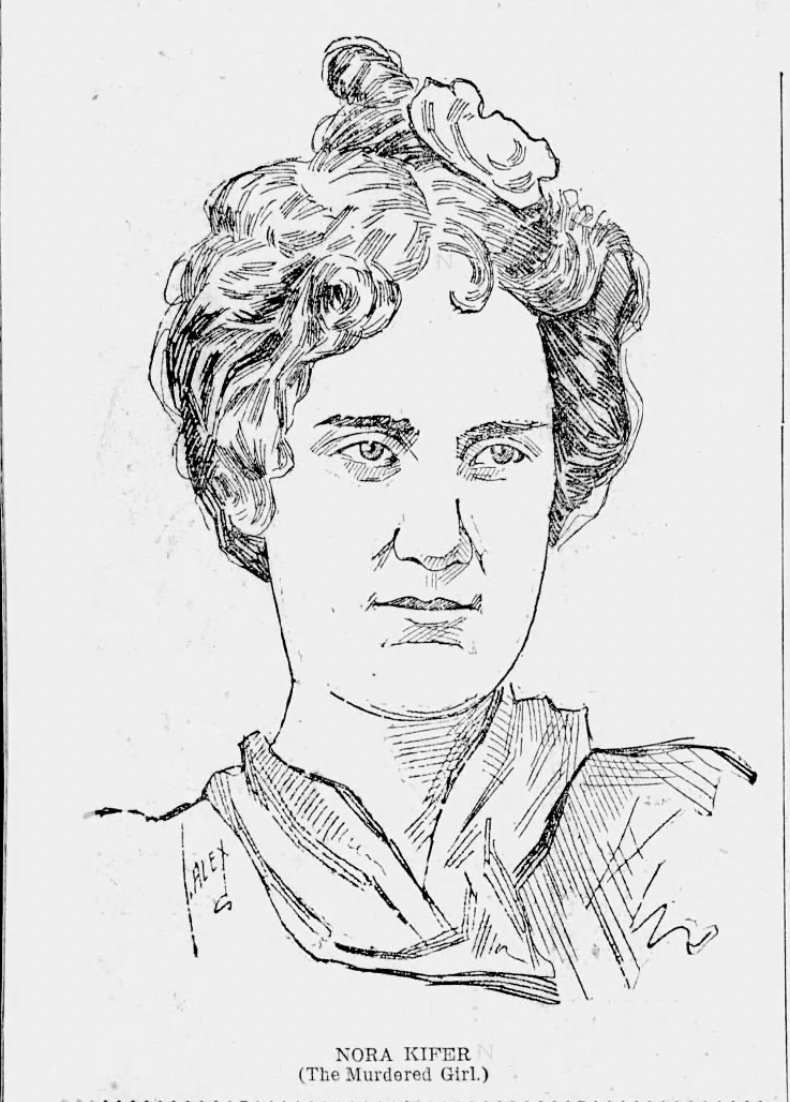
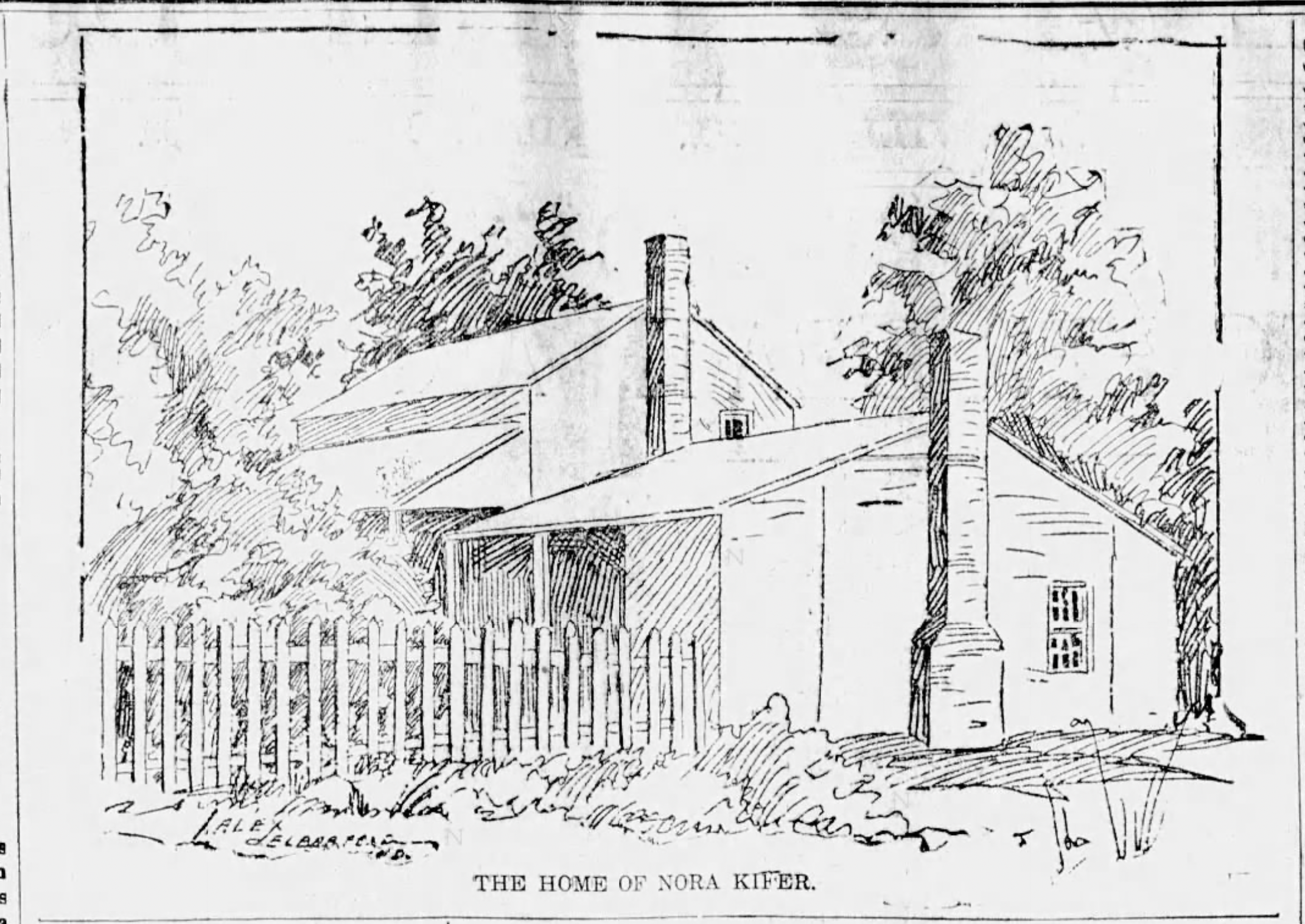
Police immediately sent out a broadcast with the description of the young woman and at 10:00 o’clock Zachariah T. Kifer of Elberfeld, Indiana, a suburb northeast of Evansville, responded because he believed the victim may be his daughter, Nora Kifer. He last saw her alive on April 3, 1900, when she left home to go to Evansville 10 days ago to marry William Clark, as was initially reported by one local newspaper. One paper reported that Mr. Clark arrived in Evansville on March 20, with the intentions of marrying Nora on March 29. That plan was foiled when William Clark became intoxicated and accused the Nora of stealing $300 from him. In fact, “Clark’s money was used to buy her a wait intended as a wedding dress but later served as a funeral shroud instead,” reported The Evansville Courier and Press on May 25, 1900. That reason for leaving on April 3 reported by the newspaper was later determined to be erroneous.
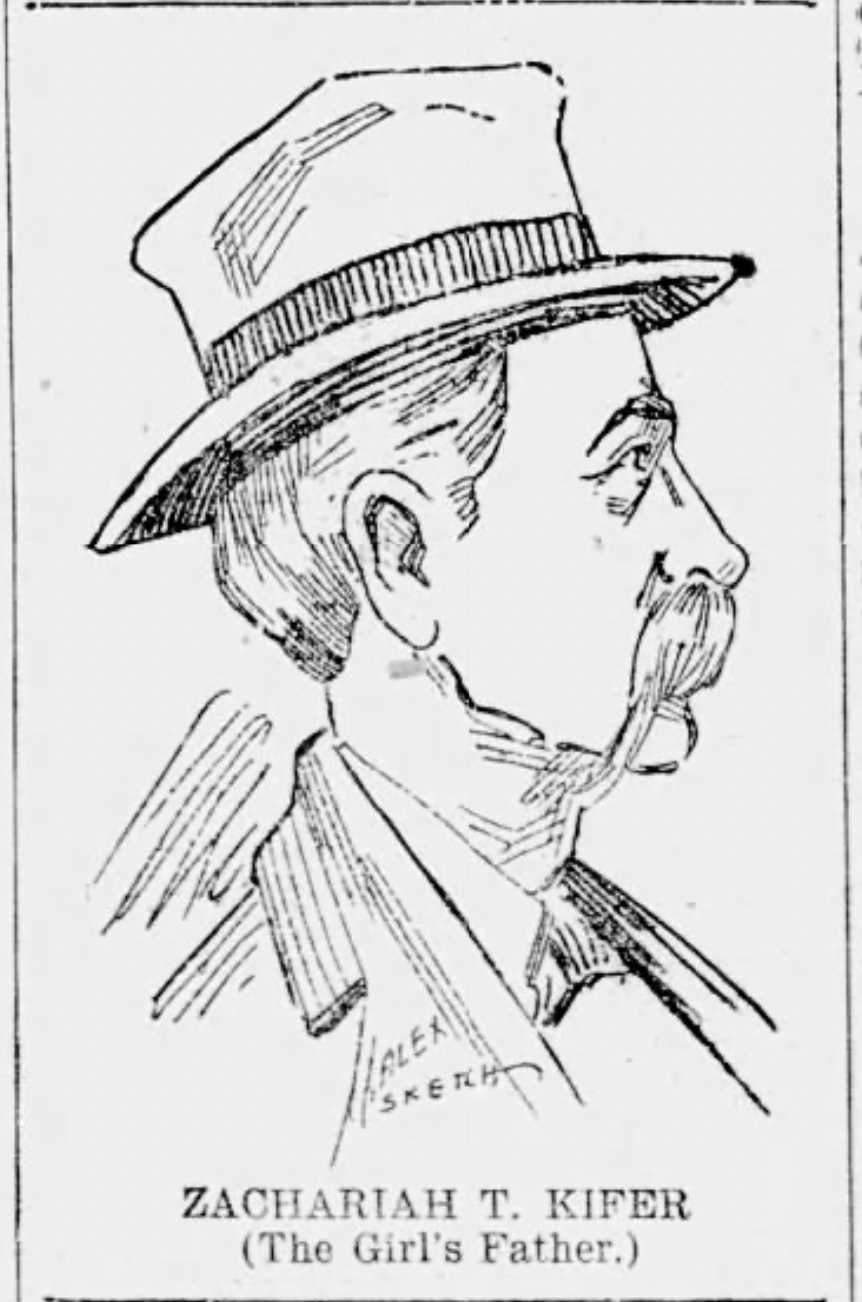
Sidebar: Elberfeld was and still is a tiny town founded by predominantly German immigrants. Its Post Office has been in continuous operation since 1868 and the city was platted in 1885. The city’s name was after a German town of the same name. The 2020 U. S. Census determined the city has a population of 644. Zachariah T. Kifer was a tenant farmer on land owned by Joseph D. Keith, a prominent farmer and real state owner.
The next day, Zachariah T. Kifer first identified the clothing found with the body and then viewed the body at the cemetery where it was in a simple pine coffin. Her father recognized the pieces of clothing found with the body as well as gold plated pins that held her waist and the small stick pin “with its tawdry blue glass jewel.” All were the items she was wearing the last time he saw her. Accompanying Kifer to confirm the identification was H. C. Greer, Nora’s cousin, who also lived in Elberfeld and a person that knew her well.
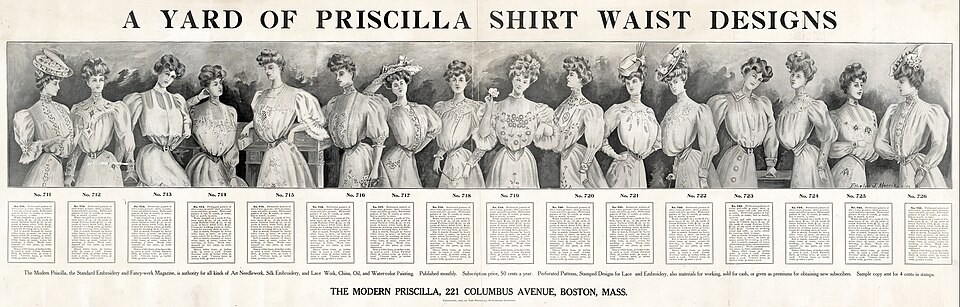
Sidebar: From the early 19th century into the early 20th century, the term “waist” was a common term used for the bodice of a woman’s dress, or for a blouse or or woman’s shirt.
Fact Finding and Investigation
At the coroner’s inquest, Mr. Kifer testified that the body found was that of his daughter, last seen “in good health and spirits the morning of the third day of April.” The Evansville Courier and Press recorded that “on April 2, Joe D. Keith called at my house and asked for my daughter.” Mrs. Kifer informed Mr. Keith that Nora said she had “gone to town (meaning Elberfeld.) He then went away.”
The next day, April 3, Mr. Kifer testified that “Mr. Keith’s son, Jesse, came over and met with my daughter.” Kifer said Nora and Jesse “went out to the orchard to pick some fruit” and talked. Jesse left and then shortly after Nora said “there was a spelling match and she was going to it.” She dressed up in her best clothes, the same clothes he recognized at the coroner’s office found with the body. She left home, walking in the direction of Elberfeld.
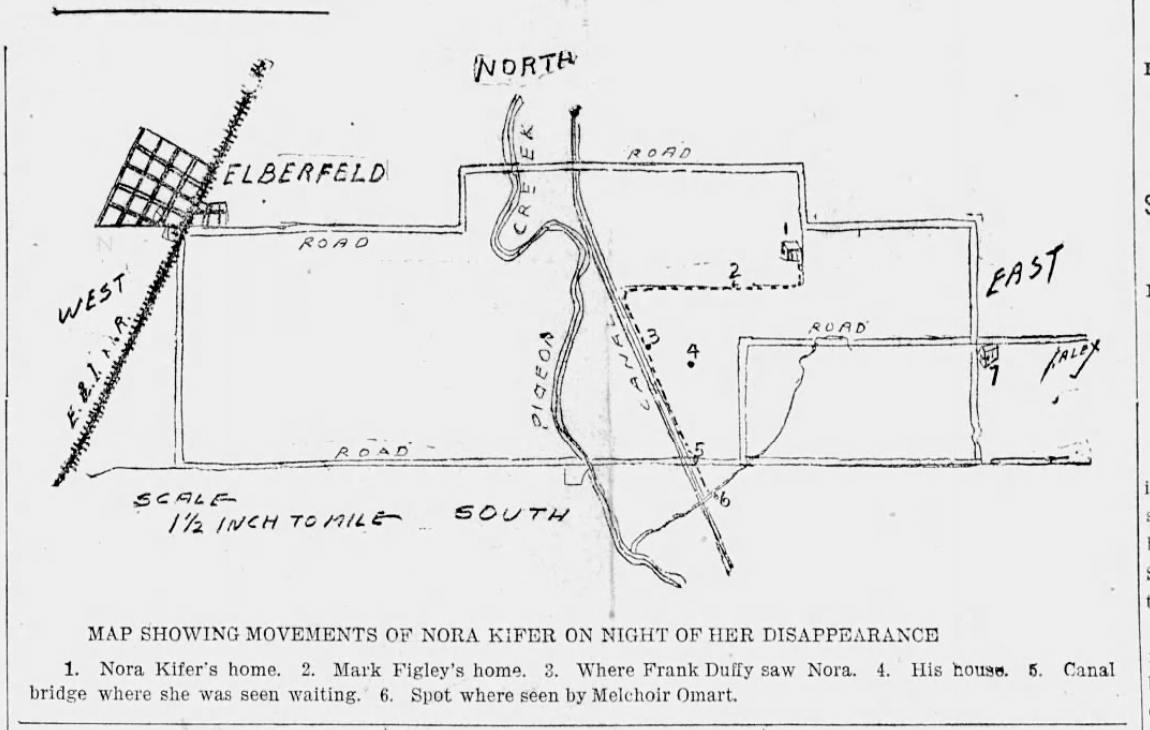
Nora stopped for visit at a neighbor’s, Ed Figley, about half-a-mile away, where she remained for about an hour, saying it was getting late and she had to leave. When she left Figley’s, Nora changed direction to a southerly bearing; several people saw her heading in that direction. She was last seen standing on the bridge over the “old canal.” After that, Nora was not seen by any neighbor again – alive.
On May 9, 1900, over a mother later, Mrs. Kifer received a letter postmarked the day she was last seen. The letter was simply worded.
Dear Mother – I start this evening for Chicago on a trip. I may be gone three months and might be six, with a friend. I except to have a find trip. Do not be uneasy about me. From you loving daughter, LORA
The Investigation
There was no eyewitness to the murder of Nora Kifer. A plethora of circumstantial evidence was obtained by the police, the prosecuting attorney and the coroner, all pointing to Joseph D. Keith as the killer. One significant piece was a note of April 9th to Mrs. Kifer, purported to be from Nora to her mother. To those who knew or worked with Joseph D. Keith recognized the handwriting to be his. That fact was confirmed through a comparison to business and personal letters and document known to have been written by Keith. Another piece of tangible evidence was the signature, LORA. That was not a name used by the Kifers for their daughter. Rather, and it was well known, that LORA was the name used by Joseph D. Keith for Nora Kifer.
It was common knowledge in the community, as well as within the church congregation the Keiths and Kifers were members, that Joseph Keith separated from his wife once because of his relationship with Nora Kifer; people knew they “patched up their differences” and were again living together. Whether speculation or first-hand knowledge, people understood that the reunion of the Keiths was triggered by Mr. Keith transferring some property solely to his wife’s name.
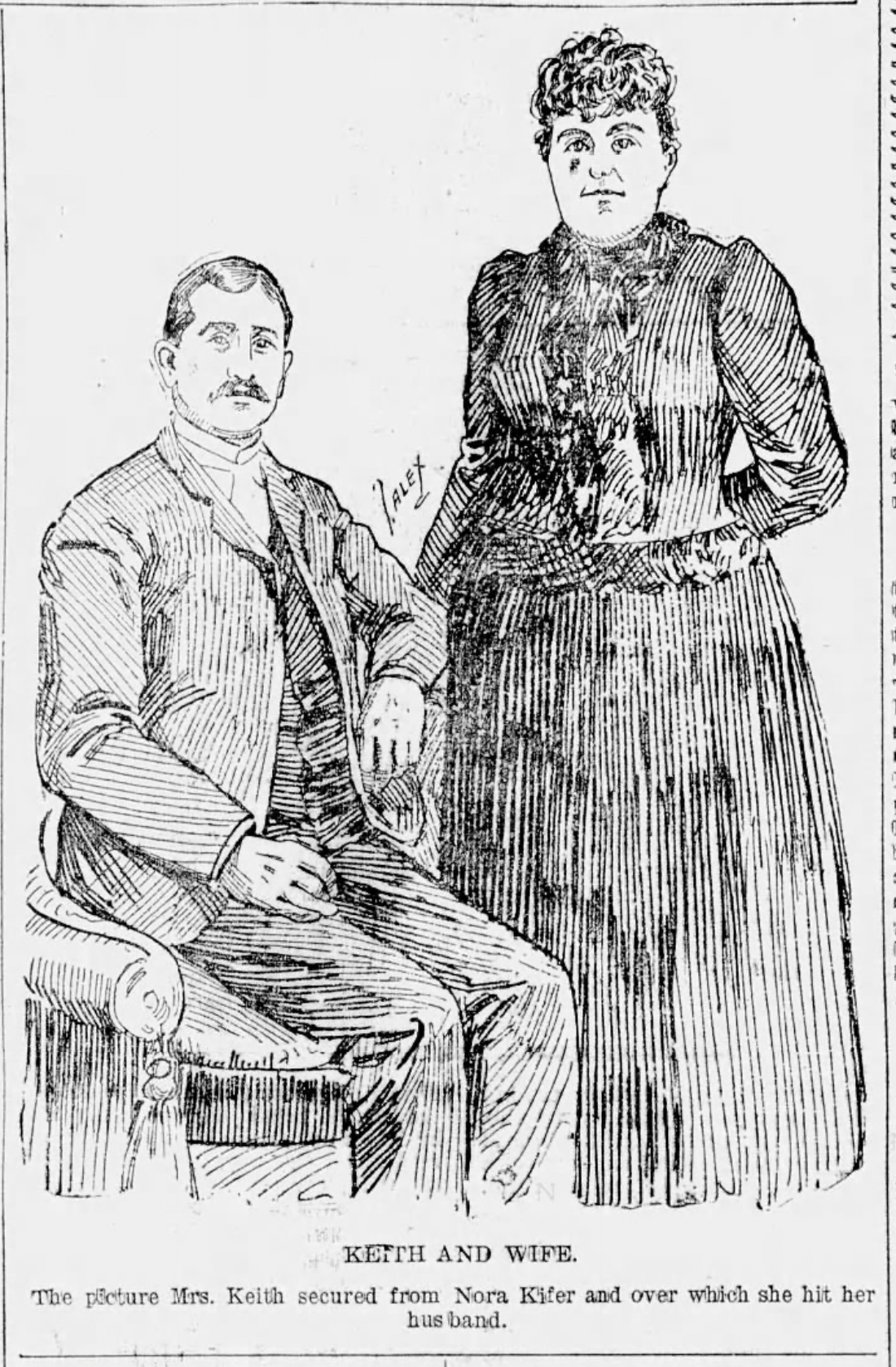
“Nora Kifer has consulted with an attorney about bringing suit for $15,000 in damages for seduction; and, Keith knew of this,” according to the Evansville Courier and Press. Joseph Keith had a widely known reputation for being very frugal, even cheap. The possibility of having to pay a large sum of money to Nora Kifer was not at all to his liking, and it was believed to be the motive for murdering the young woman.
Sergeant Heuke, Coroner Walker and Prosecutor Durre all questioned various witnesses in developing the identification of the killer. According to the Evansville Courier and Press in its May 30, 1900 issue, “It appears Keith’s visit to Evansville the middle of last December and his registering at the Richmond hotel with Nora as J. Smith and wife of Princeton, became noised around in the neighborhood in which he lived some time before the girl disappeared from home.” (“Noised” refers to the act of making a sound or noise, often in a context that implies disturbance or attention. It can, as used in the newspaper story, also relate to the idea of spreading information or gossip.)
Two of the many individuals questioned were Henry Thompson and Jesse E. Barton, both of whom claimed that Willie Butcher told them on April 5, 1900 he observed Nora Kifer at the canal bridge with two men. Butcher said he could recounted the men but would not say their names. Thompson said, “Returning to work after dinner, I sat beside Butcher on the hind end of the wagon while riding I asked him who the men were that he had seen meet Nora Kifer at the bridge. He said he would not tell me their names. I asked him if one of them was Keith. He replied that he had not said it was nor would he say so.”
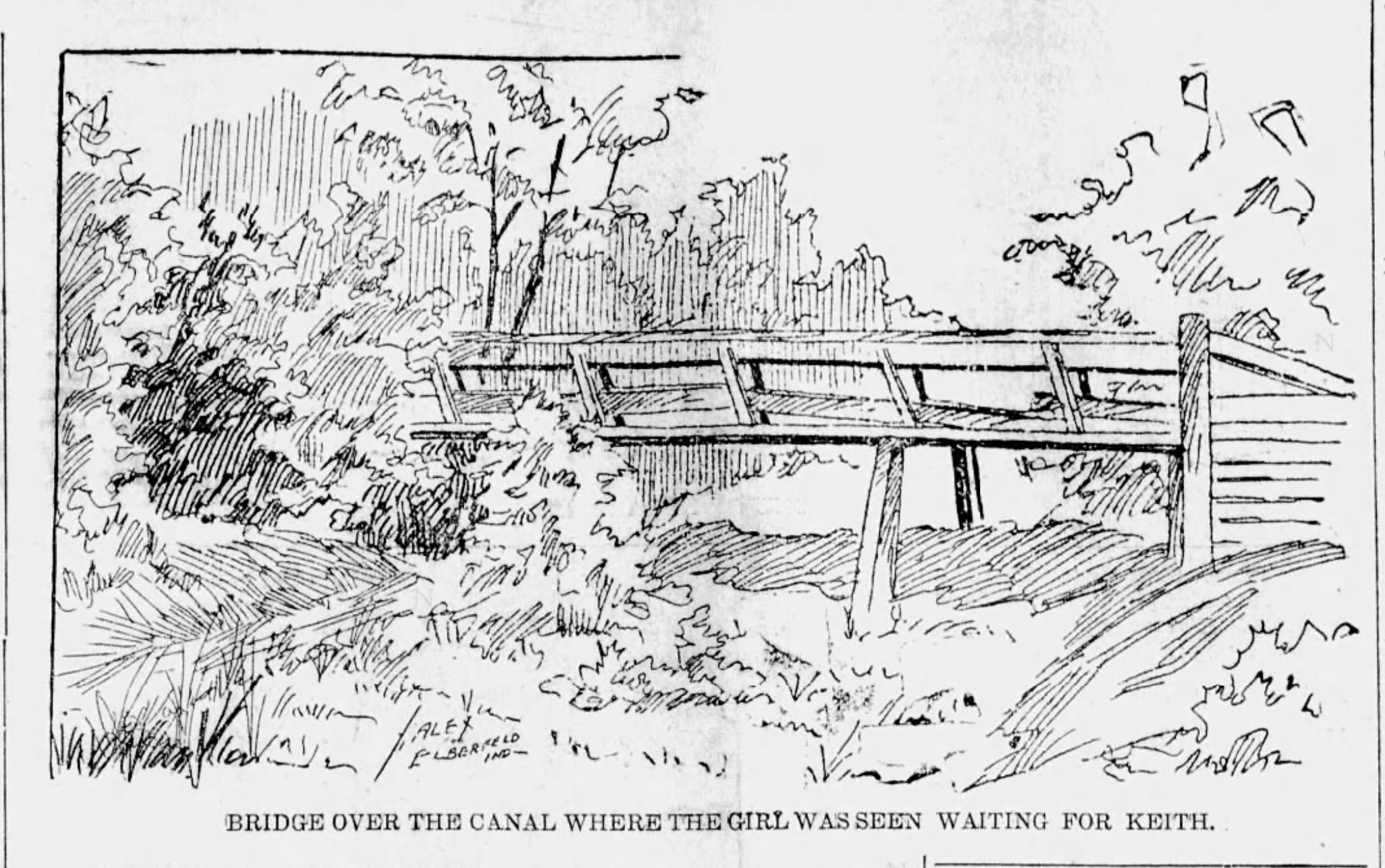
Thompson testify that, “He (Butcher) then told me after the girl had walked back and forth across the bridge several times she climbed the fence and went southwest through the woods. Shortly afterwards two men came down the towpath, climbed over the fence at the same place and went through the woods in the same direction as the girl had gone. I asked him why he did not follow the and he replied that he was afraid to. He said all this in a manner which did not have the appearance of a joke.”
Jesses E. Barton’s story was collaborated what Butcher told Thompson. “Barton’s story was:
“On April 5 I was at work at a log rolling at John Wash Greer’s place. During the morning in a conversation concerning Nora Kifer and her relations with Keith I heard Willie Butcher say that he had seen Nora on t he evening of disappearance walking down the towpath near John W. Greer’s place and a few moments later he say Joseph D. Kieth come down the towpath walking in the same direction.”
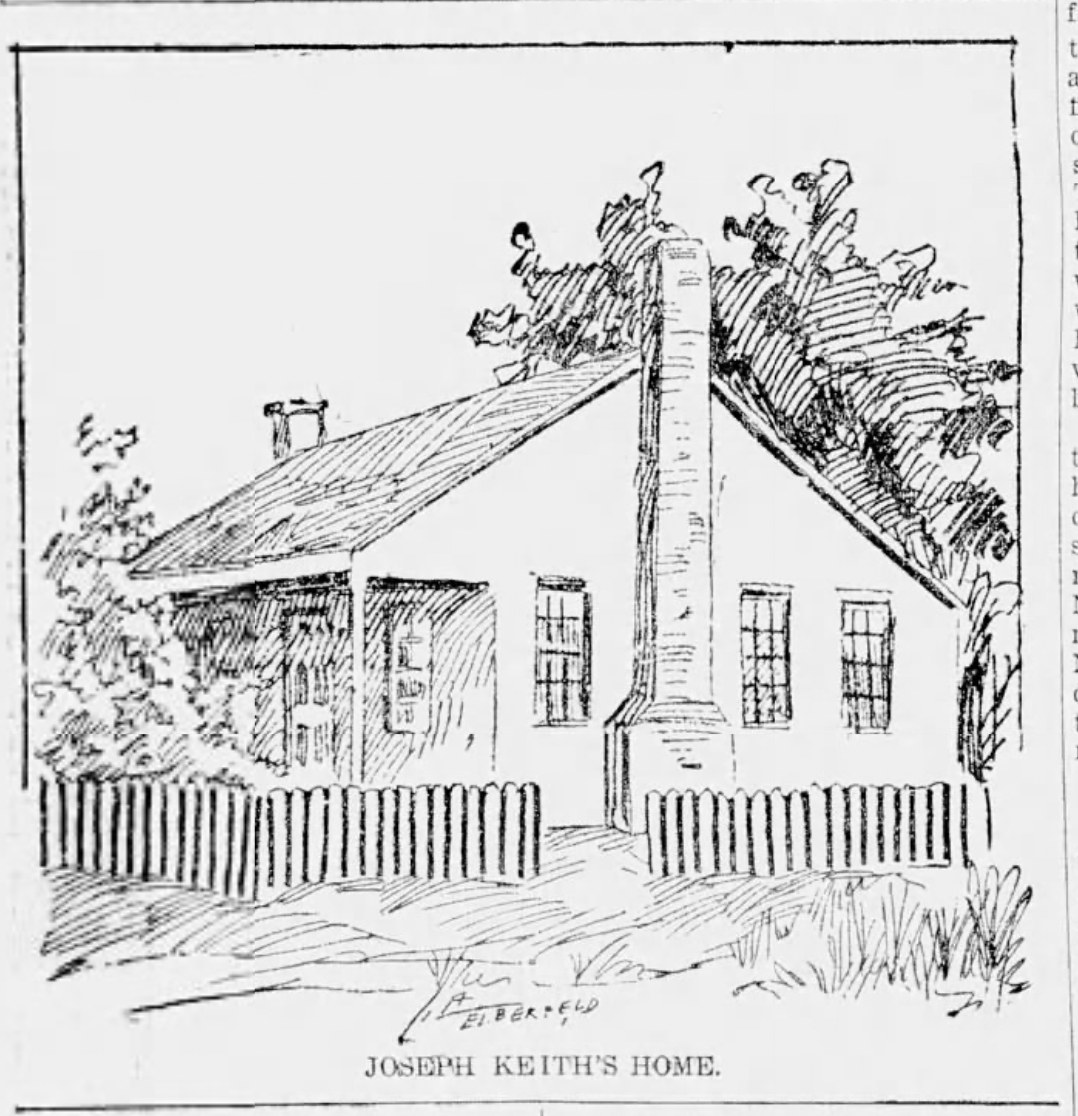
Police thoroughly searched Joseph Keith’s property. In a well, using a grabbing hook, a large clomp of hair matching Nora’s scalp, was pulled from the depths of the well. With the hair was a piece of sisal rope matching that found around Nora’s body, attached to the large stone in Pigeon Creek.

In Keith’s barn a police located a buggy wrench with confirmed blood on it and as well as blood on the “reverse side of buggy carpet. . . ” Police concluded Keith used the buggy to move Nora’s body from the woods near the bridge, placed it in the well and then days later moved it to the bridge to dump it in Pigeon Creek and, hopefully, have it sink and remain at the bottom. The theory was buttressed by Mrs. Belle Christmas who recalled Mrs. Keith telling her that her husband was away all night on April 4, 1900, the night after Nora disappeared.
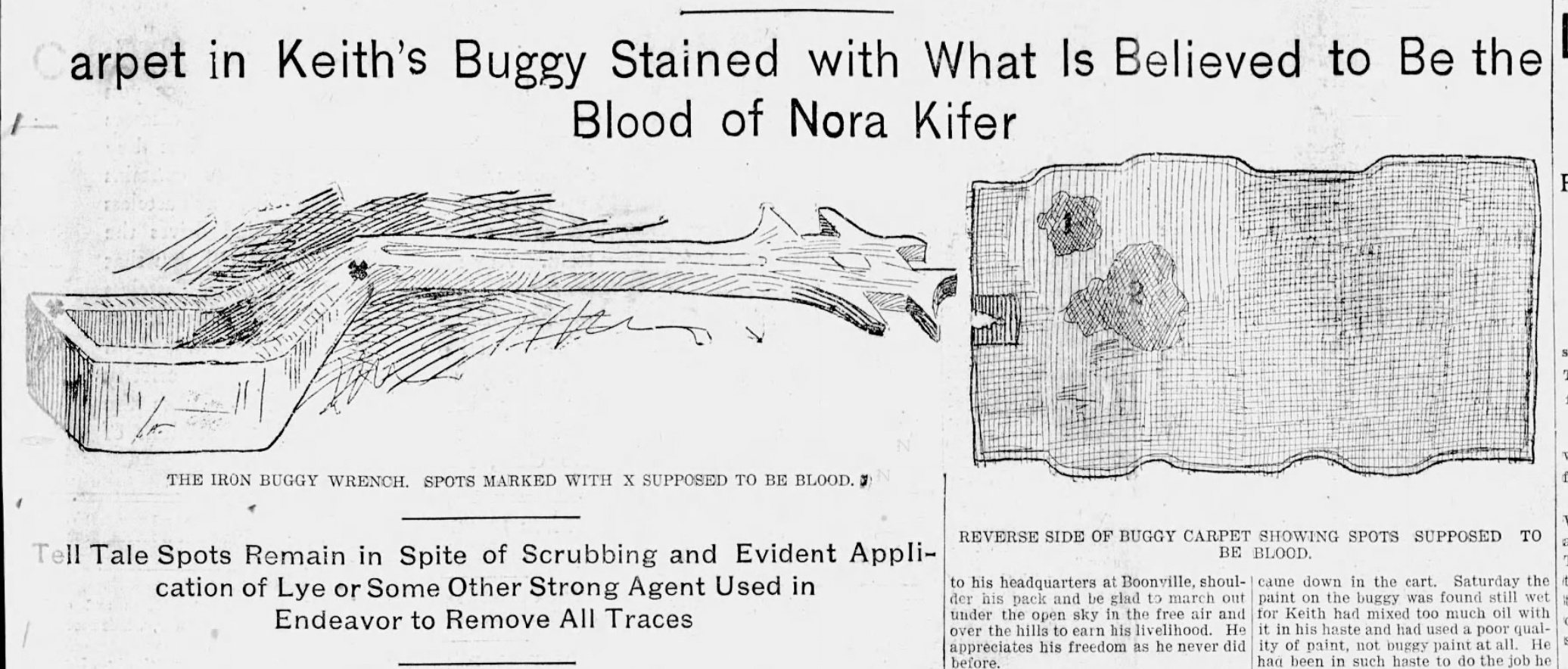
The Evansville Courier and Press declared, “One of the strongest pieces of evidence against Keith is the testimony of C. P. Hedges, one of Keith’s neighbors, that he met Keith on foot at 11 o’clock the night of April 3 when the girl disappeared. Keith was coming from the direction of the canal bridge and tried to escape observation by stepping to the side of the road and refused to answer Hedges’ salutation.”
The coupe de gras of Keith’s innocence was the testimony of Henry Holtz of Elberfeld who told investigators a few days before the girl disappeared he sold Keith a piece of sisal rope similar in size and appearance to the rope used to tie Nora’s body to the heavy stone. Additionally, U. G. Kifer, the uncle of the murdered girl, told police “that on May 16 he sheared sheep at Keith’s place and used rope like that to tie sheep” with during shearing.
Armed with a profusion of undeniable evidence, a charge of murder was issued against Joseph D. Keith for the brutal murder of Nora Kifer. H. G. Clark and Jessie Keith, the suspects first identified by the police, were released once the preponderance of the evidence point to Joseph D. Keith. At first Keith denied any guilt. It was eventually reported in the Evansville Courier and Press:
“On Saturday, June 22, Keith had his preliminary trial and was removed to jail, away from the searching questions of the police and their nerve racking sweat box work which had come so close to making Keith confess all.” In the same report the paper told the public, “Several times while he (Keith) was first confined in jail his wife visited him, but showed no emotion. If any love exists between them it could not be observed. She brought him home cooked food he relished very much and talked business with him. She never kissed him and did not show haft the interest a number of women did who wanted to being flowers to him and make his cell a bower of beauty but were prevented by unsentimental jailers.”
Trial, Verdict and Punishment
The trial was held in Princeton, Indiana, because of a request for a change of venue by the Defendant. Illness of a number of witnesses postponed the trial to December 31, 1900. Lawyers for Keith challenged all the physical evidence, going so far as to claim someone else placed the items in the well fished out by the police and that Nora was seen alive many days following her claimed death.
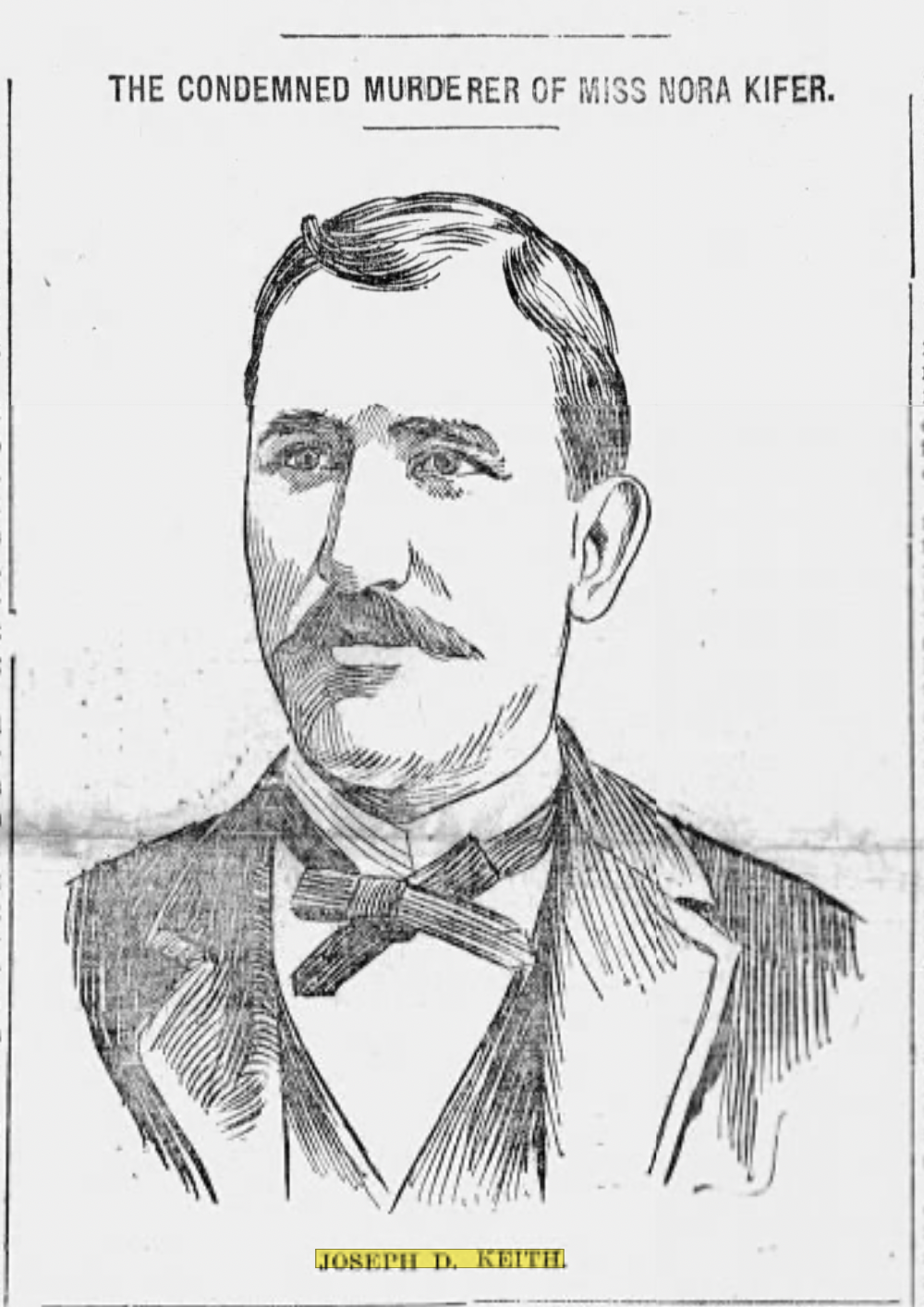
It was prominently reported by The Evansville Journal on January 12, 1901, that the case was given to a jury of his peers who found Joseph D. Keith guilty of the murder of Nora Kifer – after less than 4 hours of deliberation. The jury also decided Keith should have “the extreme penalty – death on the gallows.”
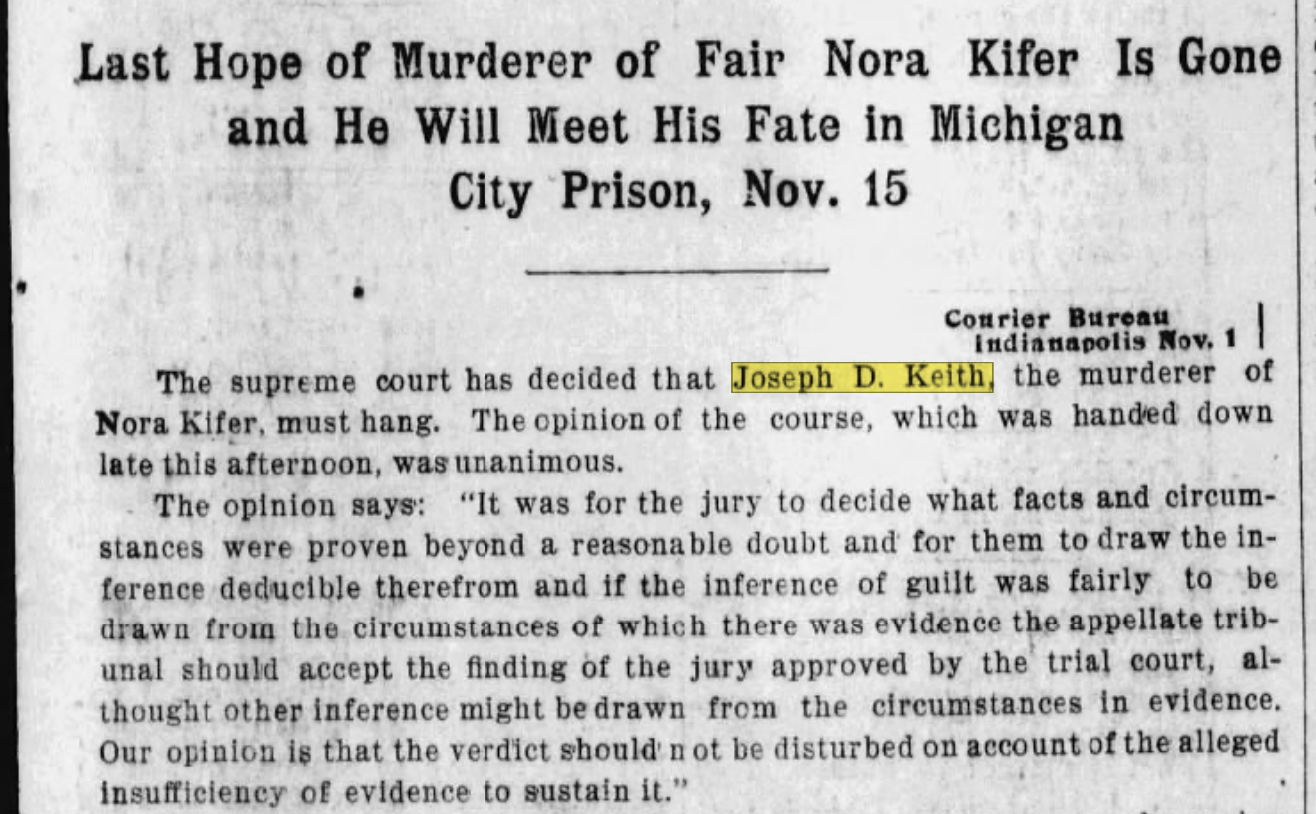
Keith’s attorney filed all the allowable appeals, using flimsy arguments that the trial should have been in a different venue and that witnesses were improperly allowed to testify. The appeal ended with the decision by the State Supreme Court:
The day of Keith’s execution, The Star Press of Muncie, Indiana, printed a dramatic headline on “Page 1” that included a summary of the case in a very long article:
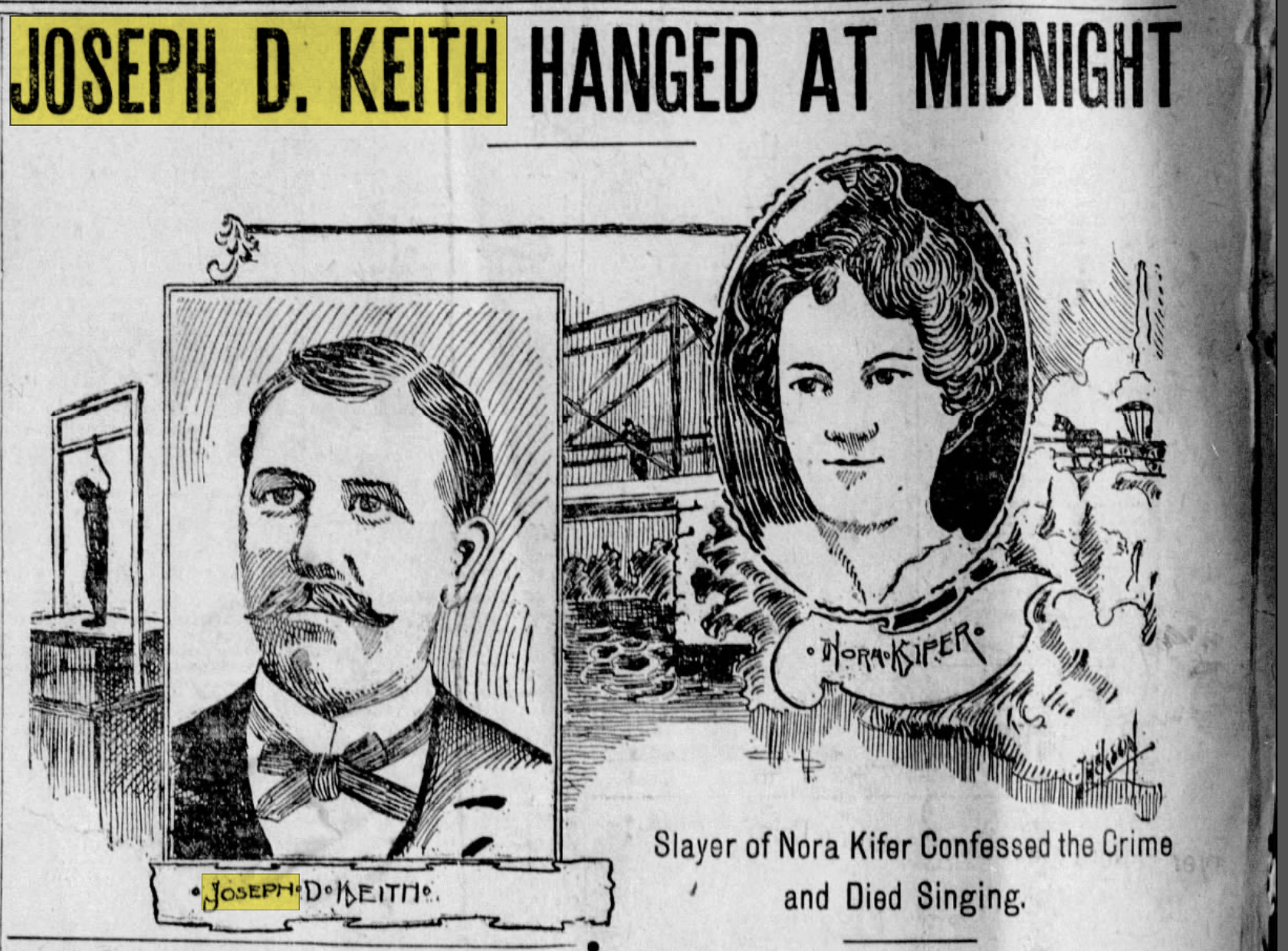
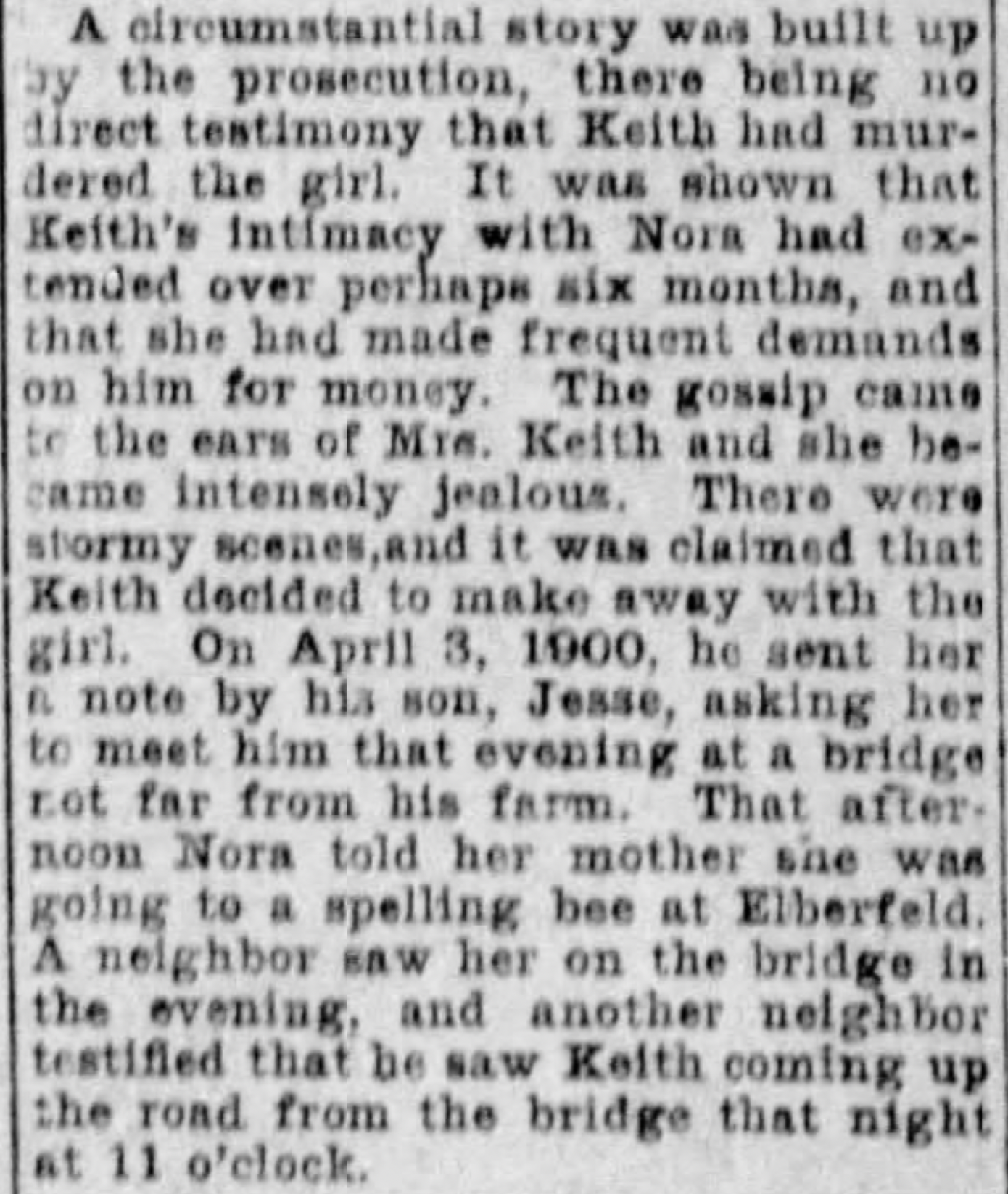
An excerpt of the The Star Press story:
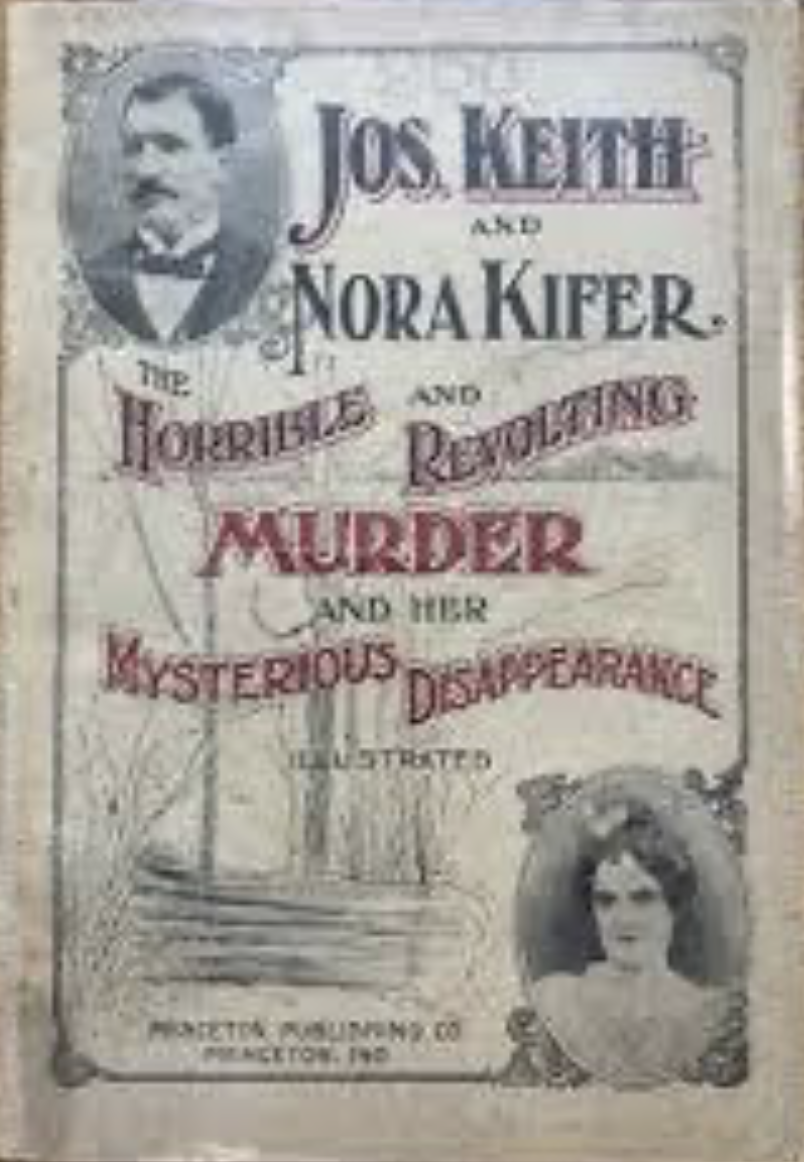
One book was published about the infamous Nora Kifer murder.
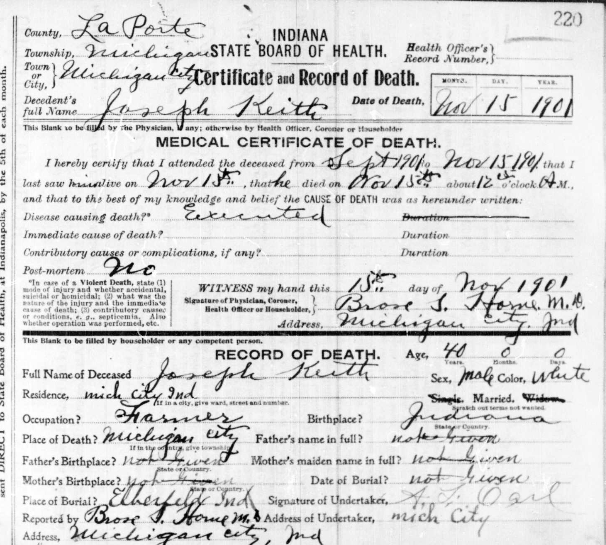
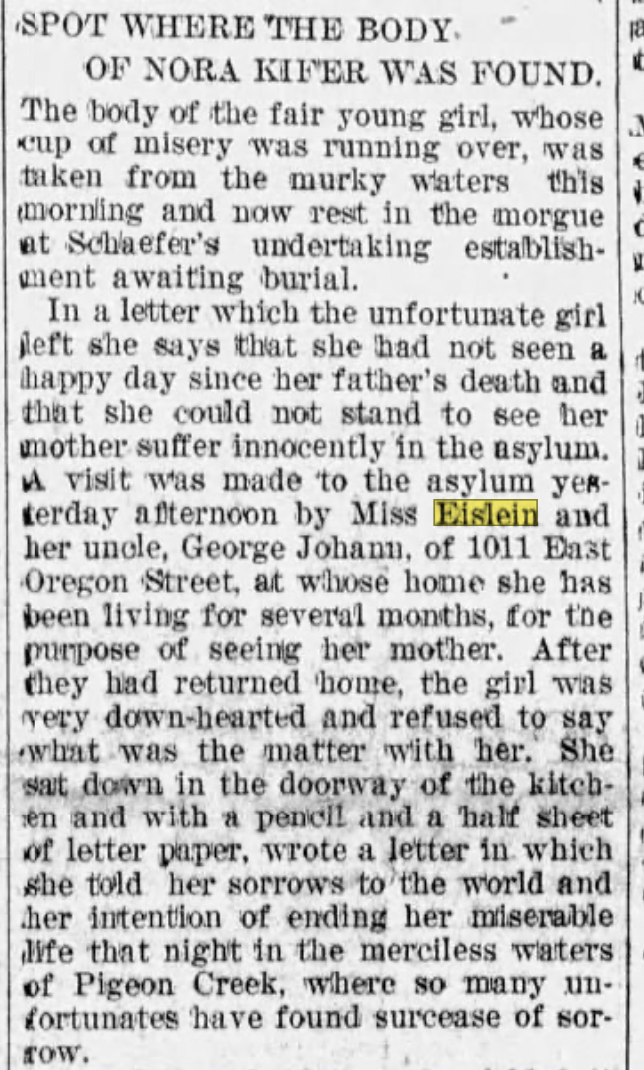
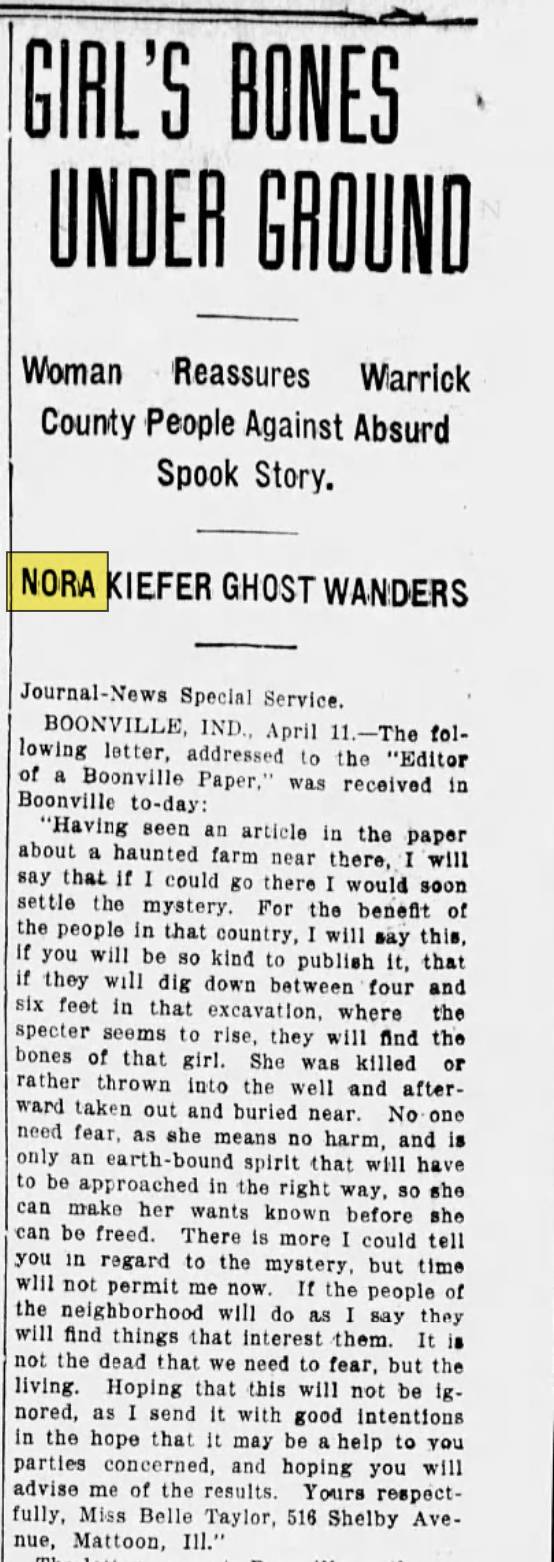
The legend of the Nora Keith’s murder lingered in the memories of residents of Evansville and Elberfeld, Indiana, for a very long time, in frightening and tragic ways.
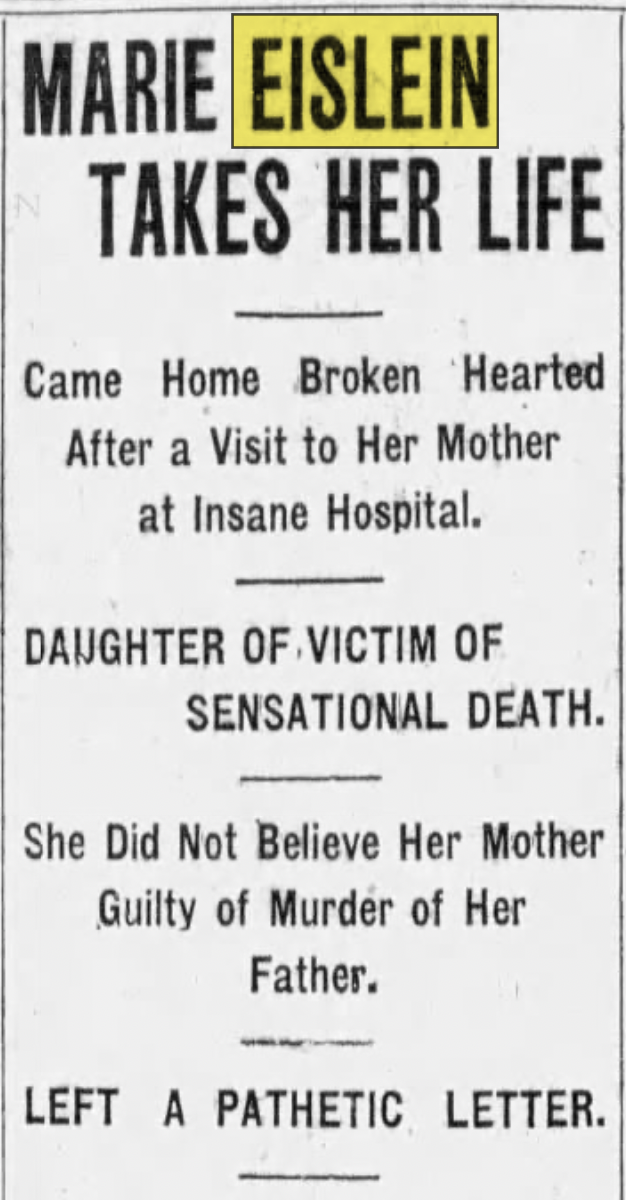
One section of the article about Marie Eislein referenced Nora Kifer murder.
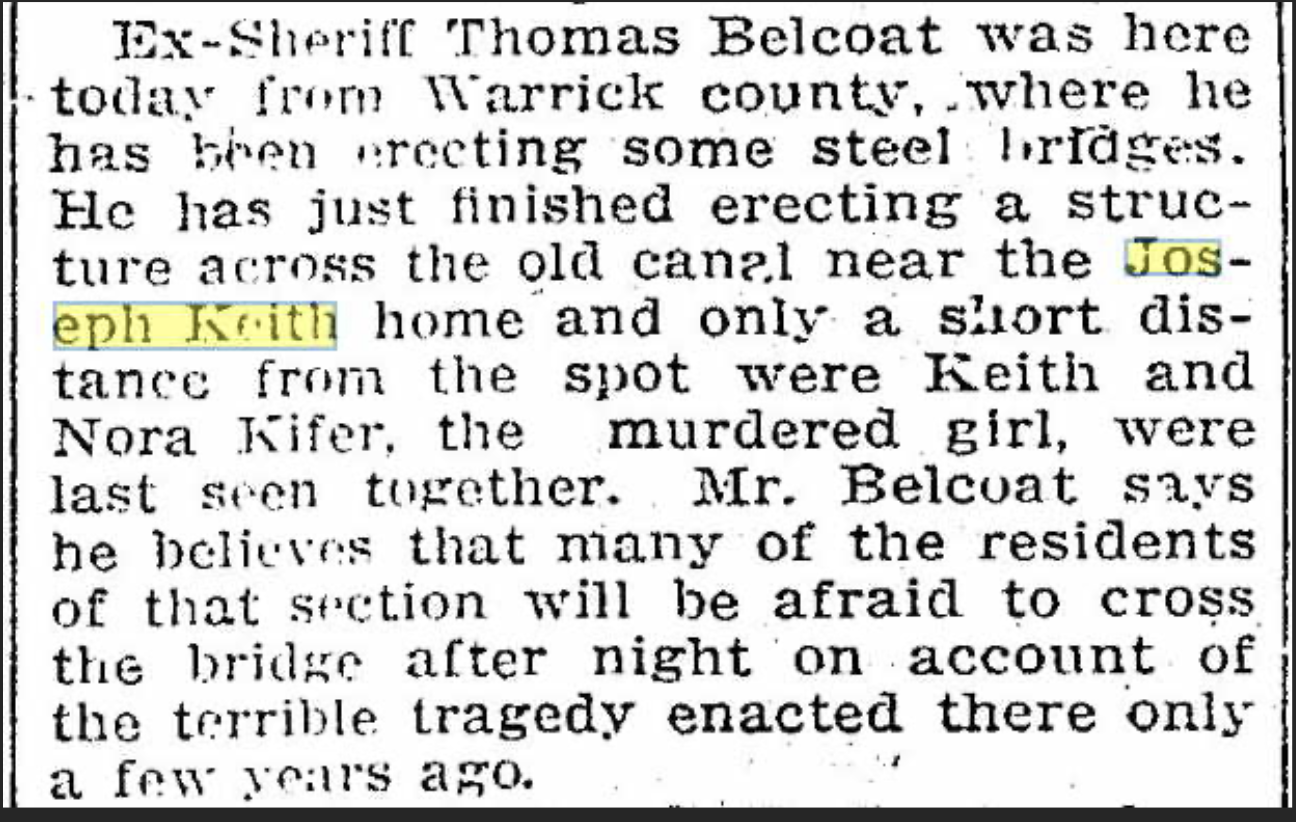
In an attempt to erase the memories and start anew, a new bridge was constructed where Nora was last seen alive.
Joseph D. Keith did, finally, confess to his crime on his way to the gallows.
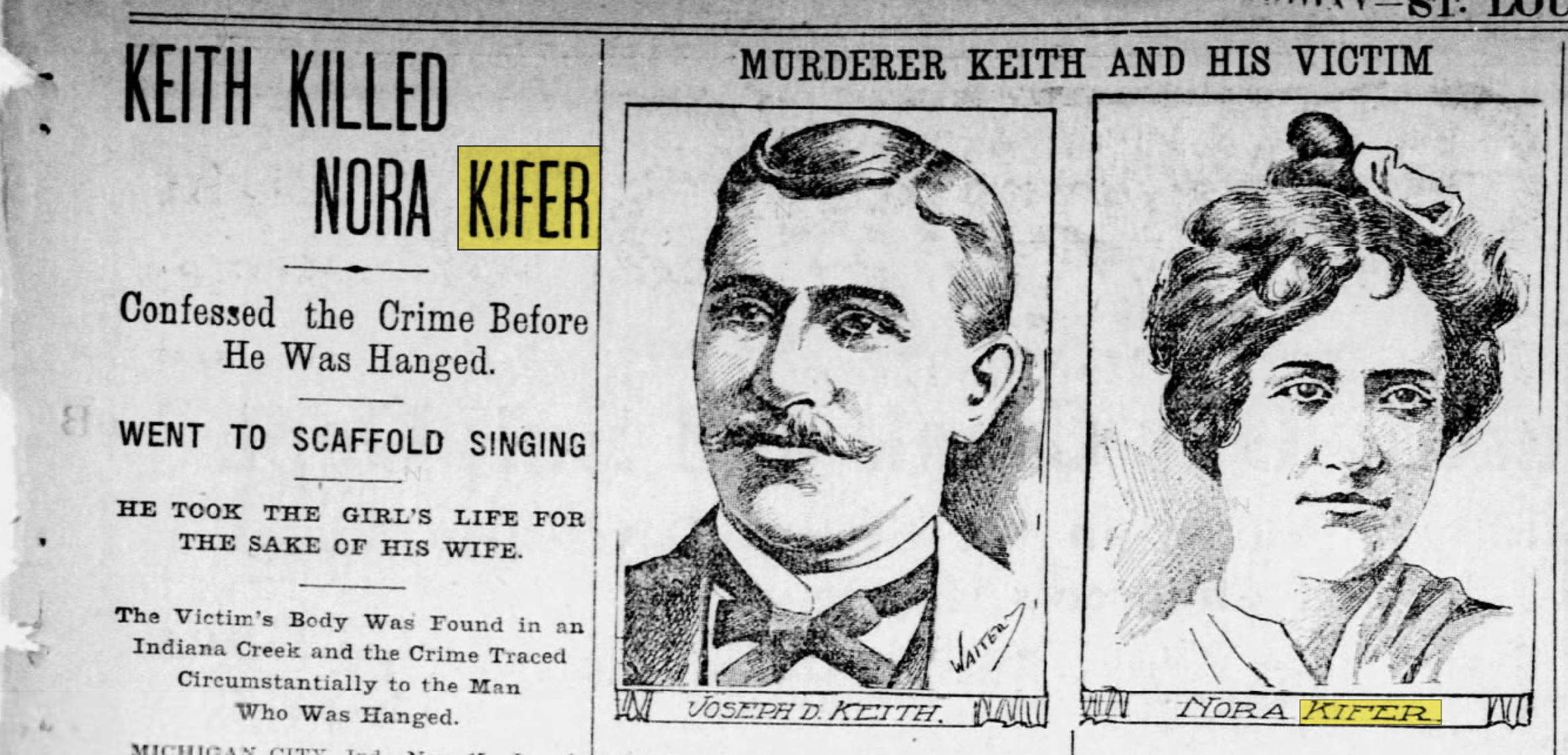
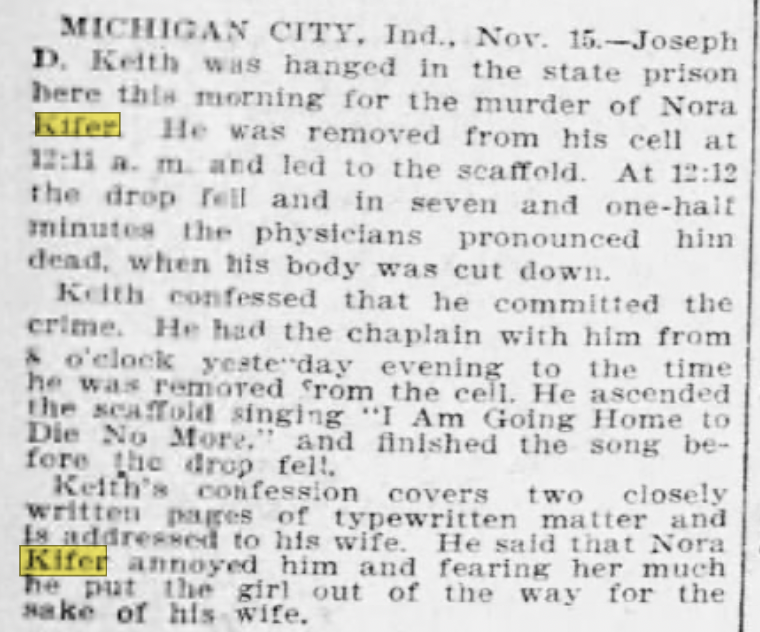
The first paragraphs below the heading described Joseph D. Keith’s last moments of life.
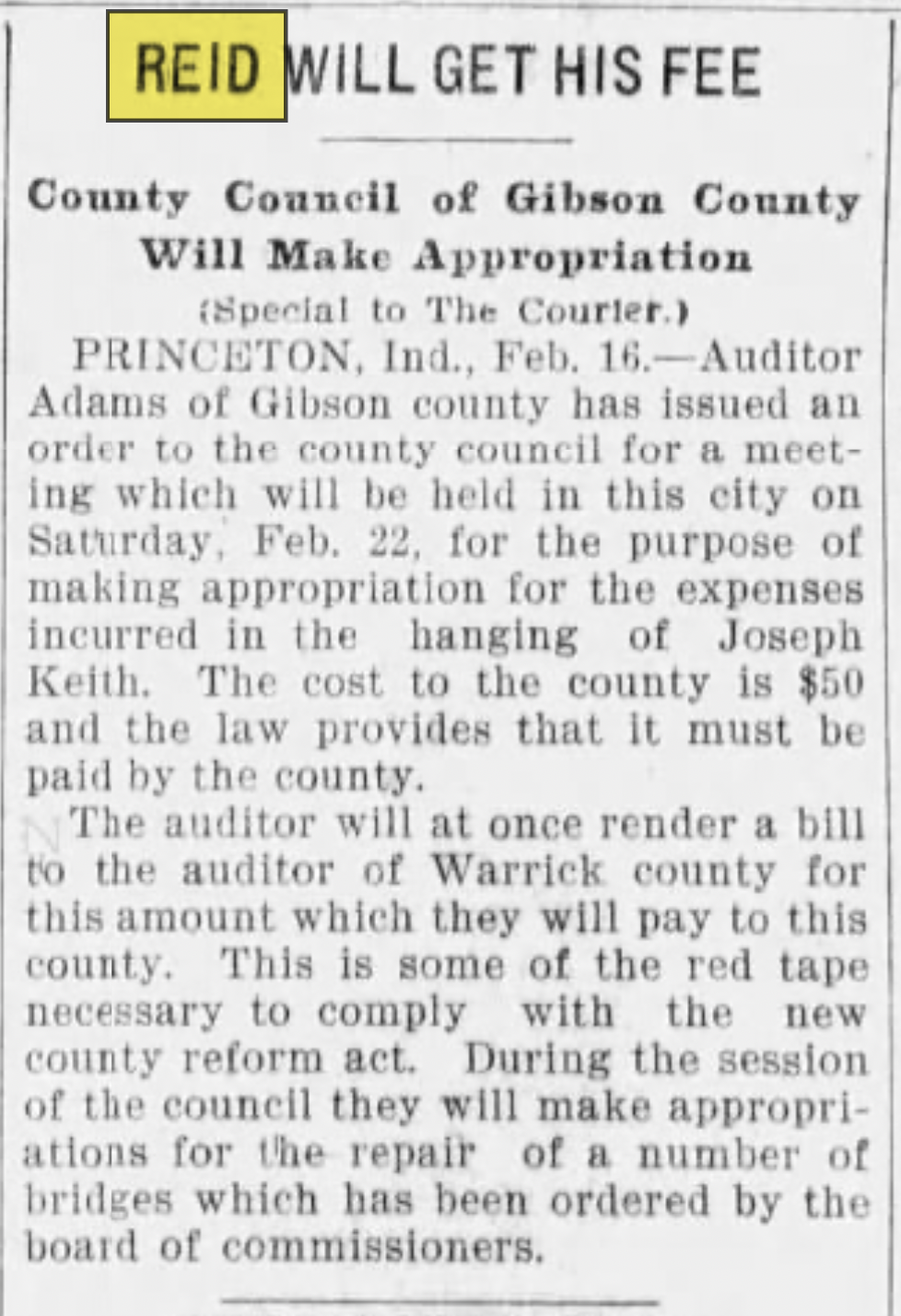
The County had to pay the cost of hanging Joseph D. Keith:
The Irony Of All Ironies
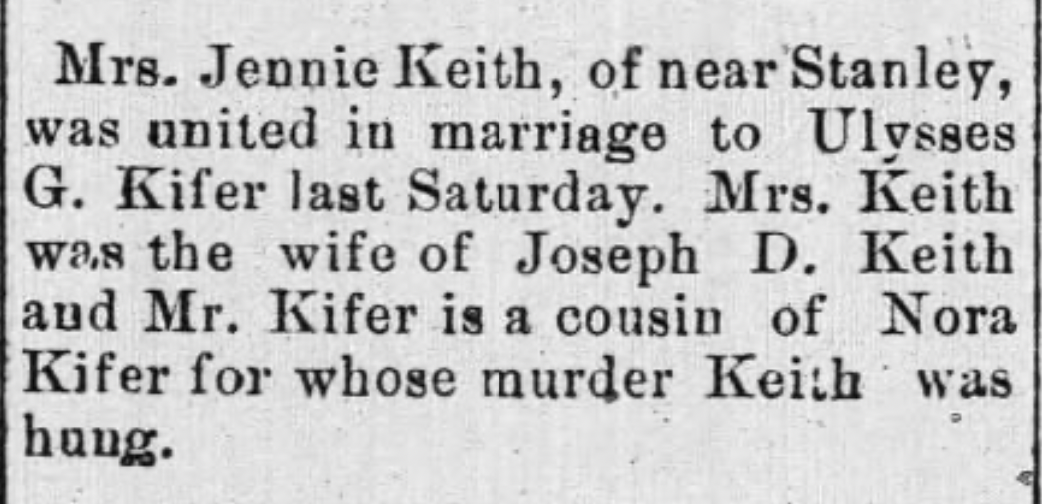
Approximately two and one-half years after the execution of her husband, Jeannie Keith again married on May 7, 1902. As indicated on her head stone, the man she married was a member of the Kifer family, Ulysses G. Kifer to be exact.
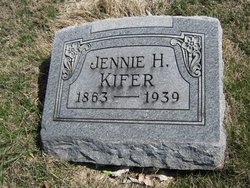
News reports during the investigation of the murder of Nora Kifer, Ulysses G. Kifer was identified as the brother of Zachariah T. Kifer, the father of the murdered girl. Ulysses provided testimony that the sisal rope he used when shearing sheep for Joseph D. Keith was identical rope that found on the body of Nora Kifer. Documents were not found to support the relationship to Nora Kifer. The 1900 U. S. Census reported that Ulysses live with his five children; no spouse is indicted living with them.
Ulysses Kifer’ grandson, Raymond Richard Gaffney, the son of Goldia Kifer, died at age 26 from a gunshot to the head on October 22, 1938. The young man was in the Green River Gardens near the Dade Park race track when Coleman Ray, age 68, first shot at Gaffney as he was walking away after a low key, short encounter. Gaffney shot back but missed as did Ray’s first two shots. Unfortunately, Ray’s third shot, fired fractions of a second before Gaffney’s second round, struck Gaffney in the forehead. Gaffney’s late shot hit a window.
Your thoughts regarding this tragic murder are welcomed.


What a sad story. It’s peculiar, but I have rarely read of a person discovering a body without hearing them say they thought it was a mannequin or a large doll. I guess most humans aren’t wired to take something like that in.
LikeLiked by 1 person
Without seeing the poor woman’s head, what they could see was from a distance. Under those circumstances I can understand why they first believed it was a mannequin and not a human body. Also, they possibly didn’t want to believe it was a human body.
It doesn’t surprise me because I know the Indiana culture; I lived in rural Indiana for 4 years. The new home I purchased was built by Mennonite and Amish craftsmen working for a general contractor. I have many examples of the culture I encountered. It was years ago, I doubt it has changed substantially. It was an early American type agrarian culture. The township school went fro K to 12th grade. The graduating class had 8 students. Teenage boys were hired to remove rocks from plowed corn fields and young teens were paid for “detasseling corn”. . . . removing the pollen-producing tassel from the top of the stalk. The purpose is to create hybrid varieties.
It is a far cry from big city life, despite the fact Indianapolis or Chicago are just a short drive by car. Indiana is the home of Orville Redenbacher, the microwave “Popcorn King.” If you have never watched the movie “Hoosiers” with Gene Hackman, I highly recommend it. The movie depicts the high school basketball team of the fictional town of Hickory, Indiana, in 1954. The movie is based on a true story of the Milan, Indiana, basketball team. It is one of Hackman’s best movies.
LikeLiked by 1 person