How Things Have Changed
Current estimates suggest that 35% to 40% of marriages will end in divorce, the percentage varies depending on the generation and projection method. In 2022, there were approximately 2.4 divorces per 1,000 people – an annual rate, not the percentage of marriages that will eventually end in divorce. In 1897, the divorces per 1,000 people was 0.46 according to the U.S. Census Bureau’s Historical Statistics of the United States: Colonial Times to 1970.
In the 21st century, the most commonly reported reason for divorce – particularly in U.S. studies – is growing apart or lack of commitment, often described as irreconcilable differences or incompatibility. Other frequent contributing factors or reasons for the dissolution of a marriage today are: persistent conflict or poor communication; infidelity; financial stress; substance abuse; and, the worse of all, domestic violence or abuse. Despite all those reasons, the official legal reason is often simply “irreconcilable differences” under no-fault divorce laws.
Certainly those reasons for a couple wanting to divorce existed during “The Gilded Age” (1870 to 1900), “The “Progressive Era” (1890 to 1920), “The Modern Era,” (a.k.a. “The Roaring 20s”) and into the 21st century. There was one legal justification for divorce in those earlier eras that is no longer a popular justification for breaking a marriage contract – “alienation of affection.” If a plaintiff could prove “alienation of affection” by the spouse or a Third Party’s actions, the law allowed for the recognition of damages – if financial harm could be proven in a court of law. Such law suits are still recognized in a few States today, specifically Hawaii, Illinois, Mississippi, New Mexico, North Carolina, South Dakota and Utah.
This preface is simply to establish a foundation for this story as well as insight into American culture regarding marriage in earlier eras. It is within that context a story in The Boston Globe, printed on page 3 of its November 9, 1897 issue, piqued my interest. It is presented as one example of how “alienation of affection” was used as grounds for the legal granting of a divorce and awarding damages.
Stolen Affection
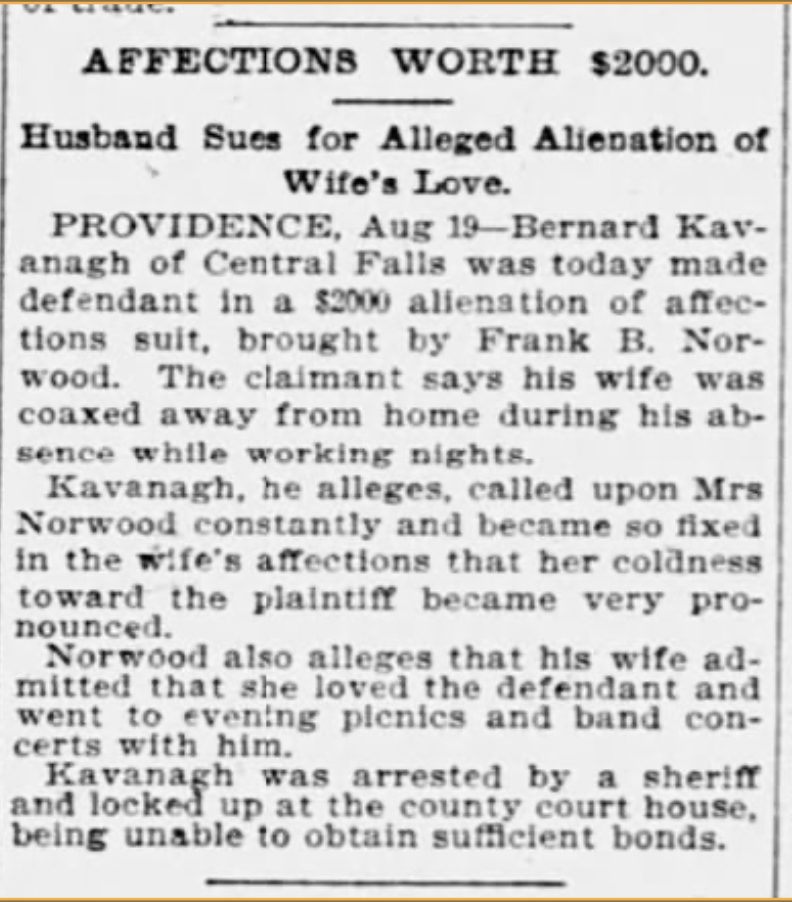
The first part of this historical anecdote was reported in The Boston Globe on August 20, 1897. It was characterized as “Affection Worth $2000.”
Mr. Norwood got his day in court in November of 1897. The preceding was headlined, again in The Boston Globe, as “For Lost Love.” It was not on page one, however. It was on page three, with the dateline: Providence, Nov 9. The chronicle started by declaring in the first sentence, “Eighty-one love letters of the velvety, sentimental sort were introduced today in the trial of the $2,000 alienation case brought by Frank D. Norwood of this city against Bernard J. Cavanaugh of Central Falls.”
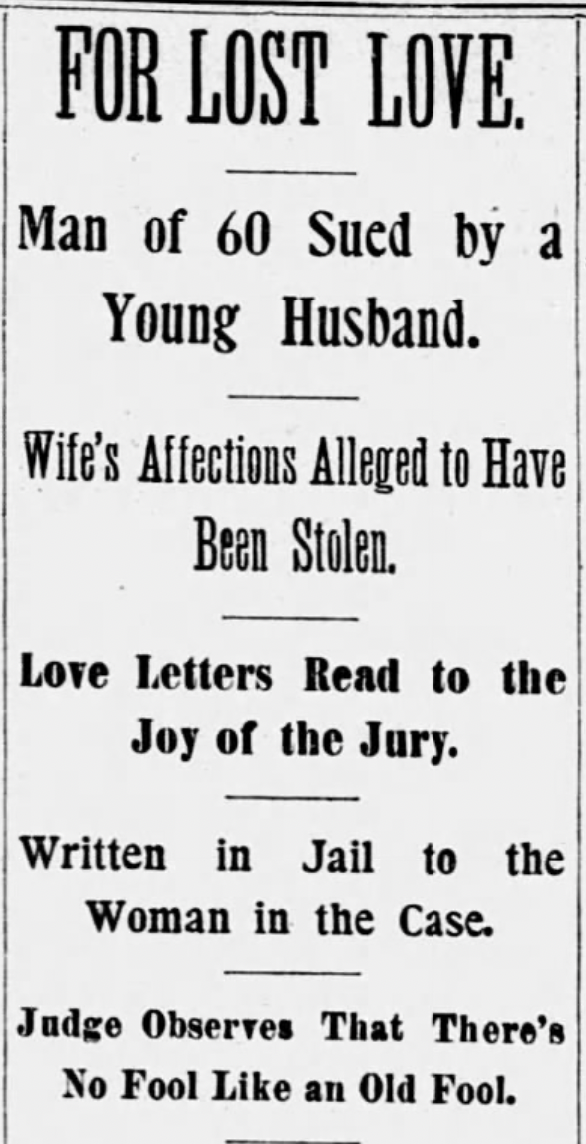
As reported by the paper, the charge made by Mr. Norwood was that the love of his wife, Mrs. Mabel Frances Harden-Norwood, “who is young and attractive, was alienated by aged Mr. Cavanaugh.” As the headlines clearly states, Mr. Cavanaugh, the paper claimed, was a 60 year old man at the time; to the reporter, Bernard Cavanaugh was many years beyond the age of Mrs. Norwood.
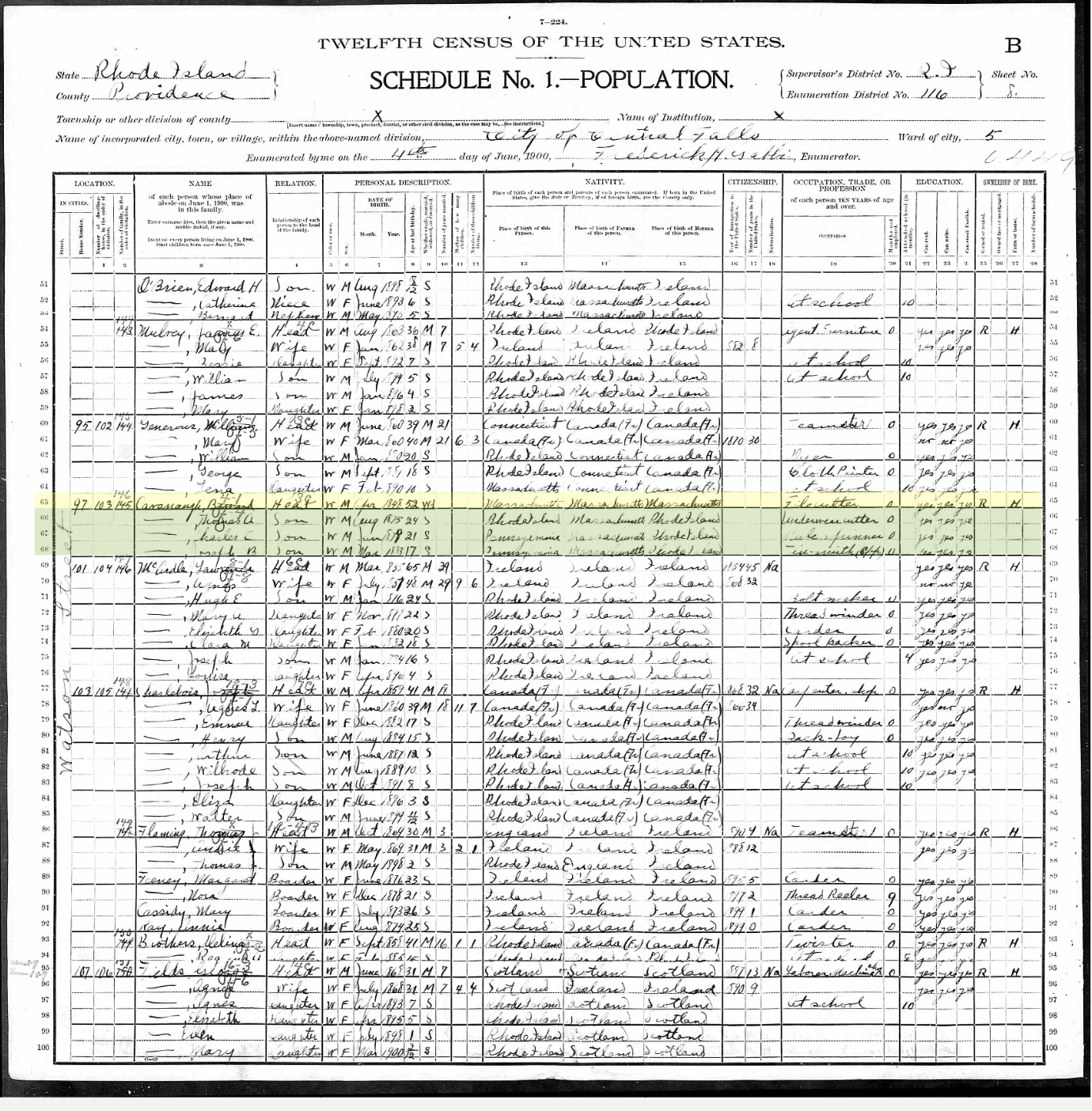
My research found that Cavanaugh reported his age as 52 for the 1900 U.S. Census, making the reporter’s claim of him being a “Man of 60” a gross exaggeration. He was, at the time of the legal proceeding, age 49 – a far cry from 60. That the Census does not reflect a “wife” in the home in Central Falls, R.I., only three sons.
Based on research about Frank D. Norwood and Mabel Frances Harden-Norwood, in 1897 they were age 28 and age 23, respectively. They had a 3 year old daughter, also with the Given Name of Mabel and the middle name of Lascell.
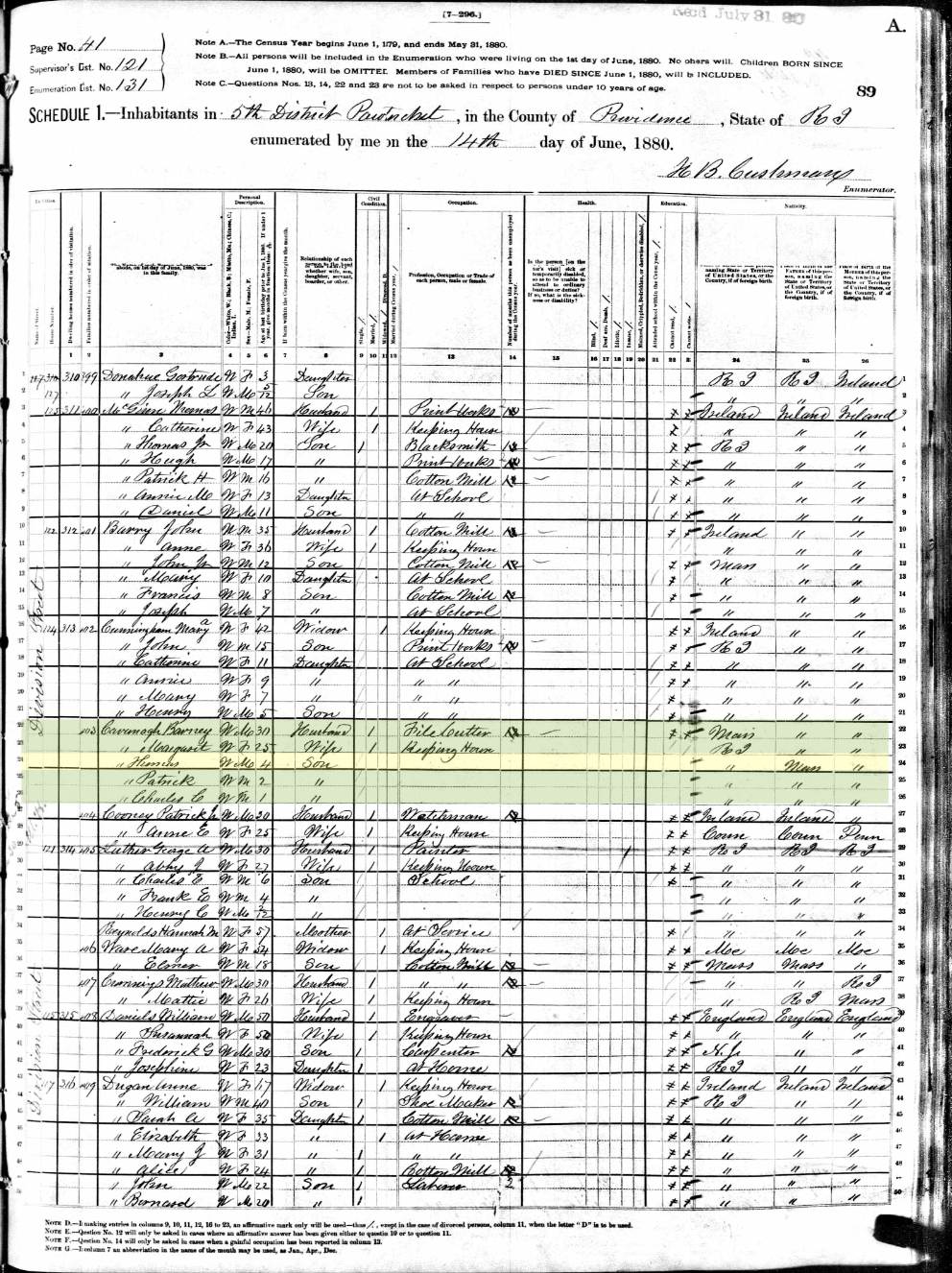
The 1880 U.S. Census, however, records a “wife,” Margaret, living in the residence with Bernard Cavanaugh and three sons: Thomas A. (1875), Henry P. (1878) and Charles (1880). Margaret was the mother of the three boys but is documented historiclly under her maiden name “Margaret Carroll.” Further investigation uncovered another son, Joseph Cavanaugh, who was born in 1883. Historical records do not reflect Bernard (a.k.a. “Barney”) and Margaret ever being married; her name is recorded, even upon her death, as Margaret Carroll never legally married to Bernard Cavanaugh.
Sidebar: I did consider Common Law marriage but found that Rhode Island has never, to this day, recognized Common Law marriage. According to Rhode Island General Laws, for a marriage to be legal it must be solemnized (duly performed in a ceremony) by a person licensed by the State. That was written into law in 1844.
Charges were brought against the older man based on love letters and Norwood’s allegations concerning Cavanaugh’s behavior. A bond was placed on Cavanaugh’s release at an amount he could not pay, as mentioned in the August 20, 1897 snippet in the paper. That meant he would be retained in the Cranston jail from August until the trial scheduled for November. As the the head of a household with four sons, being out of work as a Tile Cutter must have been a serious financial burden.
The letters written by Cavanaugh were read aloud to the jury and all present in the courtroom. The Boston Globe reported, “They were couched in fond words and counsel claimed they clearly showed an unhallowed love.” (A love that was “unconsecrated.”) The story noted, “Some of the letters were penned at the Cranston jail” when Mr. Cavanaugh was awaiting his court appearance. Reading of the letters proved them to be, according to the paper, ” . . . unique, and they were the cause of much merriment in the jury box.”
Testimony from Mr. Norwood claimed he witnessed “. . . Cavanaugh come along, stand by the fence and throw kisses to his wife, and he testified to things that he considered decidedly wicked.” He further claimed he “. . . thought the bicycle had much to do with the present trouble, his wife and Cavanaugh were alway together riding a great deal. He objected to these things, but refrained from breaking up his home on account of his child.”
Cavanaugh’s Rebuttal
In defending his actions and to disproved Mr. Norwood’s claim, Cavanaugh did admit to writing the letters, but, “There was always a third person about when the two met.” According to paper’s report, “He admitted he liked the girl as a friend,” even going on to say, “. . . he never made love to Mrs. Norwood.”
Cavanaugh’s attorney, Mr. Mulholland, positioned “. . . the case was one of blackmail, and argued the letters must have come from a lunatic or a fool.” Judge Wilbur responded to that claim by observing “. . . the letters read as though they came from a man dead in love.”
The reporter further wrote the judge publicly put forward that “. . . it was for the jury to size up the writer, the position of the wife in receiving them, his declaration that he had known her so well [presumedly in the letters] that he wouldn’t give her up, and the general wrong that ha been done the husband.”
Judge Wilbur went on to remark, “. . . that such expressions as figured in the epistles were like the foolish vaporings of a boy of 20 rather than an old man, though, as observed, there was no fool like an old fool.“ (Emphasis added.) After that sentence the reporter proclaimed, “The jury retired at noon.”
Despite many attempts, I could not find a report on the final disposition of the Norwood vs. Cavanaugh law suit. I apologize for not providing the ending to the case. I did determine that both Bernard J. Cavanaugh and Margaret Carroll, the mother of his children, both died in 1909. Bernard’s death is reported as being in Pawtucket, Rhode Island, at age 61, after a long illness at the residence of his second oldest son’s home. Margaret Carroll’s place of death is not ascertainable through available records, just her year of death at age 54.
Frank D. Norwood died in 1935 at aged 66 and his wife, Mabel, lived to until 1940, age 76. But, as often is the case, the tale of Mabel Harden Norwood doesn’t end there. Digging into official records, documents reveal that a Mabel Harden Norwood is also recorded as Mabel Harden Norwood Bennett, however her certificate of death reflects Frank D. Norwood as her spouse.
I was not able to find a divorce decree for her marriage to Frank D. Norwood, so that may be the reason he is listed as her spouse. I did find a document of her marriage to Charles F. Bennett on August 20, 1911; at the time she was age 37. The Bennetts had two children together, both daughters: Ethel and Florence. Another researcher posted on findagrave.com that he had come to the same conclusion:
“Mabel married first Francis D. Norwood in Lynn, Essex, MA. They had a daughter Mabel L. Norwood born in 1894 Providence, RI. I do not find a divorce record. She married Frederick Charles Bennett [Charles Frederick Bennett] in 1911 and had two daughters Ethel and Florence.” (Sadly, Ethel Bennett died from a self-inflicted gunshot to her head. The coroner recored that she had “multiple psychiatric problems and chronic alcoholism.”)
I suspect there is a significance to the change of spelling of her Given Name on this record. I have come to conclude it is just a spelling error, as is the Groom’s name as Charles F. Bennett rather than Frederick Charles Bennett.
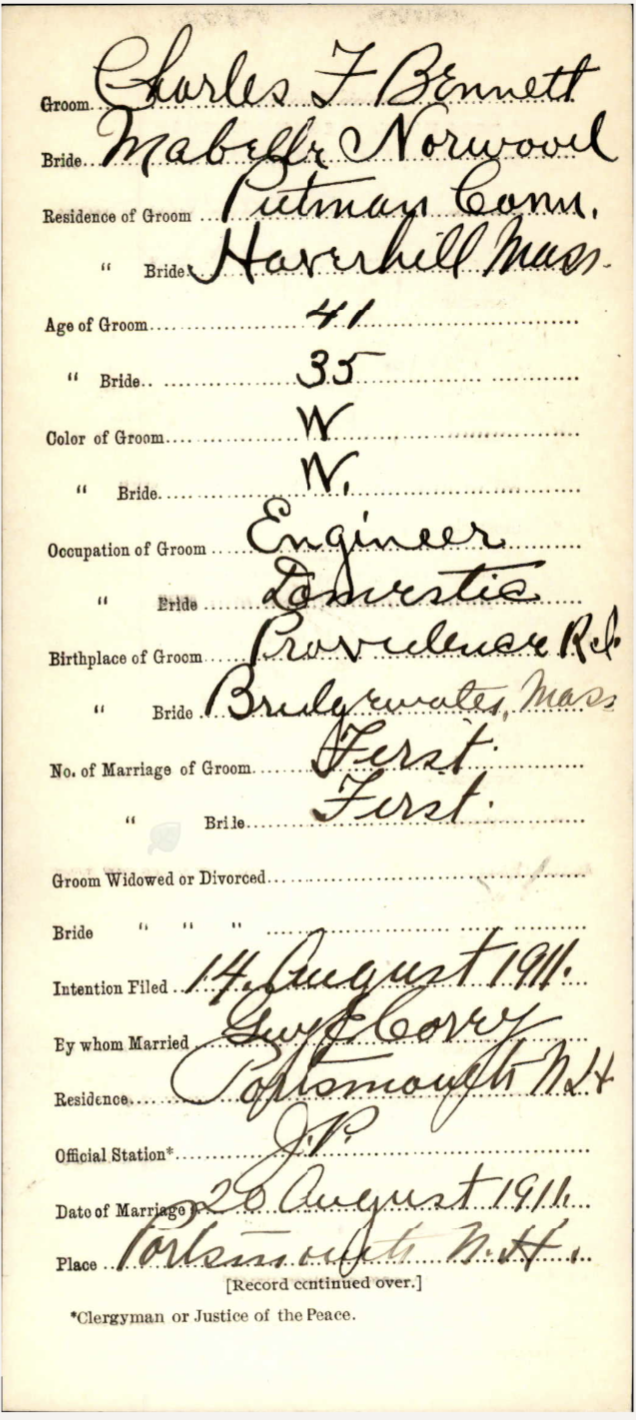
Both the Bride and the Groom indicated the marriage was their “First”, something that is patently untrue in the case of the Bride . . . . if “Mabelle” Norwood, spelled with double “Ls,” is the same “Mabel” Norwood who married Frank D. Norwood. All her other personal information match that of the “Mable” Norwood wooed by Bernard Cavanaugh. Unfortunately, we will never know based on the record keeping at the time.
If you have an opinion of or find a moral in this historical anecdote, please leave it in the comments box.

