Summer is upon us. School is out. It is vacation time! Children are thinking about exhilarating summer experiences, typically planned by their parents. Plans include everything from a week at camp for the kids to the extreme and expensive family trip to a resort, foreign travel or a cruise with several ports of call. As usual, my curiosity got the better of me. I needed to know when the phenomenon of “taking a vacation” became part of America’s consciousness and an integral part of the culture?
Puritan principles, upon which America was founded, had a great deal to do with the belief that taking time off from work was an instrument of the devil. Tenets of Puritanism mandate 6 days of hard work each week -after all, an idle mind is the devil’s workshop.” The only day of rest according to Puritan tenets is Sunday, the Lord’s Day, and on that day should be devoted to quiet religious devotion. The concept of taking days off — not working — was viewed as going down the wrong path.
Sidebar: The Puritans tenets also advocated the importance of free education.
With that underpinning the earlier settlers and colonial Americans eked out a living that eventually founded a new nation . . . Under God. It took many generations for the Puritan values to culturally dissipate.
Sidebar: I have a personal anecdote on this topic. My family had a retail business that operated 6 and one-half days per week. When, as a very young boy, I mentioned to my father that our church clergyman said people should not work on Sunday (Dad never attended church though his 3 children attended religious schools), his response was: “Tell him if he wants money in the collection basket I have to work on Sunday.“
The Paradigm Shift
Ironically, and fittingly, it is a young preacher from Boston, William H. H. Murray, who is identified as the father of the ritual of taking time away from everyday life, a vacation, for one’s wellbeing.
A Yale graduate in the Class of 1862, William H. H. Murray, went on to attend the East Windsor Theological Seminary. Murray, an outdoor enthusiast, was fascinated by the Adirondack Mountains because he said: “There the lumberman has never been. No axe has sounded along its mountain-sides, or echoed across its peaceful waters. The forest stands as it has stood, from the beginning of time, in all its majesty of growth, in all the beauty of its unshorn foliage.” It is said his time in the Adirondacks “restored his soul.”
Murray often spent time hiking, camping, fishing and hunting in that massif of mountains located in Northeastern New York State. It was not his intention to motivate his fellow Americans to take time off from work, but rather to relate the exhilarating experience of hiking and camping outdoors; the health benefits of such activities outdoors; and, how to go about doing those things.
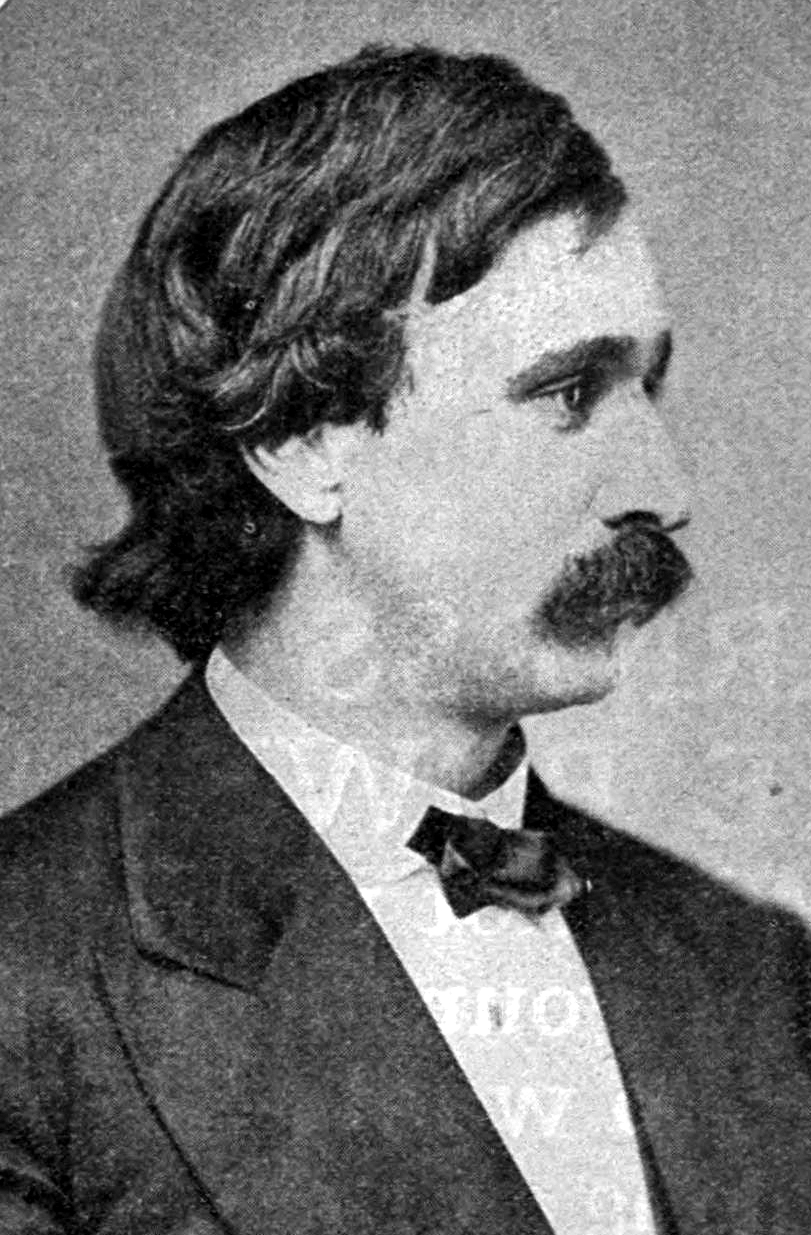
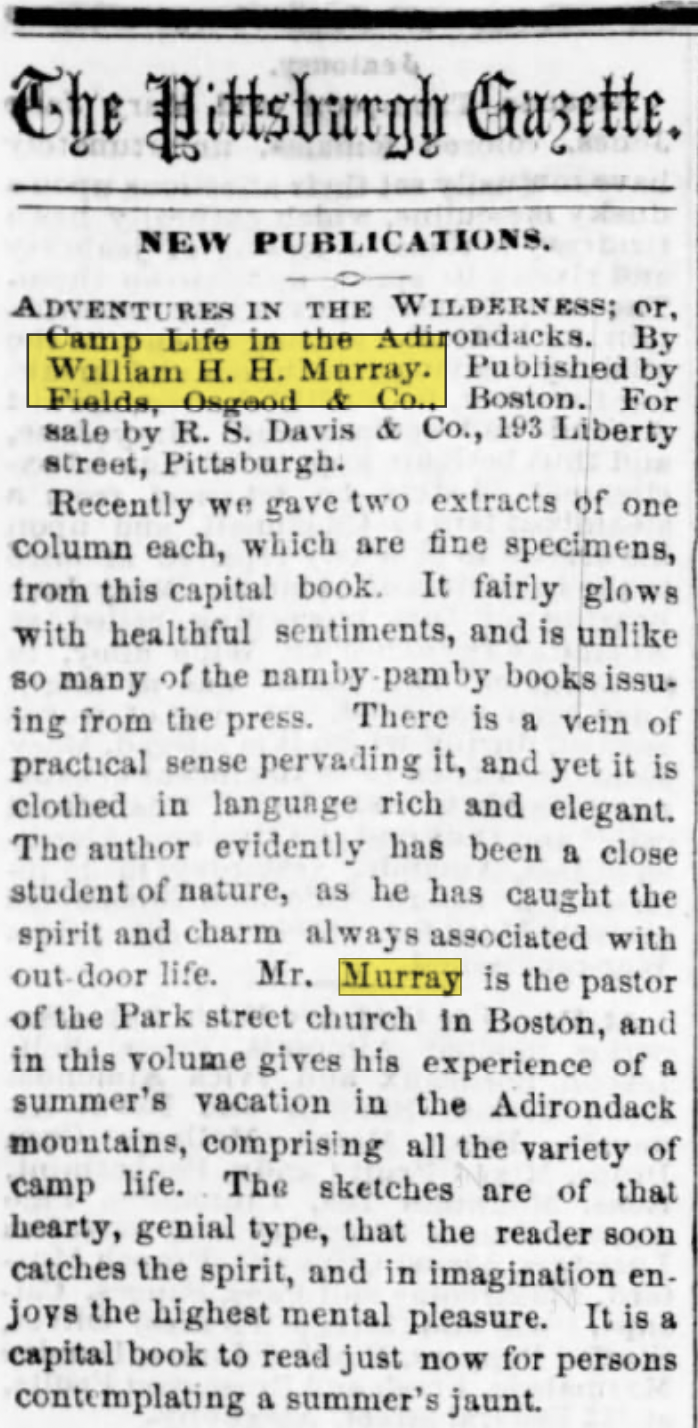
Murray wrote personal narratives, humorous to a degree, of his adventures in the Adirondacks, something many ministers did at that time to improve their sermon writing skills. Knowing of his writings, friends suggested he publish what he journalized for others to read. Because of their suggestion Murray presented his writings to the Boston publisher of Osgood, Fields, and Company and a book was born. Murray book is now considered the genesis (pun intended) of the practice of taking time off from servile work to enjoy life.
Sidebar: The term “vacation” evolved from the Latin “vacātiō” meaning “leisure, freedom from duty,” and entered the English via Old French in the 14th century as “freedom from obligations” and later taking on the meanings of “time off from work and school.” By the 19th century in America it came to mean recreational travel away from home. In Great Britain it is called a “holiday.”
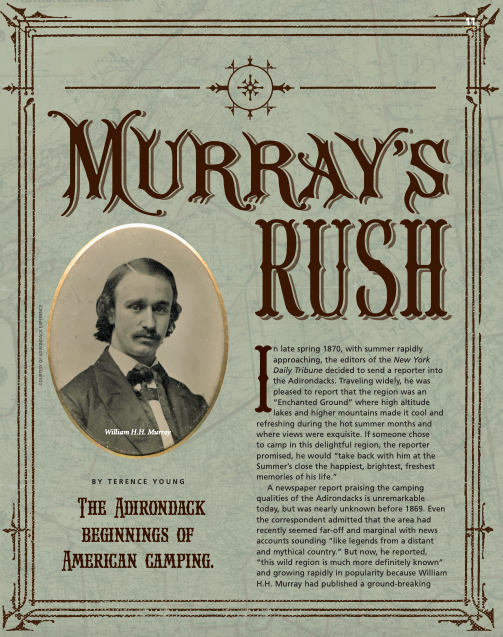
Murray’s thoroughgoing guide became a best seller after the dread of the Civil War. Also, as industrialization took hold in America, a middle class, no longer bound to farm work 7 days per week, now existed and had free time. That new class of Americans knew that the Rockefellers, Astors, Carnegies, et al, had summer estates away from the big city in areas like the Adirondack Mountains, Martha’s Vineyard and other lake and beachfront areas. This new Middle Class also wanted the “Edenic” experience described in Murray’s book – complete with instructions: Adventures in the Wilderness; and Camp-Life in the Adirondacks.
As the years passed and American labor unions established a presences in the workforce, time-off from work became a negotiated, contractual benefit. Even the Federal Government proposed the need for workers to have time-off – to escape so to speak. President William Howard Taft, the 27th president of the United States, in 1910 was reported to have espoused the importance of vacation for maintaining energy and effectiveness in work. “The president advocates a two month vacation, but gets only two weeks for himself,” noted the Iowa City Citizen. Some sources reported Taft said, “2 to 3 months of vacation.”
According to Tony Perrottet, Contributing Writer for Smithsonian Magazine in his article of April 2013, “. . . Murray’s self-help opus, Adventures in the Wilderness; or, Camp-Life in the Adirondacks, suggested that hiking, canoeing and fishing in unsullied nature were the ultimate health tonic for harried city dwellers whose constitutions were weakened by the demands of civilized life.”
/https://tf-cmsv2-smithsonianmag-media.s3.amazonaws.com/filer/Adirondacks-Great-Camp-Sagamore-631.jpg)
The Book’s Causation

That first summer after Murray’s guide book was sold, Americans with a passion to experience what the book described inundated the Adirondacks with a copy of Murray’s book under their arm. Some even had a waterproof edition with train schedules and maps that opened out from the binding. Before Murray’s book most city-dwellers viewed the wilderness as an obstacle to conquer for future city expansion. Readers read of experiences in the wilderness they also wanted to experience. Murray’s book did provide the “dos and don’ts” of trekking into the Adirondacks, but that didn’t deter the thrill seekers. This apostle of wilderness venturing even told his followers how much to pay per day for a guide; the type of equipment to take with you; how to paddle a canoe; and, how and where to fish.

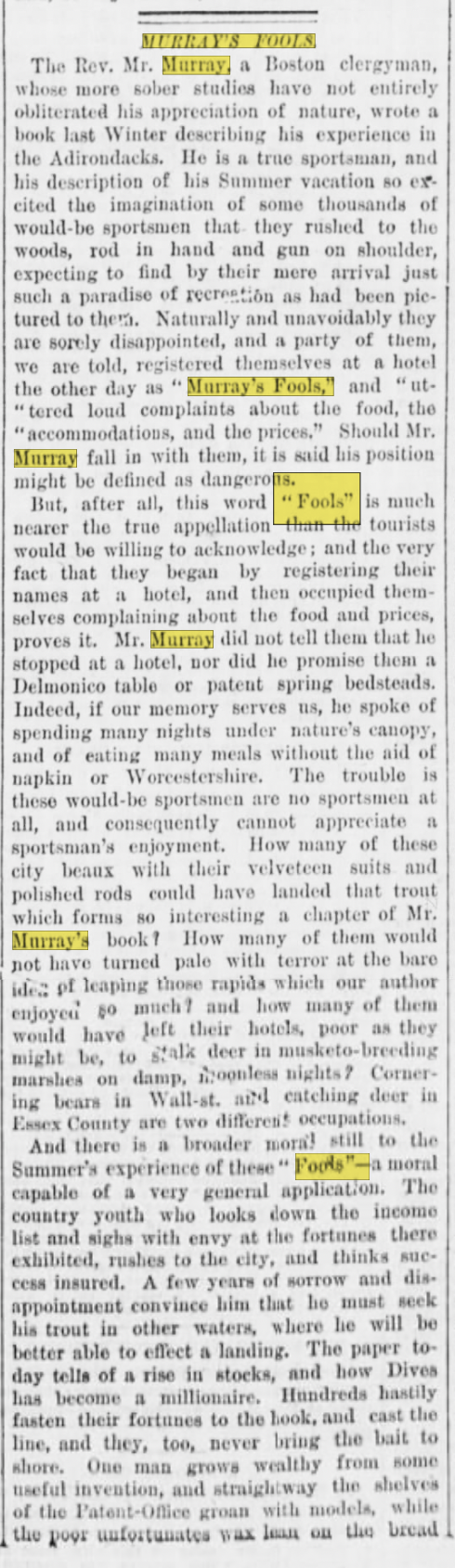
The summer of 1869 saw so many “want-to-be” campers and explorers that the media referred to the onslaught as “Murray’s Rush” and a “human stampede.” Unfortunately, the summer of 1869 was an exceptionally wet summer and one of the coldest in the history of the Adirondacks. Remember, the Adirondacks are the highest point in the State of New York at 5,344 feet, with 46 peaks listed as being over 4,000 feet above sea level. Temperature drop dramatically at such elevations, even in the summer.
Newbies to the outdoors suddenly realized besides the cold temperatures there are “dismal swamps” and millions of black flies and mosquitos. Along with the misery inflicted by the climate and insects, as always seems to happen when a inexperienced crowd is attracted to a happening, men wanting to make a “fast buck” represented themselves to be experienced guides or advisors. These phony experts often led the novices to swampy areas, the worse areas to setup camp.
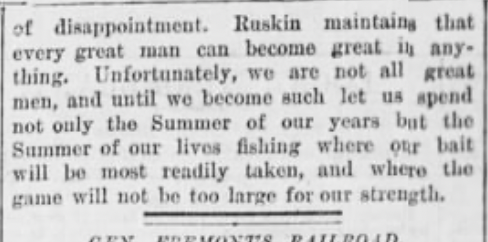
In the press the newborn naturalists were referred to as “Murray’s Fools” because the book was released around April Fool’s Day. Those who experienced the reality of camping besmirch Murray, accusing him of exaggerating the attractions and enjoyment found in the outdoors. In response, Murray defended his book and his beliefs in an article printed in the New York Tribune, referred to a “Reply to His Calumniator,” positioning that he cannot be held accountable for the bad weather, including rains that were “ten fold thicker than was ever known” or for those that failed to heed his tips.”
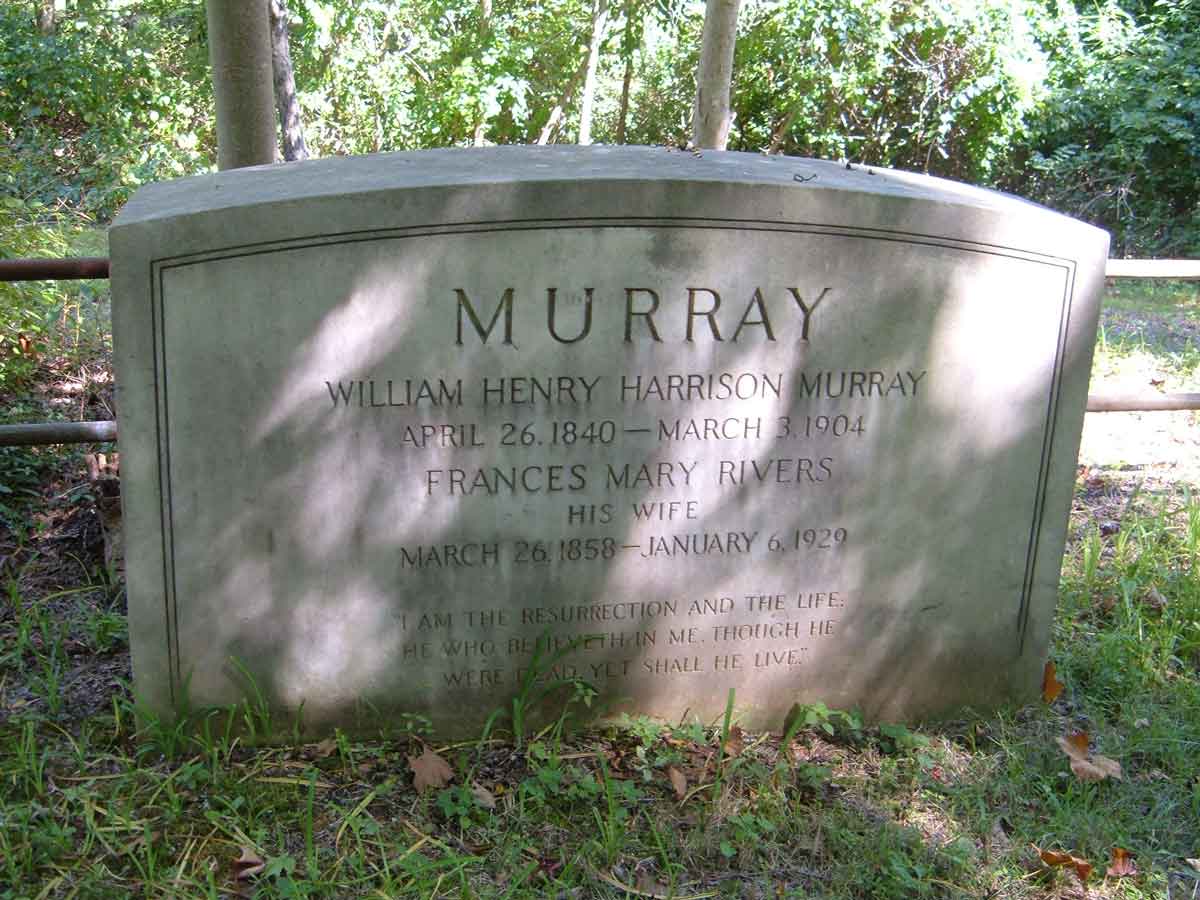
In the end, William H. H. Murray retired from the ministry at age 40 and idled away the next 10 years traveling. He spent the remaining decade of his life in his Guilford, Connecticut home living a secluded life. Murray died on March 3, 1904 at age 63.
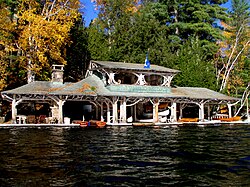
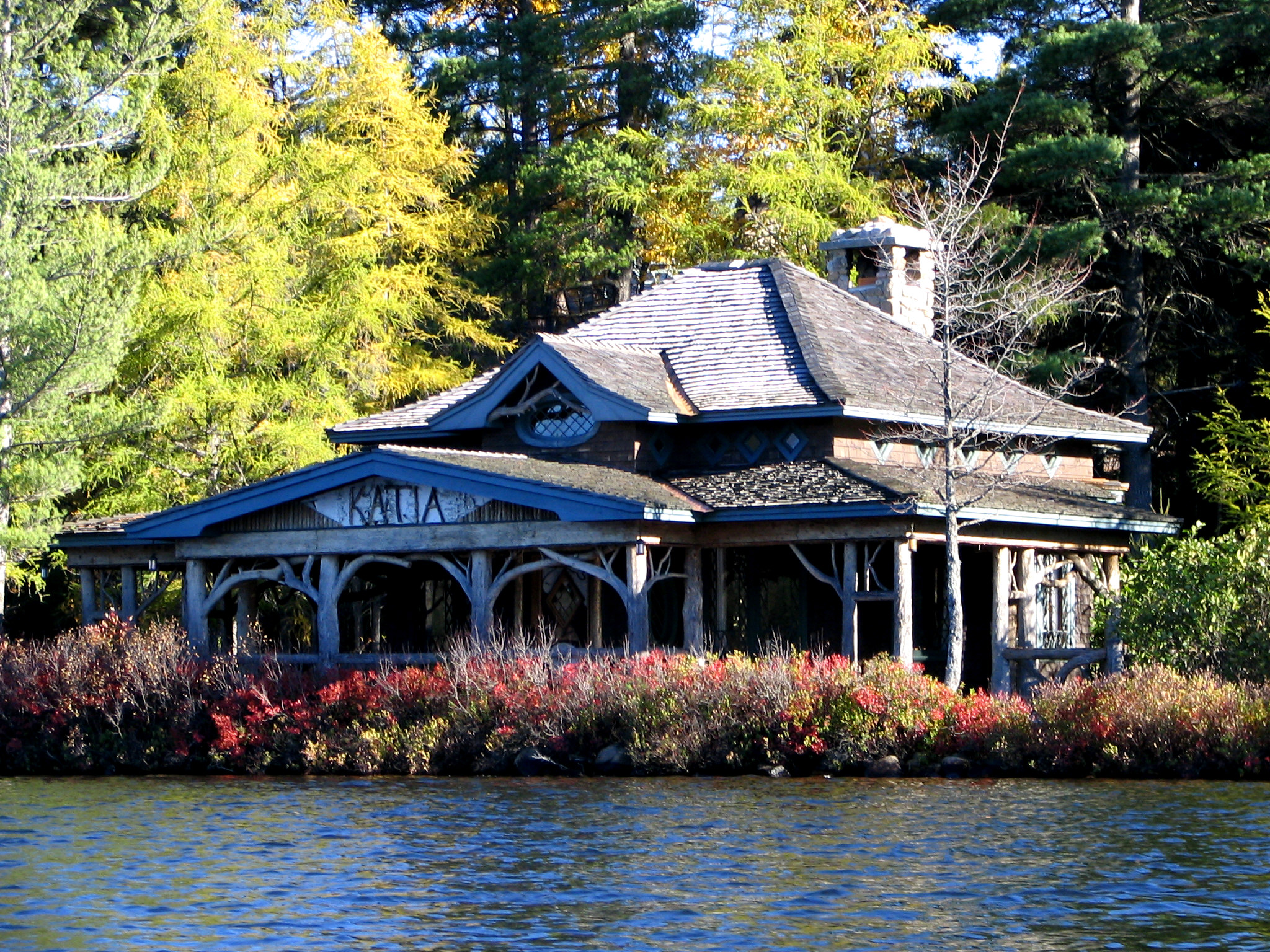
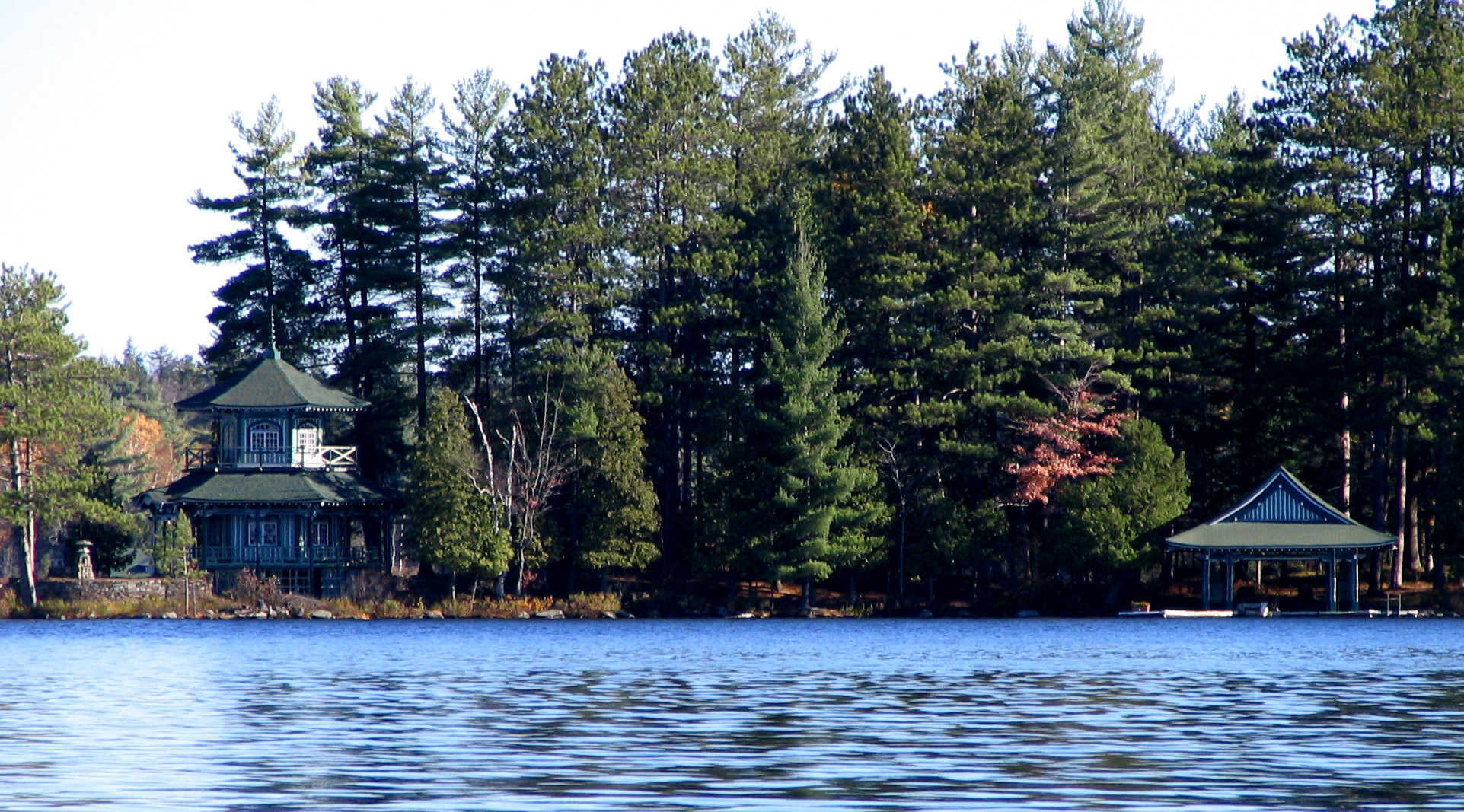
Murray’s book is called one of the most significant influences of the conservation movement, a paradoxical attribution since within 5 years of the books release over 200 Great Camps, a.k.a. family camp grounds, were established in the Adirondacks.
POSTSCRIPT
A recent story in a national periodical titled “Summer Staycation” reminded me of the concept of remaining home as a vacation. The author states that, “No trip anywhere has ever measured up to the dreams preceding it.”
According to the author of the article, “July is the most popular month for travel in the United States;” and, “If you’re vacationing this summer, you started thinking about your trip in January – arranging the time off work, saving your money, planning your destination, going online to scout places of interest, and telling your friends where you’re going so they’ll be jealous. (Italics add for emphasis.)
What I haven’t mentioned is that the writer, a Quaker pastor and author of 22 books, does described many great vacations he has taken, one involving a motorcycle trip that he planned for months with visions of grandeur. The truth is, he declared, it rained everyday of the trip – further making his point with this declaration:
“Vacations take a lot of time and money. So let me save you both.”
And he ends the article with this parting sentences:
“Trust me, you’re better off staying home.”