Charles Wawsen was a doomed man. If he had to leave life, he would go on his own terms. He would cheat the state out of the satisfaction of hanging him, at least. He made two suicide attempts: the first by trying to sever his internal organs by some unknown method. In the second instance, he cut the heads off of several boxes of matches, stirred them into a glass of water and drank it. A prison doctor managed to save him.
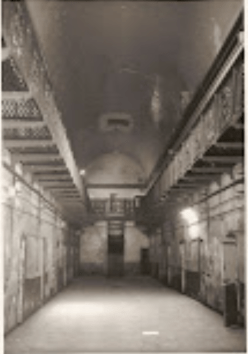
Schuylkill County Jail
The state was determined that Wawsen be put to death, and equally firm that he would not take his own life. Therefore, Charles was placed on 24-hour suicide watch from September until he was hanged in March, costing the county an additional $800.
The other topic that bothered Charles Wawsen was the fact that one of his brothers, Josef, never came to visit. Charles wanted to see him, but Josef never turned up. His only regular visitor was Father Ziebara of the Polish Catholic Church in Minersville. Because of Father Ziebara’s counseling, Wawsen began to “deeply repent his shooting of Mary Bolinsky.”
He also took up art, an old hobby from his youth. Most people who knew Charles in Shenandoah assumed he was illiterate because he didn’t speak English very well. They were shocked to learn that Wawsen was an excellent artist who spoke and wrote German, Polish, Spanish, and Lithuanian fluently. He drew pictures for the walls of his cell and for the people who came to visit him. He drew pictures of South America and Shenandoah, pictures of friends, and a picture of Francis Joseph, the Emperor of Austria. His most memorable picture was one of Hell. Satan was the centerpiece and Wawsen had included himself in the picture, being pitched into a boiling cauldron.
On March 12, 1908, 10 months after he murdered Mary Bolinsky, Charles Wawsen was summoned: his time had come. At 10:25 a.m., he was marched from his cell to the gallows in the prison yard. It was a gruesome spectacle. The prison employees and the official witnesses were in the yard. Beyond the prison walls, much of the town was gathered outside and people came in from miles away, with a morbid desire to see the prison on the day Wawsen was put to death.
Wawsen was marched up to the gallows, and addressed the crowd for 10 minutes, recounting his crime and saying he knew he was bound for a better world. When they bound his legs, he fainted. The prison officials revived him with a glass of water. Just before the spring was to drop, he fainted a second time. He was again revived and began to cry out for his brother. “Josef! Josef!” Then a dark covering was placed over his head, and the hanging was carried out.
After the hanging, the prison officials had plenty of work to do. The cell Charles Wawsen had occupied had to be re-kalsomined. Kalsomine was a kind of whitewash used to clean and refinish walls and ceilings. It was a deep cleaning process, necessary due to the paralyzing superstition amongst the prisoners that murderers executed on the gallows can leave bad mojo in their cells which would attach itself to the next occupant.
Meanwhile, the crowd outside the prison walls pestered the sheriff with requests for pieces of the rope used to hang Wawsen. Once again, this was due to a superstition the locals harbored that such a rope contains virtues, and is capable of curing diseases.
Charles Wawsen’s case was quickly forgotten, as was the youthful life he snuffed out so coldly. He was violent, selfish man who had no compassion for the young girl he had hoped to marry but he wasn’t a psychopath of the Ted Bundy variety. You get the feeling that, until the moment he actually committed the murder, he could have turned his life around. Instead he succumbed to his bitter heart.
 old spirituals
Pingback: Part 2: The Twisted Tale of Charles Wawsen – old spirituals
Wow! What a tale! You find some very interesting stories to share.
LikeLiked by 2 people
Thanks! I thought it was so interesting he asked for new clothes and a new cell…
LikeLiked by 1 person